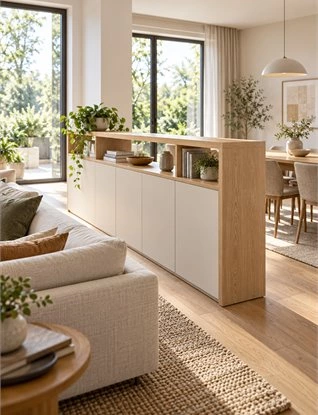
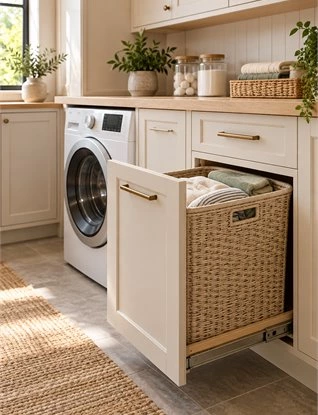
A laundry hamper cabinet should make clothes easy to drop off, sort, carry away and clean up after. Concealing a basket is only useful if the cabinet still works when the basket is full and someone needs to take it to the washing machine.
A pull-out hamper, a tilt-out front and a removable basket behind a hinged door can all look tidy when closed. They behave differently during the ordinary laundry routine. One needs forward travel, another needs a clear opening arc, and the simplest door-and-basket arrangement may require more bending. The basket itself may or may not lift out easily, regardless of how the cabinet opens.
This guide compares the main built-in laundry hamper options by collection location, sorting needs, daily access, basket removal, cleaning and cabinet space. It also lists the information to confirm before ordering custom cabinetry for a laundry room, bathroom or wardrobe.
Decide Where Laundry Is Collected Before Choosing the Cabinet
The best hamper mechanism cannot compensate for an inconvenient location. Start by observing where household members actually remove clothes and where a full basket travels afterward. A laundry hamper hidden in the utility room may be efficient for a family that carries clothes there each evening; it may be ignored if everyone changes upstairs and the route is awkward.
Match the Location to the Household Routine
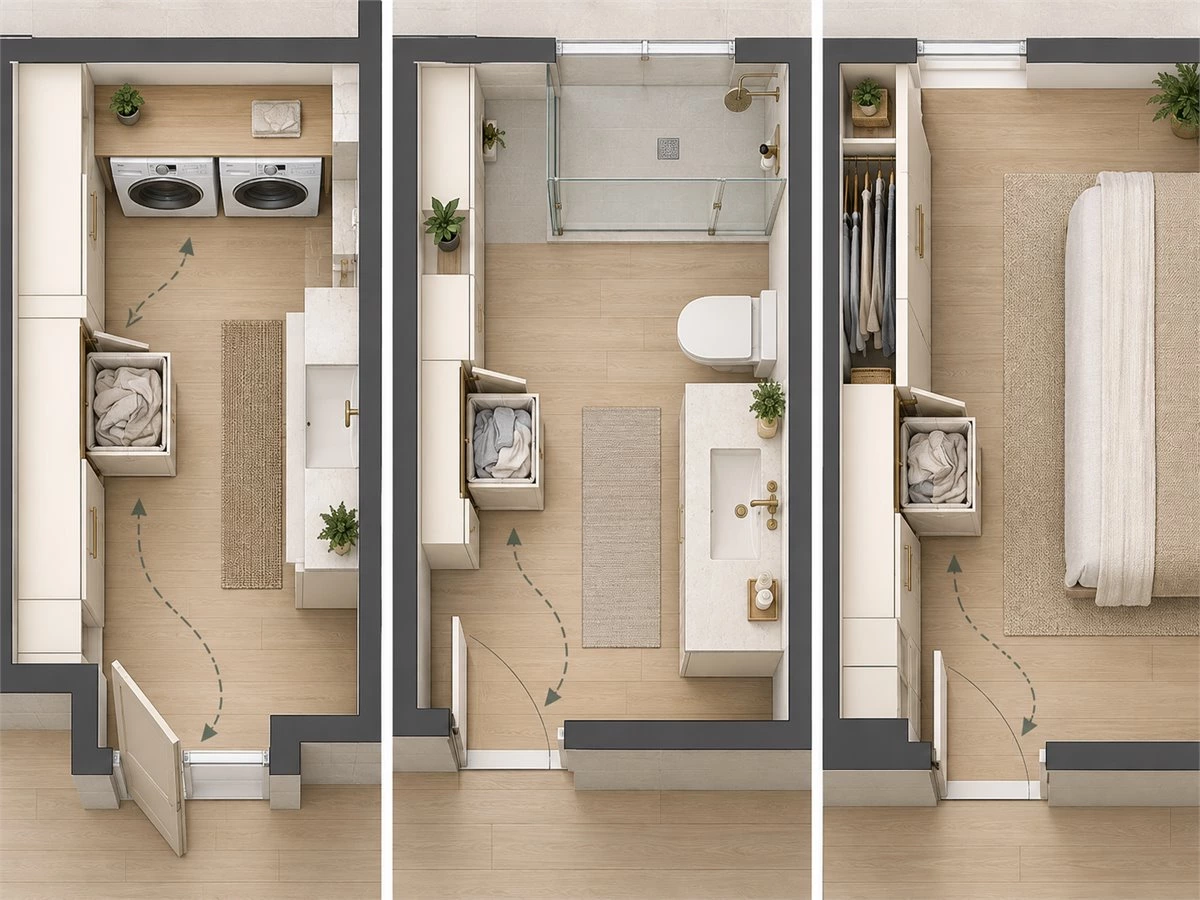
Compare the laundry room, bathroom, bedroom and wardrobe. A laundry-room hamper can sit near the washer and sorting counter, but people may need to carry loose clothing to it. A bathroom hamper may catch towels and clothes immediately after use, yet the cabinet must fit the room's traffic and moisture conditions. A wardrobe hamper may be close to dressing but should not interfere with access to clean clothing.
Walk the route with a full basket in mind. Check room doors, stairs and narrow passages, not just the hamper cabinet itself. If the basket is intended to travel to another floor or room, confirm that its shape and handles make that practical for the person who usually does the laundry.
List What Will Go Into the Basket
Ordinary clothing, towels, bedding and heavily soiled items may not follow the same routine. Some households sort at the point of collection; others sort just before washing. Record the items that regularly fill the hamper and how often it is emptied. This is more useful than specifying the largest basket that can be squeezed into the cabinet.
Consider Every User
Children, older family members and people with different reach or mobility needs may operate the same cabinet differently. Test the opening action, where clothes are dropped in and how a full basket is gripped. The opening should not demand a complicated sequence or require someone to hold a cabinet front while lifting a heavy container.
Pull-Out, Tilt-Out or Basket Behind a Door: What Changes?
These terms are often used together, but they describe different aspects of the design. Pull-out and tilt-out describe how the cabinet opens. A removable laundry basket describes how the container comes out for carrying and cleaning. Either moving mechanism can be paired with a removable basket if its construction allows it.
Pull-Out Laundry Hamper Cabinet
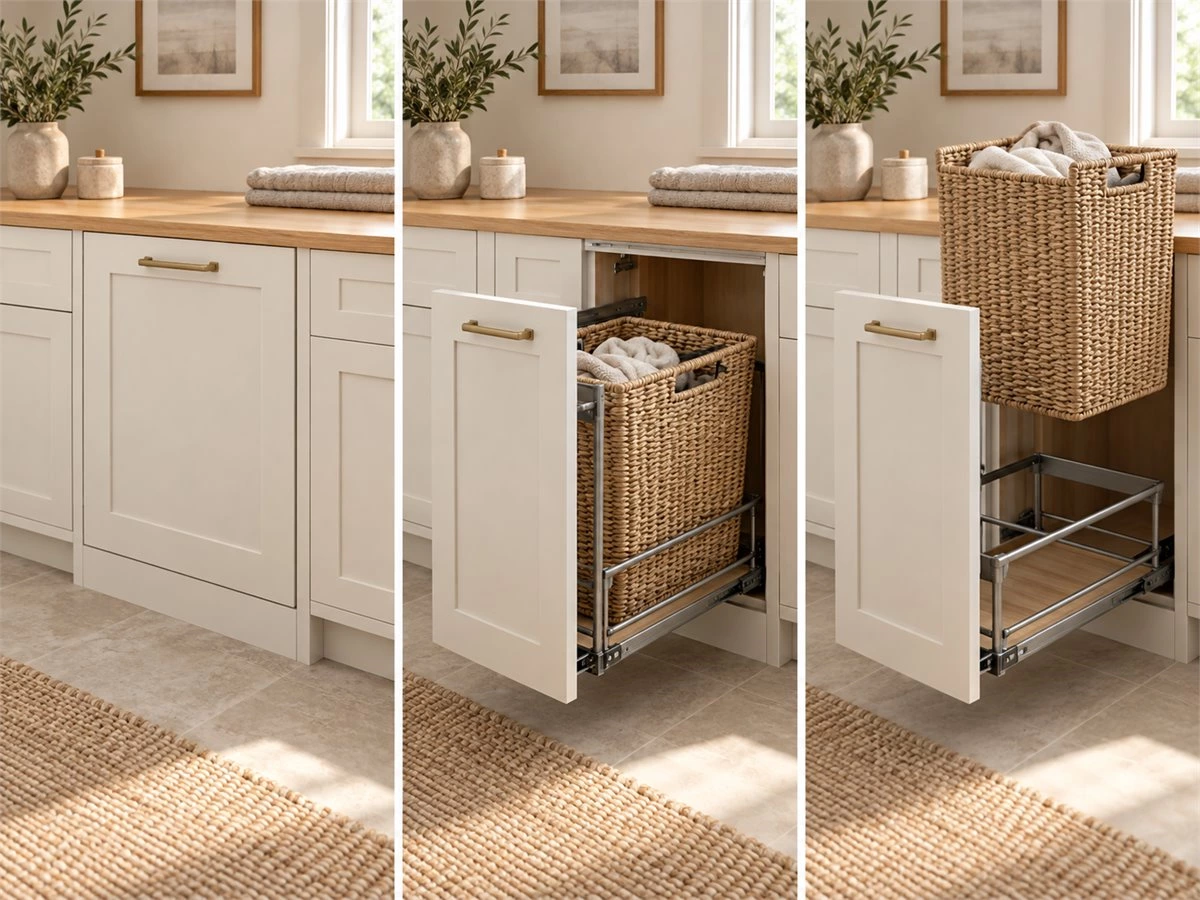
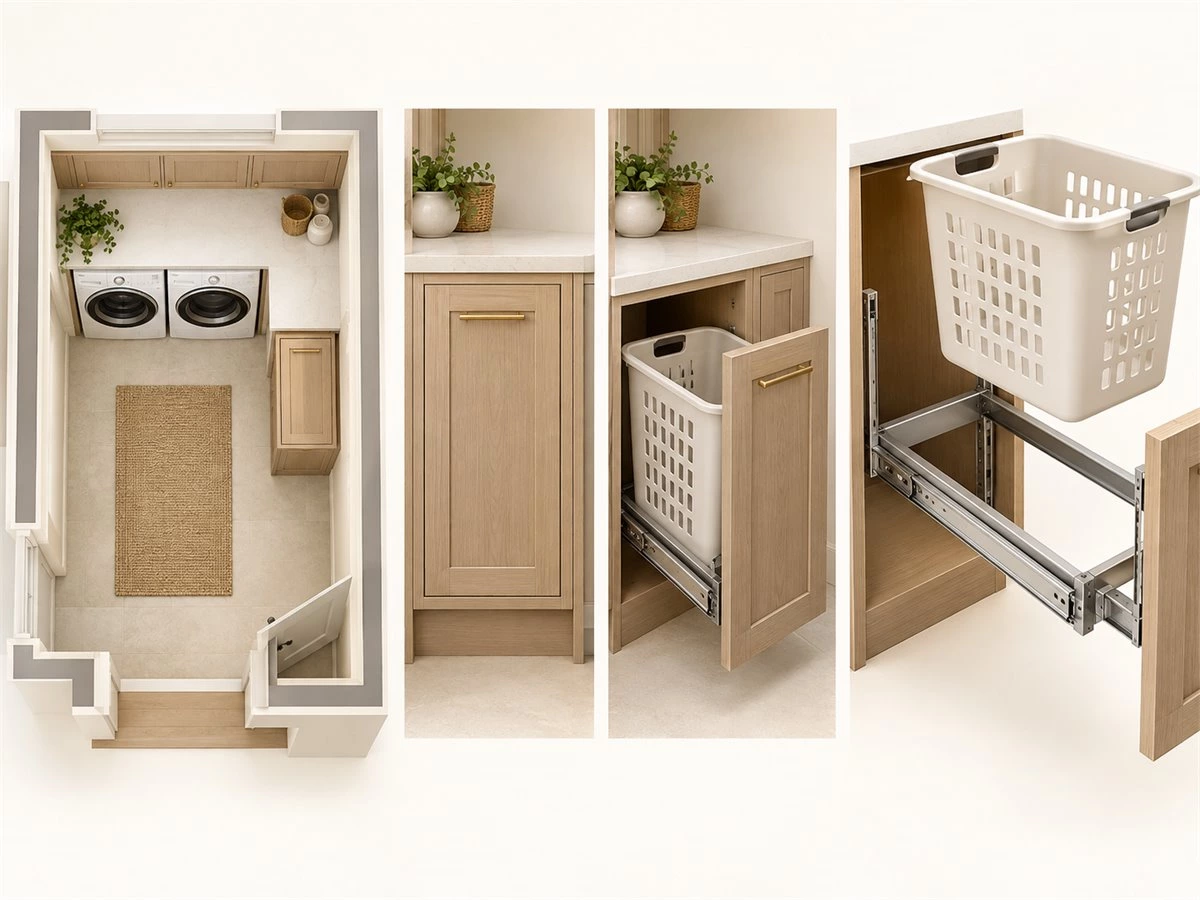
In a pull-out laundry hamper cabinet, a basket or basket carrier moves forward on a specified sliding system. This can make the contents visible from above and can simplify sorting when more than one container is used. A pull-out may also be convenient beside a folding surface because the basket comes toward the user.
The design needs enough unobstructed space for the full slide travel and for a person to stand beside or in front of the open unit. Check the path against the washer door, room door, nearby drawers and circulation. Ask how the basket lifts out of its carrier and how the slides will be cleaned or adjusted. Basket weight and slide suitability must be checked against the selected hardware and expected use, not an assumed universal rating.
Tilt-Out Laundry Hamper Cabinet
A tilt-out laundry hamper cabinet uses a front that pivots outward to expose the basket. It can create a familiar, compact-looking cabinet elevation and allow clothes to be dropped into an opening near the front. The access experience depends on the pivot point, basket position and how far the front opens.
Show the complete opening arc in the room plan. A tilted front can project into a walkway or conflict with another door. It also needs a practical method for taking the basket out when full. Confirm the hinge or pivot system, stops, front construction and basket support with the supplier. Do not approve a design on the basis of a closed-door rendering alone.
Removable Basket Behind a Hinged Door
A straightforward alternative is a cabinet with a hinged door and a freestanding or supported removable basket inside. This may use fewer moving cabinet components, but the user must open the door, reach the basket and lift it clear. The basket should pass through the actual clear opening without being tipped awkwardly or striking the frame.
Check where the door rests while a full basket is being lifted. In a narrow laundry room, the door may block the route to the washer. In a deep cabinet, the basket may sit too far back for comfortable daily use. A simple mechanism is only an advantage when the removal route is equally simple.
Multi-Bin Laundry Sorting Cabinet
A multi-bin cabinet provides separate containers for categories that the household already washes differently. It can be built around pull-out carriers, tilt-out fronts or a set of removable baskets behind doors. The benefit is less sorting at the washer; the trade-off is that each basket may hold less and the cabinet may use more width.
Choose categories first, then decide how many bins are justified. An extra compartment that nobody uses correctly can take valuable storage space from detergent, towels or cleaning tools.
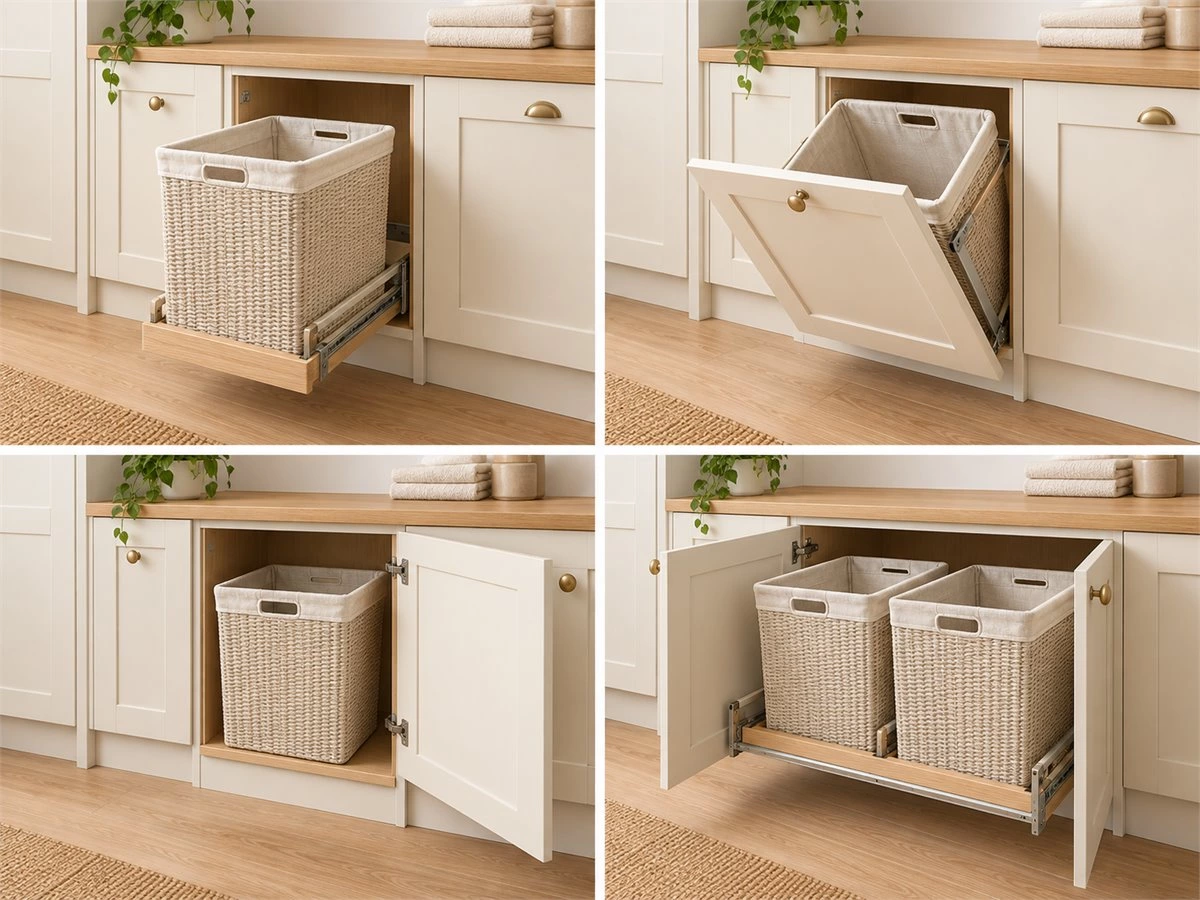
| Arrangement | Everyday access | Useful when | Confirm before ordering |
|---|---|---|---|
| Pull-out basket | Basket moves toward the user | Clothes are sorted or loaded frequently | Forward travel, slide specification, basket lifting route |
| Tilt-out basket | Cabinet front pivots outward | Front loading suits the planned location | Opening arc, pivot hardware, basket removal |
| Removable basket behind door | Door opens, then basket is lifted out | A simple internal arrangement is preferred | Door clearance, reach, basket and frame dimensions |
| Multi-bin cabinet | Separate containers for selected categories | The household already sorts at collection | Capacity of each bin, access and category identification |
Choose a Sorting System People Will Actually Use
A laundry sorting cabinet does not need a bin for every fabric or color. Start with what the household currently washes separately. Typical categories might include everyday clothes, towels or delicate items, but the appropriate divisions are specific to the household and its washing process.
Sort at Collection or Before Washing?
If family members already separate clothes when removing them, individual baskets can preserve that work until wash day. If everyone drops clothes in one place and sorting happens beside the washer, a single easily removed basket may be simpler. A cabinet should support the real process rather than force an idealized routine that is unlikely to last.
Compare One Large Basket With Several Small Ones
One basket is easier to identify and may give more uninterrupted volume for bulky items. Several baskets can keep categories apart but may fill unevenly. Towels or bedding, for example, may overwhelm a small compartment while a rarely used category remains nearly empty. Review typical contents and emptying frequency before fixing the cabinet divisions.
Check Each Basket's Removal Path
The opening may look generous until a full basket must be lifted past a top rail, tilted door or adjacent cabinet. Demonstrate the lift using the proposed basket model or a physical mock-up. Confirm grip points, removal direction and whether the container can be returned without catching on the carrier.
Test the Complete Use Sequence
When comparing hamper designs, do not stop at “the door opens.” A successful unit should support the entire sequence: approach the cabinet, deposit clothes, sort if needed, remove a full basket, carry it to the washer, clean the container and return it.
Open the Cabinet With Nearby Features in Use
Show the hamper open while the washer or dryer door is open. Check any nearby sink cabinet, storage drawer, bathroom door or wardrobe front. In a compact room, two components may work individually but block each other when used in the same laundry routine.
Remove a Full Basket, Not an Empty One
A basket can be easy to lift when empty and uncomfortable when filled with towels. Review the expected load, available hand positions and whether the cabinet front stays safely clear during removal. Ask the supplier for the specified hardware and basket arrangement rather than assuming a visual example proves capacity.
Reach the Areas That Need Cleaning
Lint and small clothing items can collect beneath a carrier or behind a basket. Confirm that the basket can be removed and that interior surfaces are reachable for wiping. If the design includes a liner, verify how it is washed and dried before it returns to the cabinet.
Plan for Cleaning, Damp Items and the Room Environment
A concealed hamper is not a substitute for a cleaning routine. The cabinet, basket and nearby room conditions should make it practical to handle lint, spills and damp textiles. This is particularly important in bathrooms and utility rooms where humidity or splashing may be part of normal use.
Use a Basket That Can Be Maintained
Compare smooth removable containers, washable liners and other proposed materials by how they are actually cleaned. A fabric liner may be convenient if it can be removed and dried properly; a fixed component that is difficult to wash may be less suitable for a high-use hamper. Follow the basket manufacturer's care guidance for the chosen product.
Do Not Store Wet Laundry Enclosed for Long Periods
Damp towels and wet clothing should be handled according to the household's drying and washing routine rather than left enclosed for extended periods. Openings or vents in a cabinet do not, by themselves, make prolonged storage of wet laundry appropriate. Plan where unusually damp items can dry or be washed promptly.
Match Cabinet Materials to Their Exposure
Review where water may splash, where the floor is cleaned and how the cabinet edges are protected. Panels, finishes, edge details and hardware should be specified for the actual room conditions. A broad “moisture-resistant” description is not enough to establish that every component is appropriate for a wet or frequently cleaned area.
Coordinate the Hamper With Nearby Cabinets and Appliances
The hamper is one part of a larger storage system. Its position should support the route from collecting clothes to washing, drying and folding, without disrupting appliance access or taking the space needed for other daily tasks.
In a Laundry Room
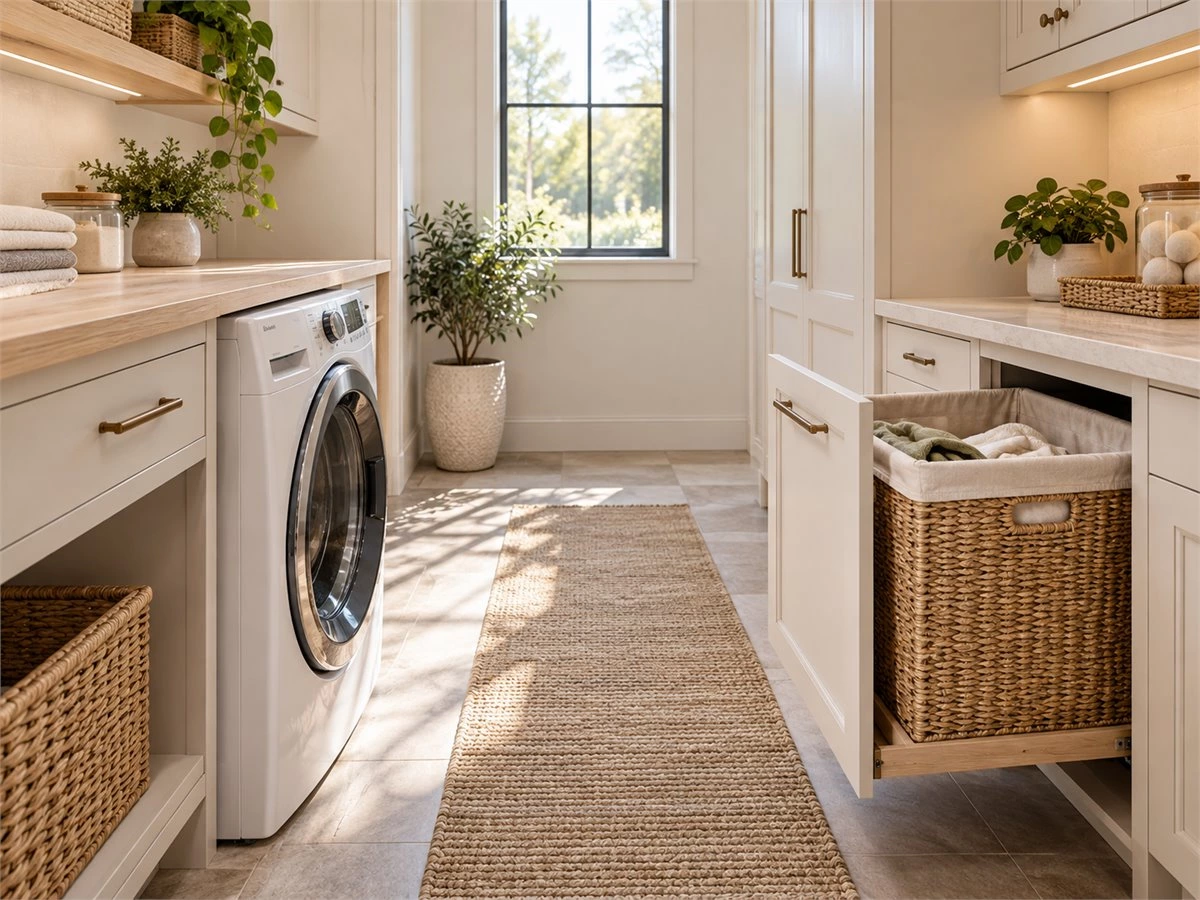
A hamper near the washer may shorten the transfer route, but it should not block loading, appliance servicing or a folding counter. If the room includes a stacked washer-dryer arrangement, compare the hamper position with the appliance doors, control access and storage zones. ALLURE's custom laundry room cabinets guide covers the broader room layout, while the stacked washer dryer cabinets guide addresses appliance-centered planning.
In a Bathroom
A bathroom hamper can be convenient for towels and clothing, but the cabinet must work with vanity doors, circulation and routine cleaning. Check splash exposure and the route for carrying a full basket out of the room. If tall storage is also planned, coordinate the hamper with shelves and daily-use bathroom supplies instead of filling every available cabinet with one function. See the tall bathroom storage cabinets guide for adjacent storage planning.
In a Wardrobe or Bedroom
Position the hamper near where clothes are changed without blocking access to frequently used clean clothing. A basket behind a wardrobe door may be less convenient if other stored items must be moved first. Decide how the container will travel to the laundry area and whether the household prefers to keep worn garments in a separate cabinet zone. For other built-in closet components, refer to ALLURE's wardrobe accessories guide.
Compare Usable Basket Space, Not Just Cabinet Size
Two cabinets with similar outside dimensions can hold different basket volumes. Pull-out slides, carriers, pivots, frames and door clearances all occupy space. The usable container and the ease of removing it matter more than the nominal cabinet width alone.
Check the Actual Container
Ask for the proposed basket's internal dimensions, material and removal method. Confirm that the basket accommodates the household's normal laundry volume and the larger items it regularly receives. Do not assume that the largest possible basket is the most practical if it becomes hard to carry when full.
Account for the Opening System
Different hardware systems can change the basket's position and the clear opening around it. A pull-out carrier may use space at the sides or below; a tilt-out may need a basket shape that works with the moving front. Compare actual product drawings or physical samples, not only generic descriptions of the mechanism.
Weigh the Storage Trade-Off
A hamper cabinet displaces other storage. In a small laundry room, that may mean fewer shelves for towels, cleaning tools or detergent. Compare the daily value of concealed laundry storage against the cabinets it replaces. Avoid adding multiple sorting bins simply because the elevation has space for them.
What Must Be Confirmed Before Production?
A custom hamper should be approved in working positions as well as closed. The room plan, cabinet elevation and basket details should agree with one another and with the selected hardware.
| Item to confirm | What to provide or show | Why it matters |
|---|---|---|
| Collection routine | Users, items collected, sorting categories and emptying frequency | Determines the number and type of baskets |
| Room and cabinet location | Measured plan, nearby doors, appliances and walking route | Tests the opening and basket-carrying path |
| Basket specification | Model, usable size, material, handles and removal direction | Confirms everyday capacity and cleaning method |
| Opening hardware | Selected pull-out, tilt-out or hinged-door system and supplier data | Checks suitability, movement and maintenance access |
| Cabinet materials | Panels, finishes, exposed edges and room exposure | Matches construction to cleaning and moisture conditions |
| Working drawings | Cabinet closed, fully open and with basket removed | Reveals conflicts hidden in a closed elevation |
Also record who will carry a full basket, whether the basket can be replaced later and how slides or pivots can be accessed for service. Confirm the installed room dimensions and unresolved site details before production. A design visualization can communicate the intended arrangement but cannot prove basket clearance, hardware suitability or final construction.
Frequently Asked Questions
Is a pull-out or tilt-out laundry hamper cabinet better?
Neither is always better. A pull-out moves the basket toward the user and may make sorting from above convenient, but it needs full forward travel. A tilt-out presents an angled opening and needs a clear pivoting area. Compare both with the proposed basket, nearby doors and the way a full basket will be removed.
Where should a built-in laundry hamper be placed?
Place it where people will actually use it and where the basket can travel easily to the washer. A laundry-room location can support washing and sorting; a bathroom or wardrobe location may catch clothes closer to where they are removed. Test the cabinet opening, carrying route and room conditions for the chosen location.
Should a laundry cabinet have one basket or several?
Use the number of baskets that matches the household's real sorting routine. One basket is simple and can be easier to carry; several bins can keep established washing categories apart. Compare usable capacity in each compartment, particularly for bulky towels or bedding.
Can the basket be removed for carrying laundry?
It can if the selected design is built for that action. “Pull-out” or “tilt-out” alone does not guarantee a removable container. Ask to see the exact basket, grip points and removal path, ideally with the cabinet in its fully open position.
What measurements are needed before ordering a hamper cabinet?
Record the installed room and cabinet space, nearby doors and appliances, the proposed basket size, the opening movement and the space needed to remove and carry a full basket. The required clearances depend on the actual hardware and layout; confirm them in project drawings rather than relying on a universal measurement.
Choose the Hamper Around the Routine
A good laundry hamper cabinet makes it easy to deposit clothes, sort them when needed, take a full basket to the washer and clean the cabinet afterward. Pull-out, tilt-out and hinged-door arrangements can all succeed when the collection point, opening path and basket removal have been designed together.
Before deciding on a finish, share a room plan, site photos, household laundry routine, preferred sorting categories and basket requirements with the design team. ALLURE's custom cabinet options can provide a starting point for coordinating the hamper with adjacent laundry, bathroom or wardrobe storage. The final mechanism and dimensions should be confirmed in the project-specific proposal.