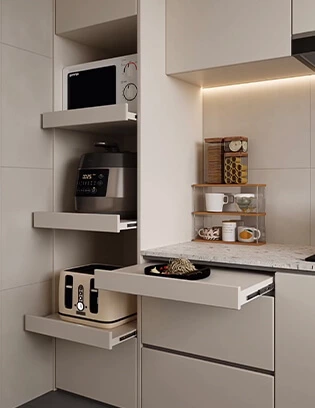
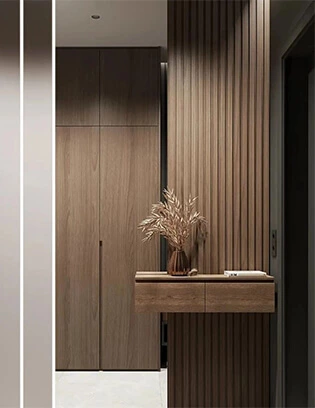
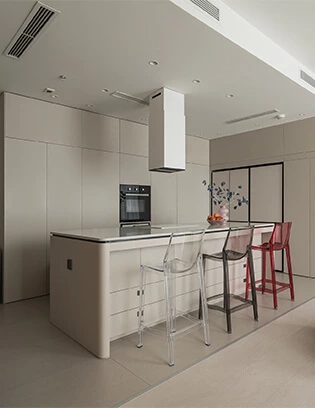
What makes cabinets more than just furniture? It’s not just about glossy finishes or expensive materials—it’s the craft beneath the surface, the stories etched into every edge, joint, and grain. Behind each elegant structure lies a world of precision, tradition, and stunning innovation. Here are three of our signature woodwork techniques in high-end cabinet customization:
For designers, builders, and homeowners reviewing bespoke interiors, custom cabinet joinery is where a concept becomes a convincing finished detail. The joint profile, panel build-up, visible reveal, material movement, and installation tolerance should be considered together—not as isolated decorative decisions. These details can be coordinated across custom kitchen cabinets, wardrobes, wall panels, display units, and other whole-home cabinetry.
Haitang Corner
Inspired by the gentle curve of the flowering crabapple petal—a classic element in traditional Chinese gardens—the Haitang corner breaks away from the harsh rigidity of standard right angles. Instead, it features rounded, beveled edges created by slicing the corner diagonally and softening it into a curve, typically 3–5mm wide.
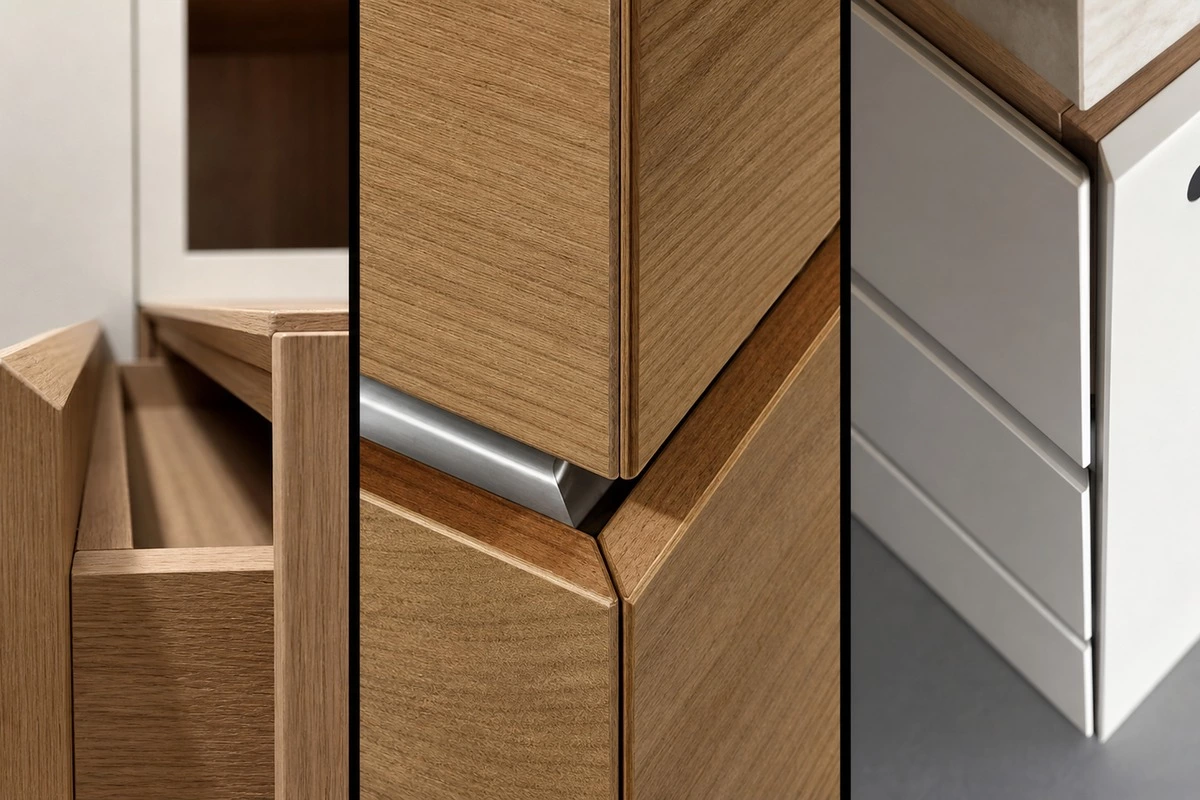
It’s not just for looks—
For safety: These softened edges disperse impact, making them ideal for stair treads, children’s furniture, and frequently used areas—where sharp corners are best left behind.
For depth: Under light, the beveled surface creates subtle shifts in shadow and texture, adding depth to minimalist interiors.
For meaning: In form and function, Haitang corners echo the philosophy of “soft outside, strong inside”—a visual metaphor often used in tea rooms, studies, or other spaces that value calm elegance.
When specifying a Haitang corner, confirm the finished radius or chamfer size, panel thickness, coating build-up, grain direction, and the relationship between adjacent doors or drawer fronts. For a more detailed look at this edge treatment, see our guide to Haitang corner cabinet trim details.
Sandwich Structure
This technique is a masterpiece of hidden complexity. Picture a luxurious wood veneer on the outside—just 0.6mm thick—adhered to a strong core of 18mm multilayer board, reinforced at the base with 2mm aluminum honeycomb. What looks like a sleek, natural finish is actually a high-performance composite.
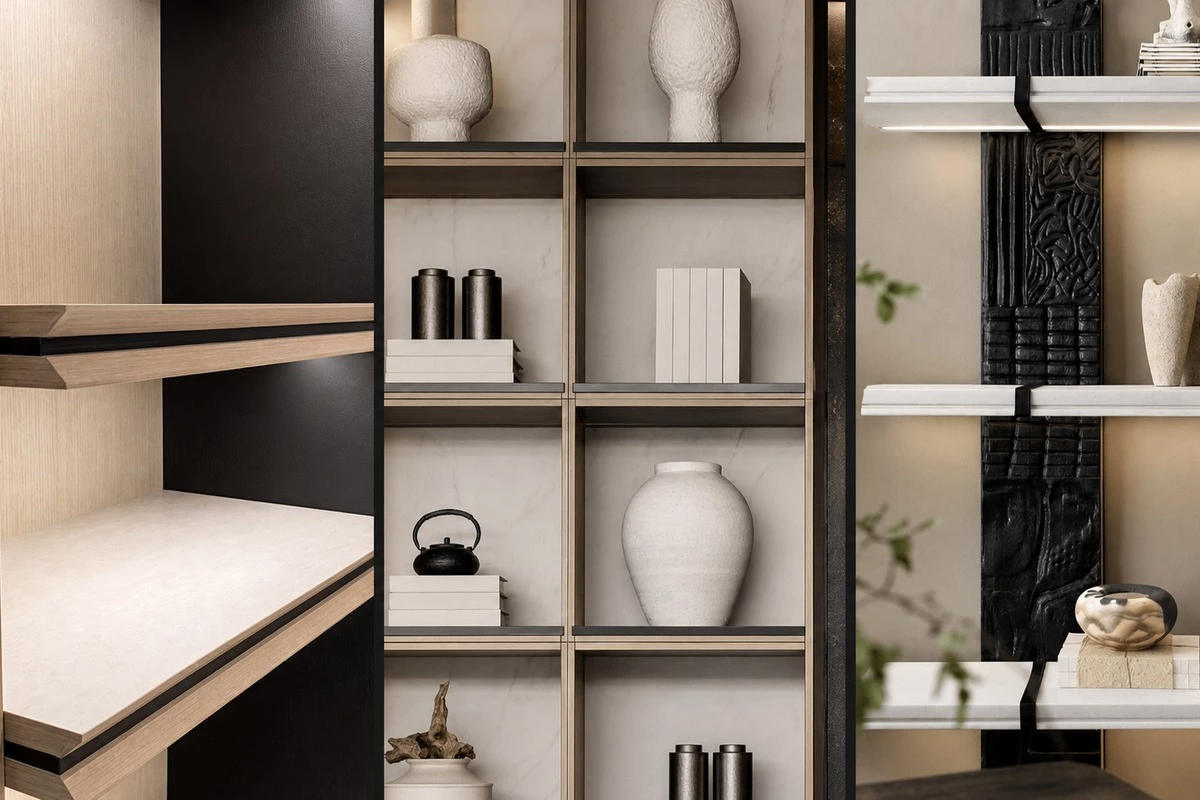
This structure delivers on several fronts:
Warp-proofing: The alternating grain directions between layers minimize expansion and contraction caused by humidity or heat—perfect for climates ranging from southern dampness to heated northern floors.
Multi-functional layering: Need sound insulation? Fire resistance? Thermal regulation? Sandwich cores can be fitted with sound-absorbing felt (reducing noise by 35dB), B1-rated fire boards, or insulation that keeps temperatures stable within ±3°C.
Light but strong: A 3.2m-long table built this way is 40% lighter than solid wood—but with triple the bending resistance. Ideal for large tables, bookshelves, and other heavy-duty installations.
Material efficiency: Using structural simulations, each layer’s thickness and orientation can be fine-tuned to maximize performance while minimizing waste—turning short offcuts into long-term solutions.
For custom cabinet joinery involving layered or composite panels, actual performance depends on the complete specification: substrate, veneer or finish, adhesive system, internal reinforcement, span, fixing method, hardware load, and service environment. The numerical performance examples above should therefore be verified against the approved material data and project-specific engineering requirements before production.
For projects using composite wood products, buyers can review the U.S. EPA’s composite wood product guidance as an external regulatory reference. This reference does not represent a certification claim for any individual supplier, material, or project.
For related board layering applications in cabinetry, explore our article on ABA sandwich craftsmanship and kitchen cabinet board details.
Miter Joint
A miter joint isn’t just a visual trick—it’s an engineering feat. By cutting and joining wood at precise angles (think 45° diamonds or 60° chevrons), pieces lock together like a wooden puzzle with no visible seams. Each component is numbered and CNC-cut to ensure perfect alignment.
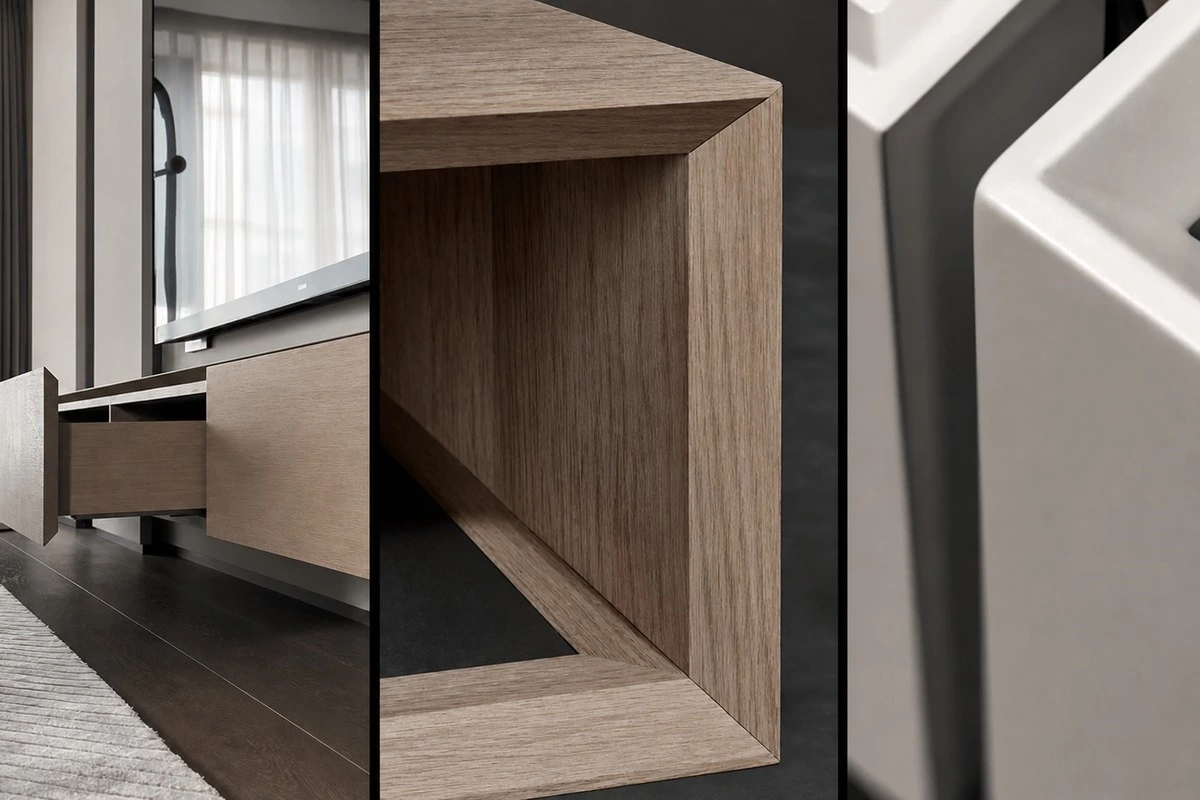
Why it works:
Stronger under pressure: Miter joints spread stress more evenly, boosting load capacity by up to 40%. Ideal for flooring or walls in high-traffic areas.
Visual illusions: Mitered patterns can stretch or lift a space—60° layouts elongate narrow corridors by 20%, while 45° splices give low ceilings a perceived 15% boost in height.
Resourceful beauty: These angled joints are also a dream for sustainability. Offcuts and short planks that would otherwise be discarded can be repurposed into intricate mitered designs—less waste, more wow.
Built-in acoustics: Add sound-absorbing material behind the seams, and miter joints become more than decorative—they turn into subtle sound barriers, ideal for home cinemas, studios, or any space that balances aesthetics with performance.
Mitered work should be sampled at full size before batch production. The sample should show the final angle, visible joint line, edge condition, finish continuity, grain direction, adhesive method, hardware clearance, and expected installation alignment. For a deeper discussion of this detail, read our guide to mitered cabinet doors and 45-degree bevel cutting.
How to Review Custom Cabinet Joinery Before Production
Good custom cabinet joinery is not defined by a render alone. Before production, prepare a clear approval record for every visible detail:
- Identify the exact joint location on elevations, sections, and enlarged detail drawings.
- Confirm panel material, finished thickness, veneer direction, coating, and edge treatment.
- Review how doors, drawers, shelves, lighting, and hardware interact with the detail.
- Approve a full-size sample when the joint is highly visible, repeated across several panels, or used near a high-contact area.
- Record acceptable reveals and alignment expectations before packing and installation.
For architectural woodwork projects, the Architectural Woodwork Institute standards can be used as an external specification reference. The final construction method should always match the approved drawings, local requirements, intended use, and selected materials.
Frequently Asked Questions
What is custom cabinet joinery?
Custom cabinet joinery is the planned method used to connect, transition, reinforce, or visually finish cabinet components. It includes edge treatments, mitered corners, layered panel structures, reveals, and other construction details that influence both appearance and function.
Is a Haitang corner suitable for every cabinet edge?
Not always. The suitability depends on panel thickness, finish type, location, cleaning requirements, impact exposure, and the desired visual effect. A physical sample is the safest way to confirm the detail.
Are miter joints only decorative?
No. Miter joints can create a clean, continuous visual transition, but their durability depends on the material build-up, remaining panel thickness, adhesive method, support, fixing method, and the intended load.
What should be checked for a sandwich cabinet panel?
Confirm the core material, outer finish, total panel thickness, reinforcement, edge construction, fixing method, hardware load, and expected temperature or humidity conditions. Do not assume one panel structure fits every application.
Why should a full-size joinery sample be approved?
A full-size sample makes it possible to evaluate the actual joint fit, finish continuity, grain direction, touch comfort, shadow line, visible reveal, and interaction with surrounding doors, drawers, or wall panels.
Conclusion
Custom cabinet joinery gives high-end cabinetry its most convincing details: softer transitions through Haitang corners, layered visual depth through sandwich structures, and crisp continuity through miter joints. The strongest result comes from treating each technique as part of a complete system of materials, drawings, hardware, finishing, sampling, and installation—not as decoration alone.
For custom cabinetry projects, ALLURE can coordinate cabinet layouts, panel details, materials, finishes, and visible joint requirements across kitchens and whole-home spaces. A clear drawing package and approved full-size sample help ensure that the finished custom cabinet joinery matches the intended design language on site.