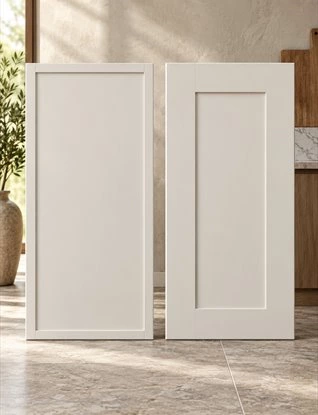
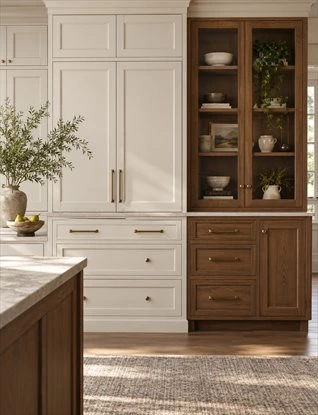
Slim Shaker vs standard Shaker cabinets is mainly a comparison of visible door proportions. Both use the familiar framed outline around a recessed center, but a slimmer rail-and-stile profile leaves more visual area for the center panel, while a broader profile gives the frame a stronger presence. The difference can look subtle on one sample and substantial across a wall of cabinets.
There is no universal industry width that makes a door “slim” or “standard.” Manufacturers may use those names for different profiles, and the apparent width also depends on door size, finish, lighting and the way several doors meet. The fairest comparison uses two complete doors with the same outside dimensions, color and viewing conditions. Then check tall doors, short drawer fronts and the full room elevation before selecting a profile.
This guide focuses on that decision—not on whether Shaker is better than slab, raised-panel or glass doors. It explains how to compare proportions, where each look may fit, what finish and hardware can change, and which details to confirm before ordering custom cabinetry for several rooms.

Slim Shaker vs Standard Shaker: What Actually Changes?
Look at the visible frame-to-panel relationship
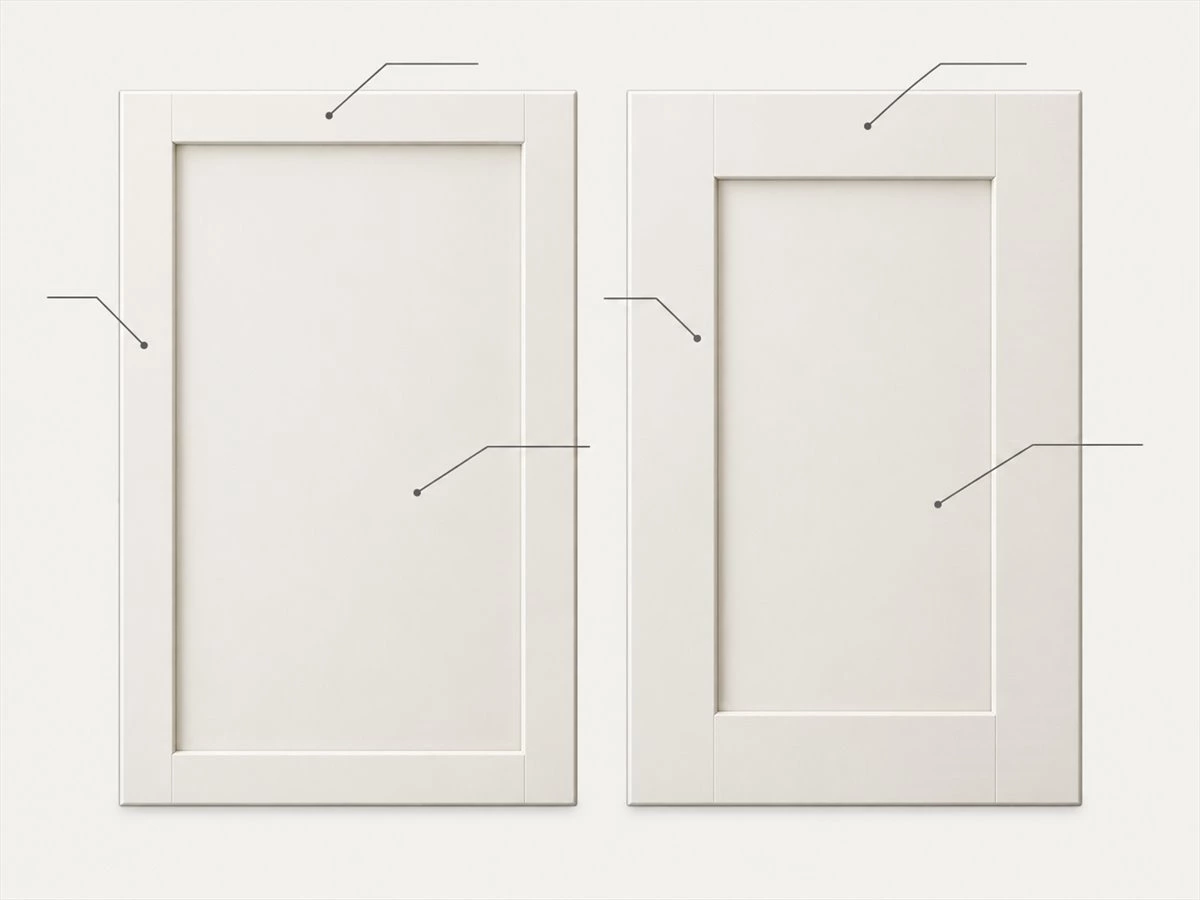
A Shaker-style front is commonly read as a center panel surrounded by vertical stiles and horizontal rails. When the visible border becomes narrower, the center area takes up more of the door face. The result can feel lighter and more restrained. A broader border makes the framed structure more noticeable and can lend a more furniture-like rhythm, particularly when several doors are repeated.
Those are visual tendencies, not rules about quality or room style. A slim profile in a dark painted finish may look more prominent than a broader profile in a quiet, wood-toned room. To see the actual difference, compare the proposed profiles in the finish and door sizes you intend to buy.
Do not confuse a slim frame with a thin door
The word slim normally describes how narrow the frame looks from the front. It does not, by itself, tell you the overall door thickness, the center-panel material, the joint construction or which hinges can be fitted. Likewise, a broader-looking Shaker border does not prove that a door is stronger. Ask for a section drawing or physical sample of each proposed door system before making technical assumptions.
Use names as a starting point, not a specification
Terms such as Slim Shaker, Thin Shaker, Micro Shaker and Standard Shaker may be used differently by different suppliers. A quotation that lists only one of these labels leaves too much open to interpretation. Record the actual sample code or profile drawing, door outside dimensions, measured rail and stile widths, center-panel detail and finish. That makes the choice repeatable across kitchen, bathroom and wardrobe fronts.
| Question | Slim-looking profile | Broader-looking profile | What to verify |
|---|---|---|---|
| What draws the eye? | A larger apparent center field | A more defined frame | Same-size samples in the intended finish |
| What happens on small fronts? | The border may look relatively restrained | The border may occupy more of the visible face | Actual drawer-front and small-door elevations |
| What does the name prove? | An intended appearance, not a fixed dimension | An intended appearance, not a fixed dimension | Profile section, material and measured widths |
Compare Full-Size Doors, Not Just Small Samples
Keep the test fair
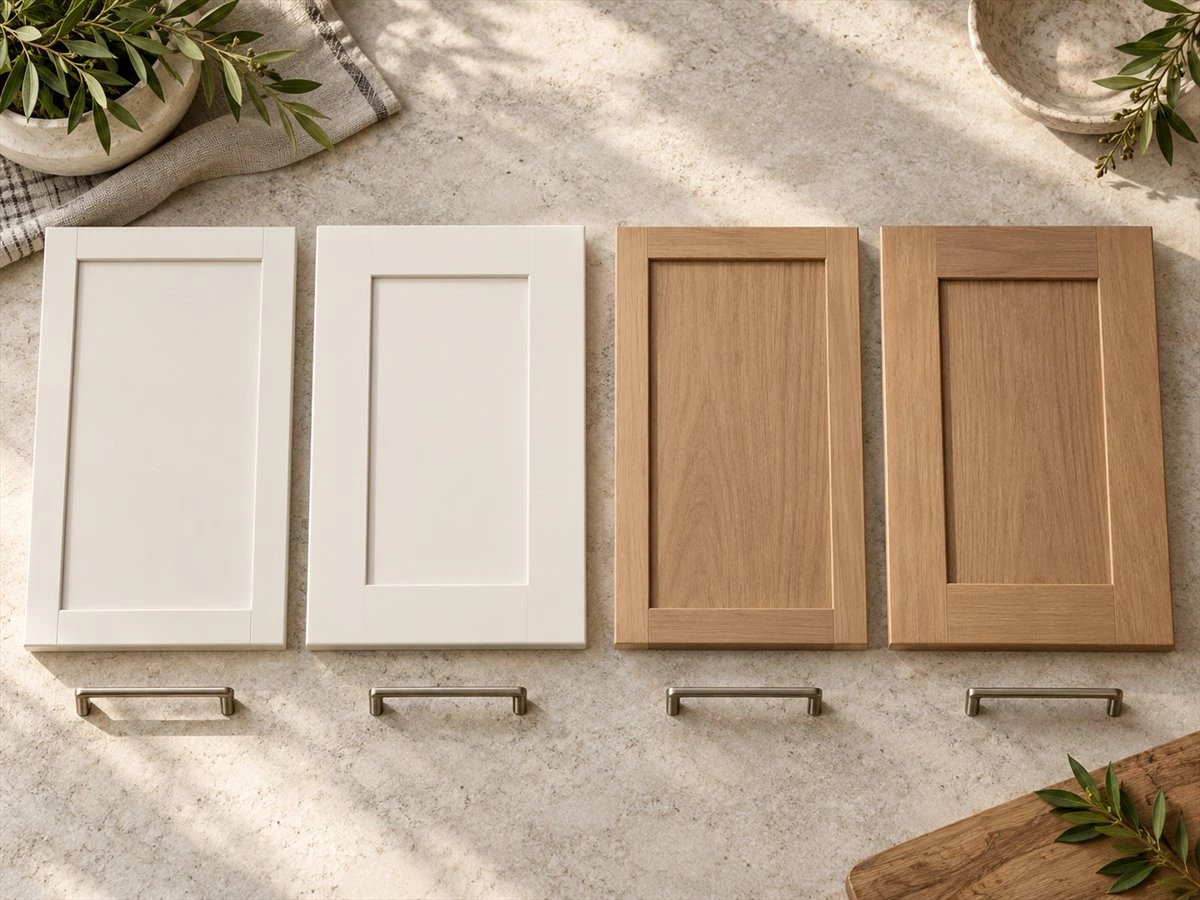
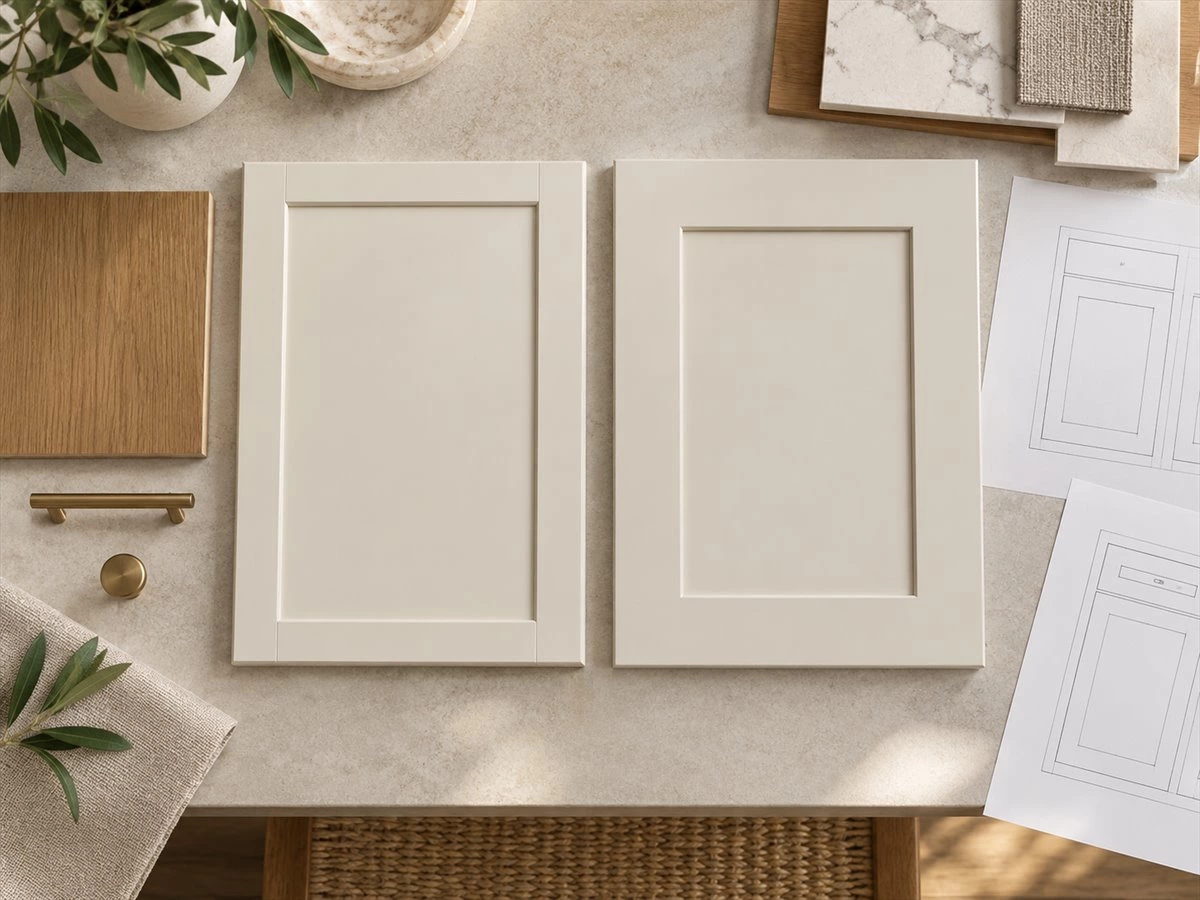
Place the two alternatives side by side at the same outer height and width. Give them the same color or wood finish, sheen, handle position and light. Otherwise you may find yourself choosing the more attractive photograph rather than the better proportion. A sample corner can help explain a profile, but it cannot show how the whole door reads from across a room.
Measure the visible top, bottom and side borders of the actual samples. The numbers are useful because “slim” and “standard” are not fixed specifications, but the visual decision should not be reduced to those numbers alone. Two door systems can have the same nominal border width yet differ in the depth of the recess, edge shape or shadow line.
Review the door within the whole elevation
A single door may look balanced on a table, while a row of tall fronts creates a much stronger repeated pattern. Ask to see the proposed kitchen or wardrobe elevation showing the true door and drawer sizes, reveals between fronts, end panels, fillers and appliance panels. The relationship between those lines often matters more than a close-up of the frame itself.
Compare center-panel proportion at viewing distance
Stand back from the samples at approximately the distance from which the installed cabinetry will normally be seen. Does the broader border help the cabinetry feel composed, or make the center look cramped? Does the slim border maintain enough definition, or disappear into a large bank of doors? Repeat the review under daylight and the planned artificial lighting. Strong side lighting can emphasize a recessed profile that seemed subtle under flat showroom light.
Check Tall Doors, Small Doors and Drawer Fronts
Tall pantry and wardrobe doors
Long vertical stiles become a strong part of a tall-cabinet wall. A slim outline may let large doors feel quieter, especially beside full-height wall panels. A broader outline can make each door more legible as a distinct piece of cabinetry. Neither effect is automatically preferable. Compare the actual wall elevation and look at how the top and bottom rails meet nearby ceiling lines, plinths and horizontal divisions.
For a tall or unusually large door, appearance is only one part of approval. The supplier should confirm the proposed door construction, suitable hardware and any project-specific limitations for its dimensions and weight. Do not infer structural performance from the apparent front border.
Compact wall cabinets and vanity doors
On a small front, the frame occupies a greater share of the visible area. A broad border that looks handsome on a tall pantry door might leave a small center panel on a compact wall cabinet. A slim border may preserve a clearer center field, but it still needs to look intentional next to the surrounding wall cabinets and handles. Compare the exact small-door size instead of scaling down a large-door rendering.
Short drawer fronts
Drawers deserve separate attention because their height is often much smaller than a cabinet door's. Several framed drawer fronts stacked together can create a busy sequence of horizontal rails. Ask whether the supplier proposes the identical profile for every drawer, a modified framed detail for the shortest drawers, or a different front treatment. Any variation should appear on the approved elevation and sample set rather than being decided during production.
The key question is not whether every front has the same label. It is whether tall doors, compact doors and drawers form a coherent family once installed together.

Choose Profiles for Different Rooms
Kitchen: compare the entire cabinet composition
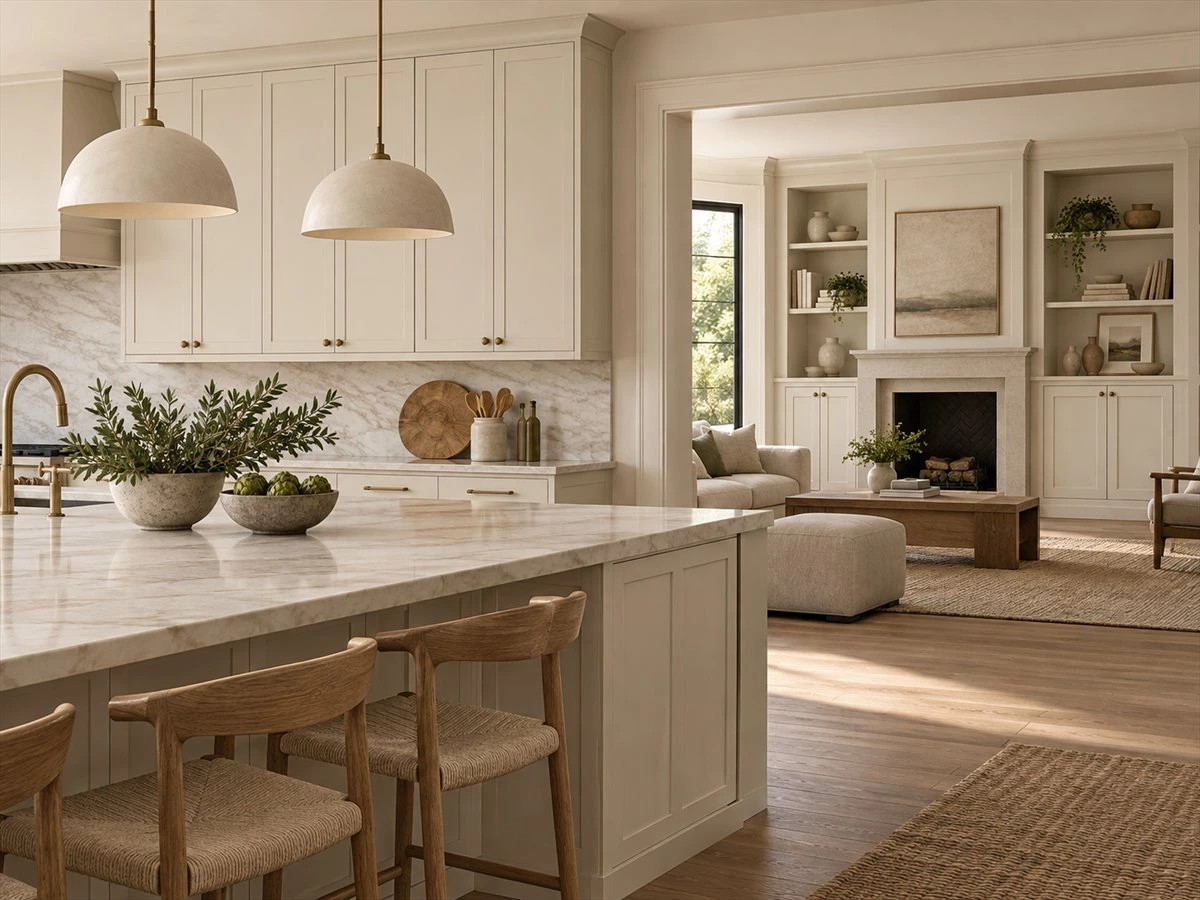
A kitchen combines base cabinets, wall cabinets, tall storage and often an island. If stone, lighting and shelving already have strong visual character, a quieter frame may help the cabinetry support them. If the cabinets are meant to be the primary architectural feature, a more visible frame may add structure. Check how the profile repeats around a hood, refrigerator enclosure and window rather than selecting it from one island photograph.
For an overview of Shaker beside other door families, see ALLURE's cabinet door styles guide. This article is a narrower choice between two proportions within the Shaker family.
Bathroom vanity: judge the smallest fronts
Vanities may combine narrow doors and shallow drawer fronts, so the frame-to-panel balance can look different from a kitchen sample. Review the profile with the basin, mirror cabinet, handle and wall finish shown together. A door's appearance does not establish its suitability for a damp room; assess the complete specified board, coating, edge details and installation conditions separately.
Wardrobe: test repetition on a full wall
A bedroom wardrobe can contain many tall, similarly sized fronts. Slim Shaker can create a restrained rhythm, while a broader profile can read as a more deliberate furniture-like wall. Compare both with the bed, headboard, interior doors and flooring in view. If a wardrobe is designed to blend into painted walls, the finish may matter as much as the profile width.
Dining and living areas: decide whether the cabinet should stand out
A sideboard or media-wall storage unit may be seen alongside open shelves, glass doors and wall panels. Here a Shaker frame can either tie the cabinetry to the kitchen or give one piece its own identity. Use a connected-room elevation to assess the result. Whole-home coordination does not require every cabinet in every room to have identical rails and stiles.
| Application | Proportion to review | Other conditions to confirm |
|---|---|---|
| Kitchen | Repeated bases, wall doors, tall units and drawers | Appliance fronts, lighting, handles and adjacent finishes |
| Bathroom vanity | Small doors and shallow drawer fronts | Specified materials, coating and room conditions |
| Wardrobe | Tall, repeated fronts across a full wall | Door construction, hardware and opening path |
| Living/dining built-in | Framed doors beside display or wall panels | Alignment and visual connection to other rooms |
Coordinate Finishes, Handles and Opening Details
Review both profiles in the finish you intend to order
A profile that looks delicate in a light paint may appear more graphic in a dark finish. Wood-grain direction and a visible edge can also change how the border reads. Compare the proposed finish on both full-size samples, rather than choosing a slim painted door against a broad wood-look door and attributing the entire difference to frame width. ALLURE's Shaker kitchen color and finish ideas can help with palette exploration after the profile decision is understood.
Place handles on the actual door or drawer
A handle can change the apparent scale of a Shaker frame. A large pull may dominate a narrow border; a small knob may leave a broad frame looking more prominent. Check handle placement on a full-size door and a typical drawer front. Do not assume there is enough suitable fixing area on a particular profile until the door construction, handle model and drilling locations are approved together.
Confirm hinges and opening paths
The visible front profile does not tell you which hinge, lift system or opening method has been specified. Ask the supplier to confirm compatibility for the actual material, thickness, size, weight and installation condition. Draw the door open beside walls, appliance panels and nearby handles. A beautiful closed elevation can still contain an awkward collision or limited access once the cabinet is used.
Look Beyond Appearance: Construction, Care and Cost
Ask how each proposed door is built
The same front-facing style can be made through different approved door constructions. Request the door material or substrate, center-panel detail, profile section, exposed edges and finish system for each option. These are project-specific specifications, not qualities that can be read reliably from a styling term. A slim-looking frame is not automatically weaker, and a broader-looking frame is not automatically stronger.
Compare cleaning and repair in the chosen finish
Both profiles include corners and recessed transitions that deserve attention when cleaning. The amount of dust or residue visible may depend on the profile depth, color, sheen and use environment as much as on the apparent border width. Follow the care instructions for the exact supplied surface. If a door is damaged, the repair method and likely visual result depend on its full construction and coating, not simply whether it is called slim or standard.
Request a like-for-like quotation
There is no reliable universal price gap between slim and broader Shaker doors. Cost may change with the chosen material, tooling, finish, panel size, order quantity, sample development and hardware. Compare quotations using the same cabinet dimensions, door construction standard, finish, hinges and installation scope. If one option needs a custom profile or additional approval sample, ask for that item to be shown clearly instead of accepting an unexplained total.
Can You Mix Slim and Standard Shaker Profiles?
Set one main language first
Mixing profiles can work when the difference has a purpose. A kitchen might use one profile for its main cabinet run while a freestanding-looking bar or sideboard uses another. A bedroom might repeat the home's finish color but use a quieter frame on its tall wardrobe doors. The first step is to decide which profile establishes the dominant rhythm in the connected spaces.
Keep the transitions deliberate
View the two profiles in one sightline. If their frame widths differ only slightly, the result may look accidental rather than intentional. If they differ substantially, use color, material, handles or panel alignment to explain their relationship. An effective mixed scheme can also keep one room private and visually distinct; whole-home coordination is not the same as uniformity.
Do not invent a project example to prove the point
A visualization can help compare options, but it cannot prove that a specific combination was built or that ALLURE offers a particular measured profile. If a real project is used as an example, identify its actual doors and obtain permission to show the photography and specification. Otherwise treat the combination as a design proposal to be checked against samples.
What Should You Confirm Before Ordering?
Approve a comparable sample set
Where possible, obtain full-size doors of the same outside dimensions in both proposed profiles and the intended finish. Record the measured rail and stile widths, panel detail and sample identification. A profile sample alone is useful for touch and construction, but it does not replace a complete door when proportion is the decision.
Review every important front size on the elevation
Mark the profile used on tall pantry doors, wardrobe doors, compact wall units and drawer fronts. Check the actual pattern of gaps and horizontal lines across each cabinet run. Confirm whether small drawers use the same frame, a modified version or another agreed treatment. Any exception should be visible in the drawing and described in the quotation.
Connect profile, finish and hardware approvals
Keep the final door construction, finish sample, handle model, hinge arrangement, drilling locations and opening direction together in one approval record. If the profile changes between rooms, identify exactly where. Retain the signed or otherwise documented sample reference and drawings for production review and future service.
| Approval item | Record for each proposed profile | Common risk if omitted |
|---|---|---|
| Door sample | Full-size sample code, outer size, measured rails/stiles and center detail | Different interpretations of “slim” or “standard” |
| Cabinet elevation | Profile on tall, small and drawer fronts; panel alignments and gaps | Unbalanced proportions across the room |
| Construction and finish | Material, section, panel, edge, color and sheen | A visual label mistaken for a technical specification |
| Hardware and price | Hinge/handle compatibility, drilling, quote inclusions and sample revisions | Late changes to appearance, operation or cost |
FAQs About Slim and Standard Shaker Cabinets
Are Slim Shaker cabinets only suitable for modern kitchens?
No. A narrower frame can look contemporary, but the overall result also depends on door size, color, hardware, countertop and room architecture. Compare full elevations rather than assigning the profile to one style label. ALLURE's Shaker kitchen ideas show broader applications; the proportion decision still needs the actual door samples.
Does a narrower frame make a cabinet door weaker?
Not automatically. Visible frame width is only one aspect of a door. The material, construction method, overall dimensions, center panel and hardware all need to be evaluated for the proposed system. Ask the supplier for the actual section and application limits instead of drawing a strength conclusion from a front-view image.
Can Slim Shaker doors be paired with wide drawer fronts?
They can be considered together, but the drawer-front detail should be reviewed at its real height and width. A profile that looks balanced on a full door may not be used in exactly the same way on every drawer. Request an elevation and sample showing the supplier's proposed treatment.
Should every cabinet in the home use the same Shaker profile?
No. One main profile can establish consistency while another is used deliberately for a feature or separate room. Check both in the same sightline and coordinate finishes, handles and panel lines. Mixing should look planned rather than like a substitution made after approval.
What should I ask for before choosing between the two?
Request same-size full-door samples or verified drawings, measured frame dimensions, the door's material and section, finished elevations for the relevant rooms, and confirmation of handle and hinge arrangements. Review the actual quotation scope alongside those records before approving production.
Compare the Complete Door Before Choosing a Profile
A Shaker door is experienced as part of a room, not as a label on a small sample. Bring together the full-size profiles, the cabinet elevations and the finish you want to live with. If you are planning cabinetry across several rooms, share photos, a floor plan or elevations, the important door sizes, preferred handles and an approximate project scope. Contact ALLURE to discuss the door profiles and specifications that can actually be supplied for your project.