Stainless Steel Cabinet Materials: Grade, Finish and Buying Guide
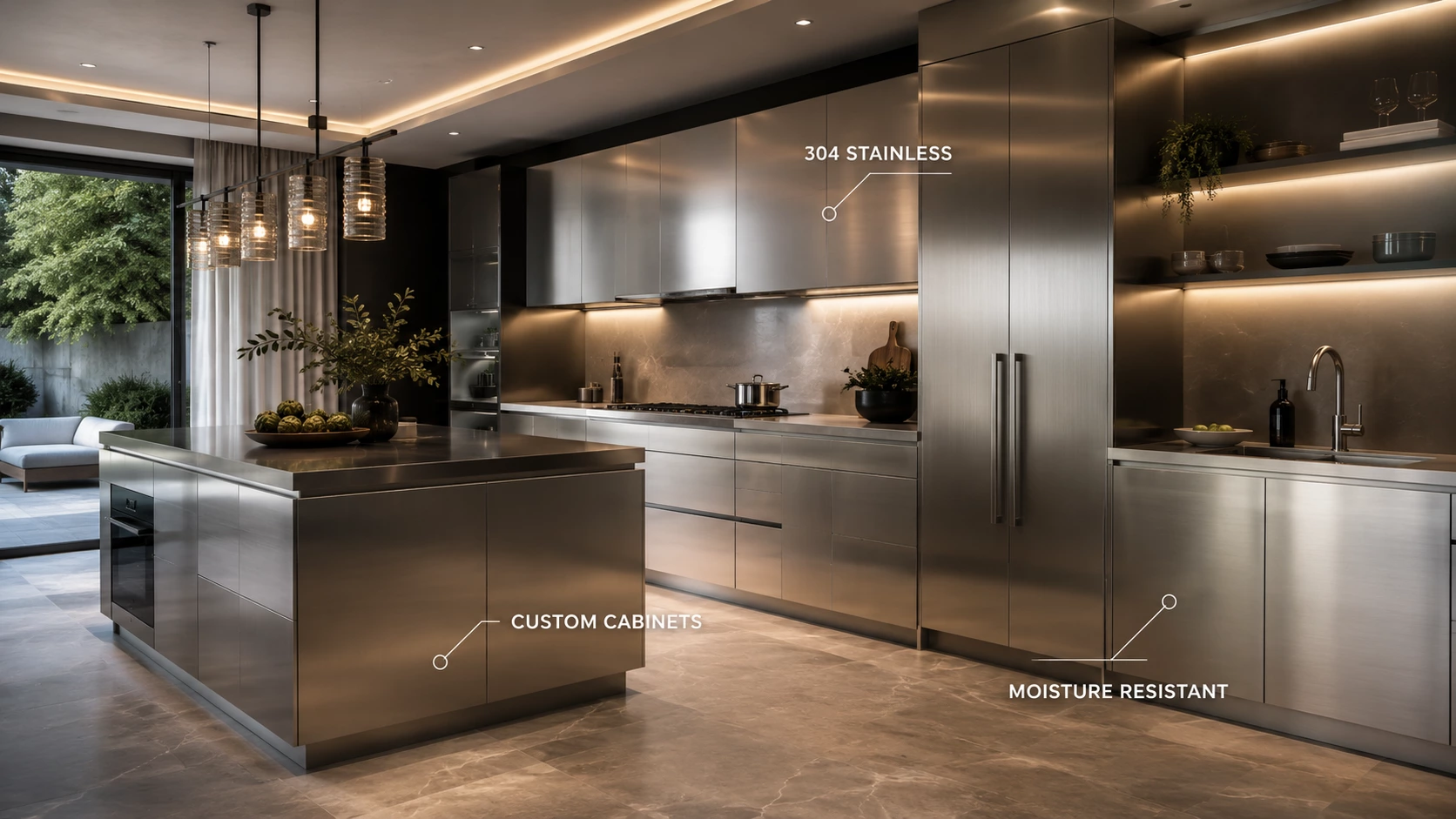
Stainless steel can be used for complete cabinet systems or strategically applied to doors, sink bases, islands, shelves and moisture-sensitive areas.
The best stainless steel cabinet material is not determined by appearance alone. Grade, sheet condition, surface finish, panel construction, edge treatment, hardware and environmental exposure must be specified together.
For most indoor residential kitchens, Type 304 stainless steel is a practical starting point because it combines corrosion resistance, formability, weldability and broad availability. Coastal outdoor kitchens, poolside installations and chloride-rich environments may justify 316L. Type 430 can be considered for dry interior panels and selected decorative components, while 201 should be limited to carefully evaluated, lower-risk indoor applications.
A successful stainless steel kitchen also depends on cabinet engineering. A premium alloy cannot compensate for poor drainage, distorted doors, exposed sharp edges, incompatible fasteners or an unsuitable surface finish.
This guide explains how homeowners, designers, contractors and project buyers can specify stainless steel cabinet materials with greater technical and commercial confidence.
Quick Answer: Which Stainless Steel Should You Use?
- 304 / UNS S30400 / EN 1.4301: the most versatile option for indoor kitchens, islands, sink cabinets and general-purpose cabinetry.
- 304L / UNS S30403 / EN 1.4307: useful when extensive welding or a project specification requires a low-carbon grade.
- 316L / UNS S31603 / EN 1.4404: preferred for coastal, poolside, marine-influenced or chloride-exposed cabinet systems.
- 430 / UNS S43000 / EN 1.4016: a magnetic ferritic grade suitable for selected dry indoor panels, trims and appliance-related components.
- 201: a cost-oriented grade that should not automatically replace 304 in humid, wet, outdoor or coastal applications.
1. Start With the Cabinet Material Strategy
A stainless steel kitchen does not need to use the same material in every cabinet component. The most efficient projects assign material according to moisture exposure, structural load, visual priority and cleaning frequency.
| Cabinet Component | Possible Material Strategy | Main Design Priority |
|---|---|---|
| Sink-base cabinet | 304 or 316L stainless steel body | Leak resistance, drainage and access to plumbing |
| Kitchen island | Full stainless steel or stainless exterior over a reinforced structure | Flatness, visual finish, countertop support and appliance integration |
| Wall cabinet doors | Stainless steel skin, folded stainless door or mixed-material front | Low weight, hinge capacity, alignment and finish consistency |
| Tall pantry | Hybrid cabinet box with stainless steel doors, trim or internal shelves | Storage load, door stability and visual coordination |
| Outdoor cabinet | 304 or 316L according to exposure | Weather, drainage, ventilation and chloride resistance |
| Decorative wall panel | 304, 430 or another approved decorative stainless steel | Color, texture, flatness, grain direction and fingerprint behavior |
| Internal organizer | Stainless wire, strip or formed sheet components | Load capacity, smooth edges, cleaning and corrosion resistance |
This component-based approach allows a project to use stainless steel where it creates the greatest functional value without forcing the entire kitchen into one material or visual style.
For a wider comparison with plywood, MDF, solid wood, laminate and other cabinet materials, review ALLURE’s guide to custom kitchen cabinet materials .
2. Stainless Steel Grades for Cabinet Materials
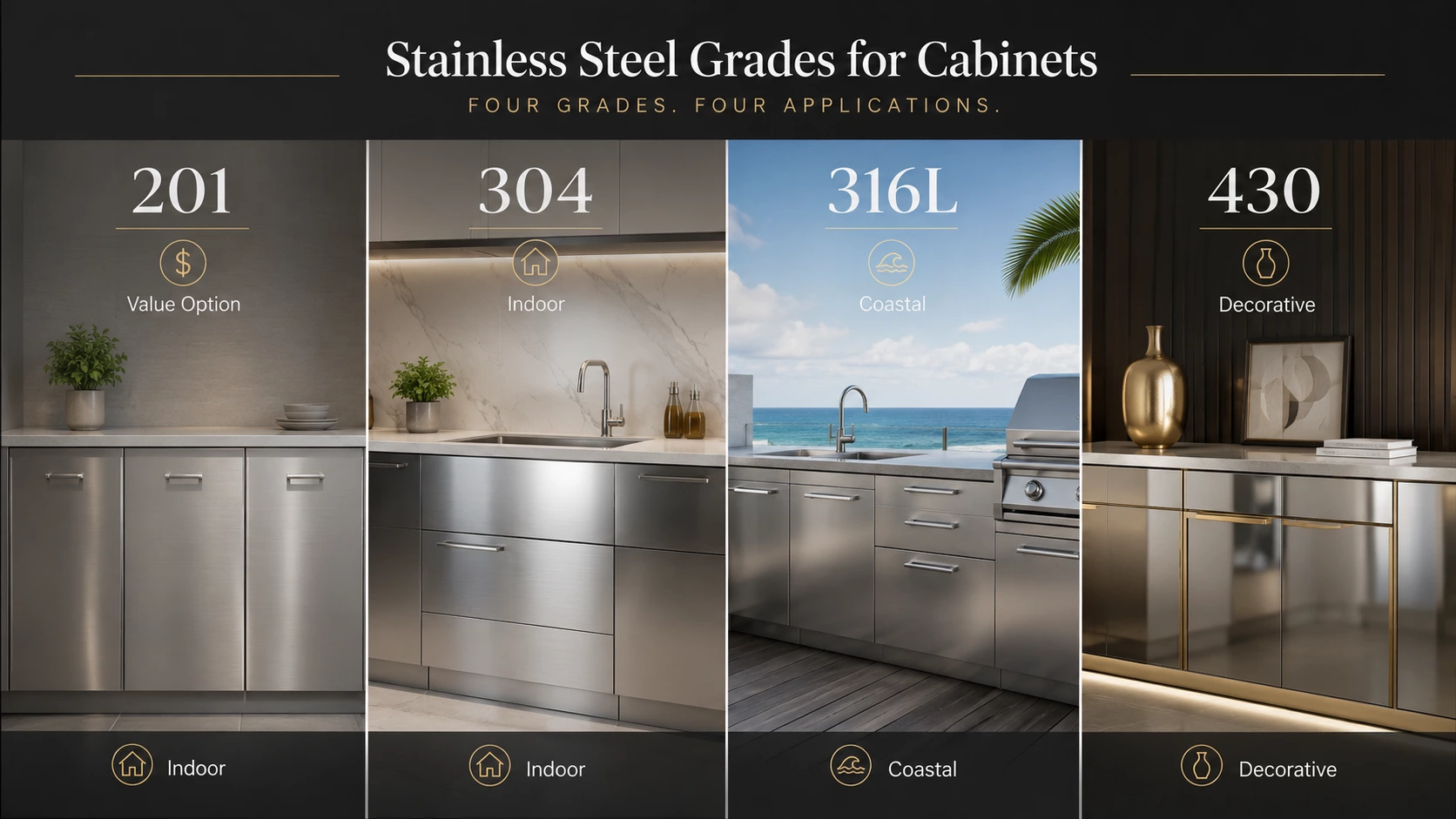
Stainless steel grade selection should reflect the cabinet location, fabrication route, chloride exposure and expected service life.
| Grade | Structure | Cabinet Advantages | Recommended Use | Main Limitation |
|---|---|---|---|---|
| 201 | Austenitic | Competitive alloy cost and useful strength | Selected dry indoor frames or noncritical panels | Lower corrosion margin than 304 in many wet or chloride-bearing conditions |
| 304 | Austenitic | Good balance of corrosion resistance, forming, welding and appearance | Indoor kitchens, sink cabinets, islands, shelves and commercial cabinets | Not the preferred option for severe coastal or chloride exposure |
| 304L | Austenitic | Low carbon content for welded fabrication specifications | Welded frames, cabinet bodies, counters and custom assemblies | Does not provide the molybdenum-enhanced chloride resistance of 316L |
| 316L | Austenitic | Improved resistance to pitting and crevice corrosion in many chloride environments | Coastal kitchens, poolside cabinets, marine hospitality and aggressive washdown areas | Higher material cost and still requires cleaning and good design |
| 430 | Ferritic | Magnetic, nickel-free or low-nickel cost structure and good indoor appearance | Dry interior panels, trims and appliance-related components | Lower corrosion margin and not preferred for extensive welded fabrication |
3. How to Select the Right Stainless Steel Grade
304 for General Indoor Kitchens
Type 304 is the standard starting point for most indoor stainless steel kitchens. It is suitable for formed cabinet bodies, shelves, drawer fronts, islands and sink-zone components when the environment is properly maintained.
Buyers who need detailed grade and product information can review JUDE’s 304 stainless steel material page .
304L for Welded Structures
The lower carbon content of 304L reduces sensitization risk during welding. It can be specified for welded cabinet frames, integrated counters and custom metal furniture.
304L is not automatically required for every thin cabinet panel. The decision should follow the fabrication process, weld procedure and project specification.
316L for Chloride Exposure
The molybdenum in 316L improves resistance to localized corrosion in many chloride-bearing environments. This makes it a stronger starting option for beachfront homes, pool areas and outdoor kitchens exposed to salt-bearing air.
Additional technical data is available on JUDE’s 316L stainless steel page .
430 for Selected Dry Interiors
Type 430 is a magnetic ferritic grade used in mildly corrosive indoor applications, appliances and kitchen equipment.
It can be suitable for decorative cabinet fronts or trims when continuous moisture, aggressive cleaning and extensive welding are not expected.
4. Stainless Steel Cabinet Surface Finishes
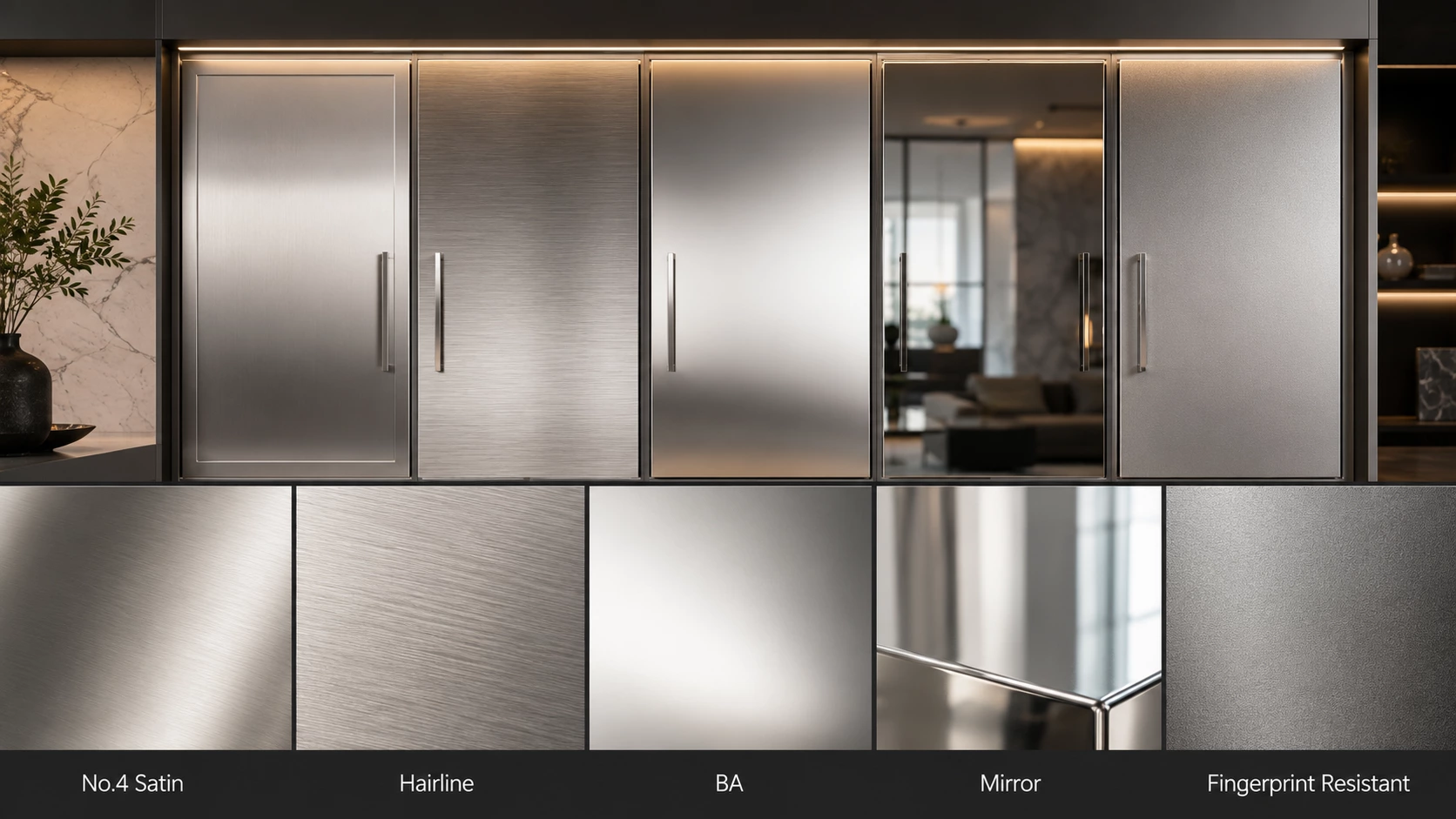
Surface finish controls much of the cabinet’s appearance, scratch visibility, fingerprint behavior and cleaning experience.
| Finish | Visual Character | Best Cabinet Use | Specification Point |
|---|---|---|---|
| 2B | Smooth, functional mill finish | Cabinet interiors, concealed structures and commercial storage | Confirm visual acceptance because different mills may have subtle appearance differences |
| No.4 satin | Uniform brushed appearance | Doors, drawers, islands and visible kitchen surfaces | Define grain direction and sample quality |
| Hairline | Fine, continuous linear texture | Luxury fronts, tall cabinets and architectural panels | All adjacent panels should follow the approved directional pattern |
| BA | Bright annealed surface | Decorative accents and selected appliance-style fronts | Reflectivity can reveal panel distortion and fingerprints |
| Mirror | Highly reflective | Display panels, luxury accents and feature cabinets | Requires strong flatness control and careful installation |
| Patterned or embossed | Textured, three-dimensional surface | Doors, wall panels and areas where minor scratches should be less visible | Confirm pattern scale, direction and bending suitability |
| PVD color | Gold, bronze, black, copper or other decorative color | Premium cabinet fronts, handles and feature panels | Approve a physical sample and define coating consistency |
| Fingerprint resistant | Protected surface designed to reduce visible marks | Handleless doors, drawers and frequently touched panels | Confirm cleaning compatibility and coating durability |
A finish name alone is not enough for a premium project. Buyers should approve a real sample showing the base grade, brushing pattern, color, gloss level and protective film.
For visual planning ideas, see ALLURE’s stainless steel kitchen design guide .
5. Full Stainless Steel vs Hybrid Cabinet Construction
Full Stainless Steel Cabinet
The cabinet body, doors, drawers, shelves and structural elements are primarily stainless steel. This construction is useful in commercial kitchens, wet kitchens, outdoor kitchens and high-cleaning environments.
Stainless Steel Body With Decorative Doors
The moisture-resistant cabinet body is stainless steel, while the visible fronts use wood veneer, lacquer, PET, glass or another decorative material. This can combine practical wet-zone performance with a warmer residential appearance.
Stainless Steel Door Skin Over a Core
A thin stainless steel face is bonded or mechanically fixed to a reinforced core. This construction can reduce weight and improve flatness, but adhesive selection, edge sealing and thermal movement must be controlled.
Targeted Stainless Steel Wet Zones
Stainless steel is used only around the sink, dishwasher, waste cabinet, preparation island or outdoor cooking zone. The remaining cabinets use plywood, MDF or other approved materials.
ALLURE supports component-based cabinet material planning through its custom kitchen cabinet collection , allowing the structure, door finish, storage hardware and countertops to be selected as one coordinated system.
6. Stainless Steel Thickness and Panel Engineering
There is no single universal stainless steel thickness for all kitchen cabinets.
The appropriate thickness depends on:
- Panel height and width
- Door construction
- Folded edge depth
- Internal reinforcement
- Shelf loading
- Hardware position
- Welding and bending method
- Surface reflectivity
- Required impact resistance
- Transport and installation conditions
A thin sheet can perform effectively when it is folded, hemmed or bonded to a stable core. A thicker sheet can still look uneven if it is poorly welded or lacks suitable reinforcement.
7. Fabrication Quality Requirements
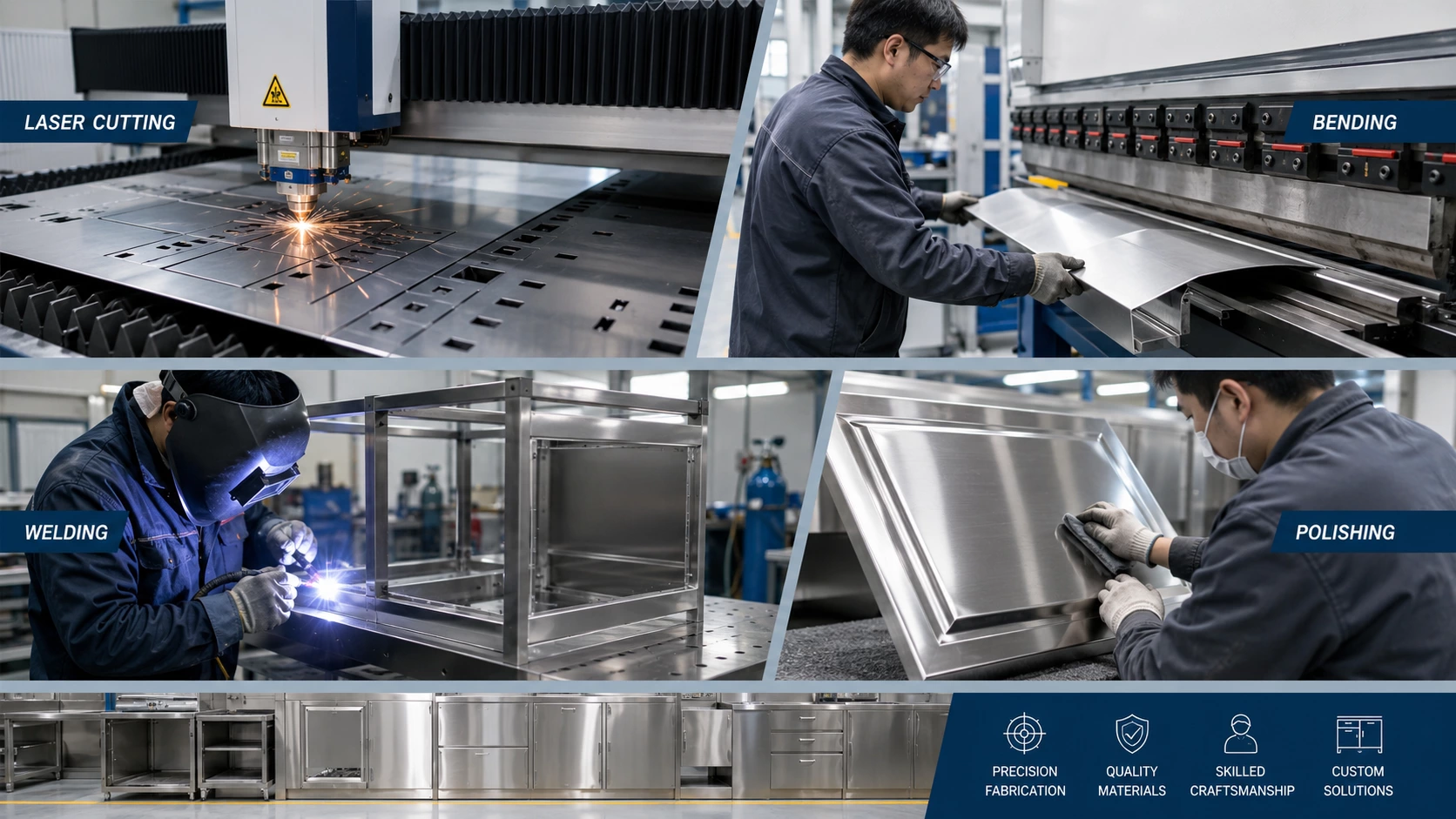
Cutting, bending, welding, reinforcement and surface protection determine whether a stainless steel cabinet looks precise after installation.
Grain Direction
Brushed and hairline surfaces have a directional appearance. Cabinet drawings should show the required grain direction for every visible panel.
Cutting and Protective Film
Laser cutting, shearing, punching and waterjet cutting can be used according to edge quality, thickness and production volume. The visible surface should remain protected during fabrication and handling.
Bending and Edge Safety
Folded and hemmed edges improve stiffness and reduce sharp exposed edges. Bend radius, springback and finish direction should be included in the forming plan.
Welding and Distortion Control
Excessive heat can distort doors and create visible surface waves. Weld sequence, fixture design, heat input and finishing must be controlled.
Surface Restoration
Grinding and polishing after welding must reproduce the approved directional finish. An irregular repair can remain visible under kitchen lighting even when the joint is structurally acceptable.
For projects requiring cut, bent or fabricated stainless steel components, review JUDE’s stainless steel sheet-metal capabilities .
8. Indoor, Outdoor and Coastal Cabinet Selection
| Environment | Recommended Starting Point | Additional Requirements |
|---|---|---|
| Dry indoor kitchen | 304; 430 or 201 may be evaluated for selected noncritical parts | Control fingerprints, cleaning products and finish consistency |
| Sink and dishwasher zone | 304 or 316L according to exposure | Drainage, sealed joints, accessible plumbing and compatible cleaners |
| Inland covered outdoor kitchen | 304 or 316L after project review | Rain protection, ventilation, drainage and regular cleaning |
| Coastal outdoor kitchen | 316L is normally the safer starting choice | Remove salt deposits and minimize sheltered crevices |
| Poolside cabinet | 316L or project-specific material | Consider chlorinated water, cleaning chemicals and splash exposure |
| Commercial kitchen | 304 or 304L; 316L for aggressive conditions | Hygienic joints, frequent cleaning and high-cycle hardware |
Even 316L can develop staining or localized corrosion when salt deposits remain on the surface or when water is trapped in uncleanable joints.
9. Hardware and Mixed-Material Compatibility
Stainless steel cabinet performance also depends on hinges, drawer slides, fasteners, adhesives, handles and countertop supports.
Confirm the following:
- Hinge capacity for the final door weight
- Corrosion resistance of fasteners and drawer slides
- Compatibility between different metals
- Adhesive compatibility with the stainless steel surface and core material
- Sealing around sinks, countertops and utility openings
- Access for replacing hardware
- Drainage beneath appliances and plumbing
- Ventilation around ovens, refrigerators and outdoor cooking equipment
A stainless steel door mounted with unsuitable hardware can fail before the metal surface itself shows any significant deterioration.
10. Sheet, Coil or Fabricated Components?
Cabinet manufacturers can purchase stainless steel in different supply forms.
| Supply Form | Best Use | Buyer Responsibility |
|---|---|---|
| Stainless steel sheet | Custom doors, cabinet boxes, shelves and low-volume fabrication | Cutting, nesting, bending and finish protection |
| Stainless steel coil | Repeat production, roll forming and high-volume cabinet components | Coil processing, leveling, blanking and yield management |
| Cut-to-size blanks | Cabinet manufacturers without full coil-processing equipment | Bending, welding and final assembly |
| Finished sheet-metal components | Projects requiring outsourced cutting, forming or welding | Final assembly, cabinet integration and installation |
| Decorative finished sheet | Visible doors, wall panels and premium accents | Finish matching, protection and careful handling |
JUDE supplies stainless steel sheet and stainless steel coil in multiple grades and surface conditions for cabinet, appliance and architectural fabrication.
11. Material Inspection and Documentation
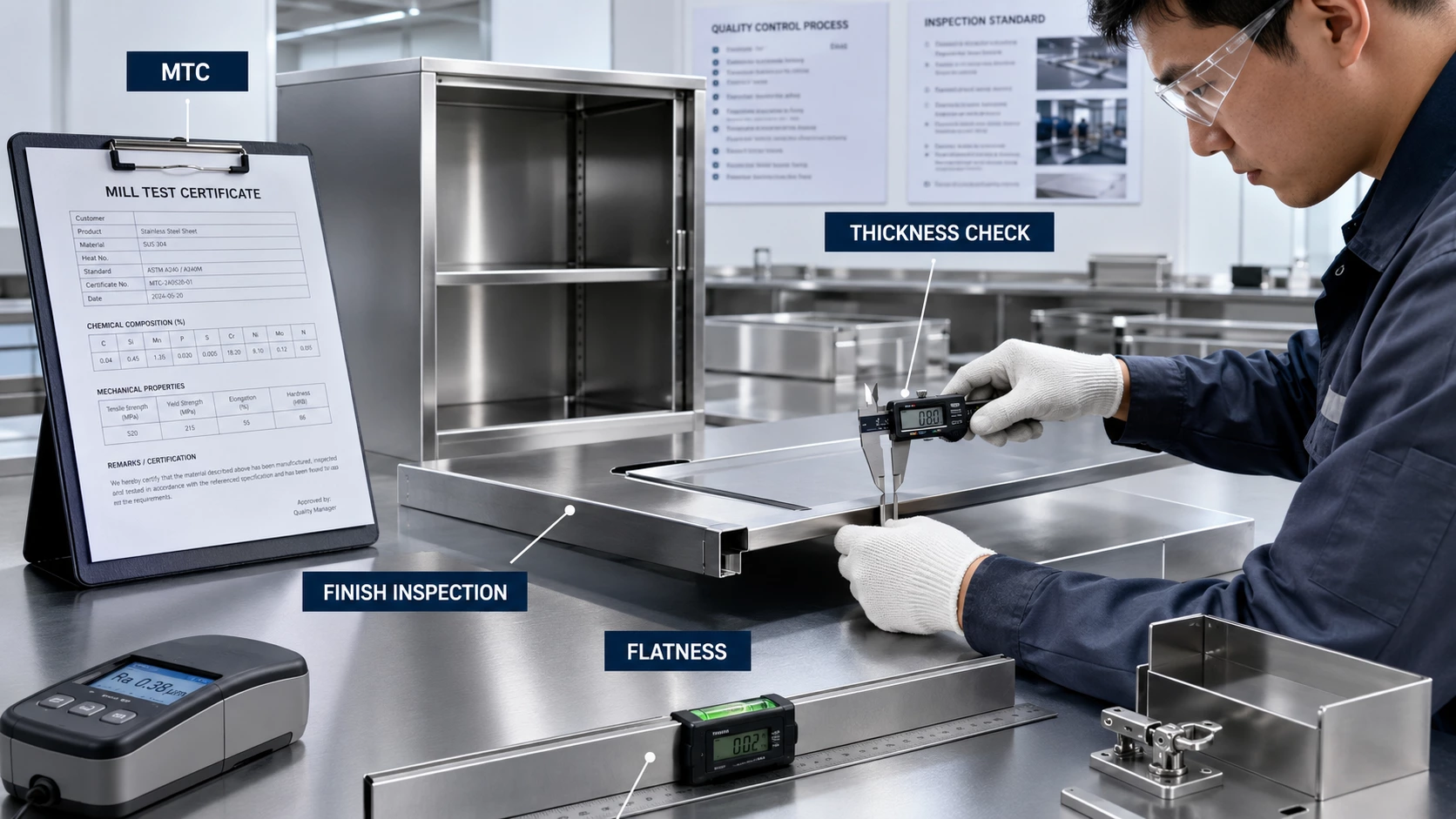
Grade, thickness, flatness, finish direction and protective film should be checked before cabinet fabrication begins.
A professional incoming-material inspection may include:
- Grade and product-standard verification
- Mill test certificate review
- Heat-number or batch traceability
- Thickness measurement
- Width and length inspection
- Flatness evaluation
- Surface-finish comparison with the approved sample
- Grain-direction confirmation
- Scratch, dent and color inspection
- Protective-film condition
- Packaging and edge-protection review
An EN 10204 Type 3.1 inspection certificate can be requested when required by the project, but the certificate must remain traceable to the material delivered.
JUDE publishes selected stainless steel inspection documents for buyers reviewing material quality and traceability.
12. Price and Lifecycle Value
Stainless steel cabinet cost should not be compared using sheet price alone.
Total cabinet cost can include:
- Base alloy and grade
- Sheet thickness
- Decorative finish
- Protective coating or fingerprint-resistant treatment
- Cutting yield
- Bending and reinforcement
- Welding and surface restoration
- Hardware
- Packaging
- Transport
- Installation
- Cleaning and maintenance
- Expected replacement cycle
A lower-cost grade may not provide better value if it requires more maintenance or develops visible corrosion in the intended environment.
Conversely, specifying 316L for every dry indoor cabinet may add cost without providing a meaningful performance advantage.
13. Stainless Steel Cabinet Material RFQ Checklist
Cabinet Application
Identify indoor kitchen, sink zone, outdoor kitchen, coastal project, commercial kitchen or decorative panel use.
Stainless Steel Grade
State 304, 304L, 316L, 430, 201 or another approved grade.
Material Standard
Specify the applicable flat-product standard, such as ASTM A240 with relevant general requirements or EN 10088-2, as agreed.
Product Form
Define sheet, coil, cut blanks or finished sheet-metal components.
Dimensions and Tolerances
Provide thickness, width, length, panel size and any special flatness or tolerance requirement.
Surface Finish
Specify 2B, No.4, hairline, BA, mirror, patterned, PVD or fingerprint-resistant finish.
Grain Direction
Show the required directional finish on drawings for every visible cabinet panel.
Protective Film
Define film type, adhesion, printed or unprinted condition and removal timing.
Fabrication Scope
List cutting, punching, bending, welding, polishing, assembly and edge treatment.
Inspection Documents
Request the MTC, heat or batch traceability, dimensional report and finish inspection where required.
Sample Approval
Approve a physical finish sample before mass production, especially for adjacent visible panels.
Quantity and Delivery
Provide the required weight or number of components, destination, packing requirements and required delivery date.
14. Connecting Cabinet Design With Stainless Steel Supply
Stainless steel cabinet projects require coordination between the cabinet designer, material supplier, fabricator, hardware supplier and installation team.
ALLURE can support the cabinet side of the project, including layout planning, cabinet styles, internal storage, material combinations, hardware, drawings, production coordination and project delivery.
Review ALLURE’s global custom cabinet projects to see how kitchen, vanity, wardrobe and whole-house systems can be coordinated within a complete interior project.