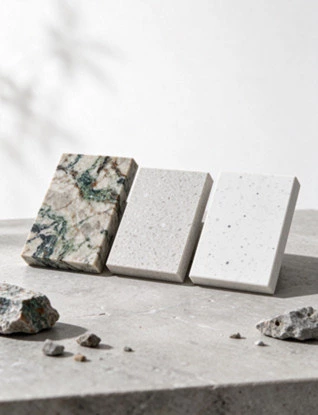
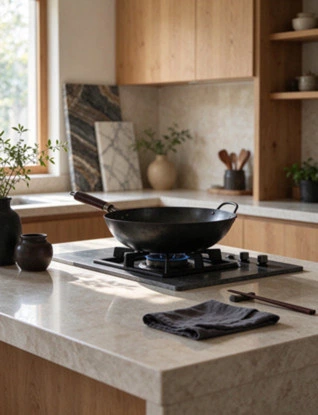
Start with the island drawing, not a material ranking. Natural stone, engineered quartz, and sintered stone can be compared through four recorded dimensions: slab size, thickness, surface finish, and price tier. Those details tell you which catalogue entries deserve a closer layout and quotation review.
This guide compares countertop slab sizes and commercial specifications across 416 entries: 101 natural stone, 131 engineered quartz, and 184 sintered stone. The source is ALLURE’s material-catalogue export reviewed on November 26, 2026. Counts refer to records, including versions and thin decorative products—not 416 independently verified countertop designs or items confirmed in stock today.
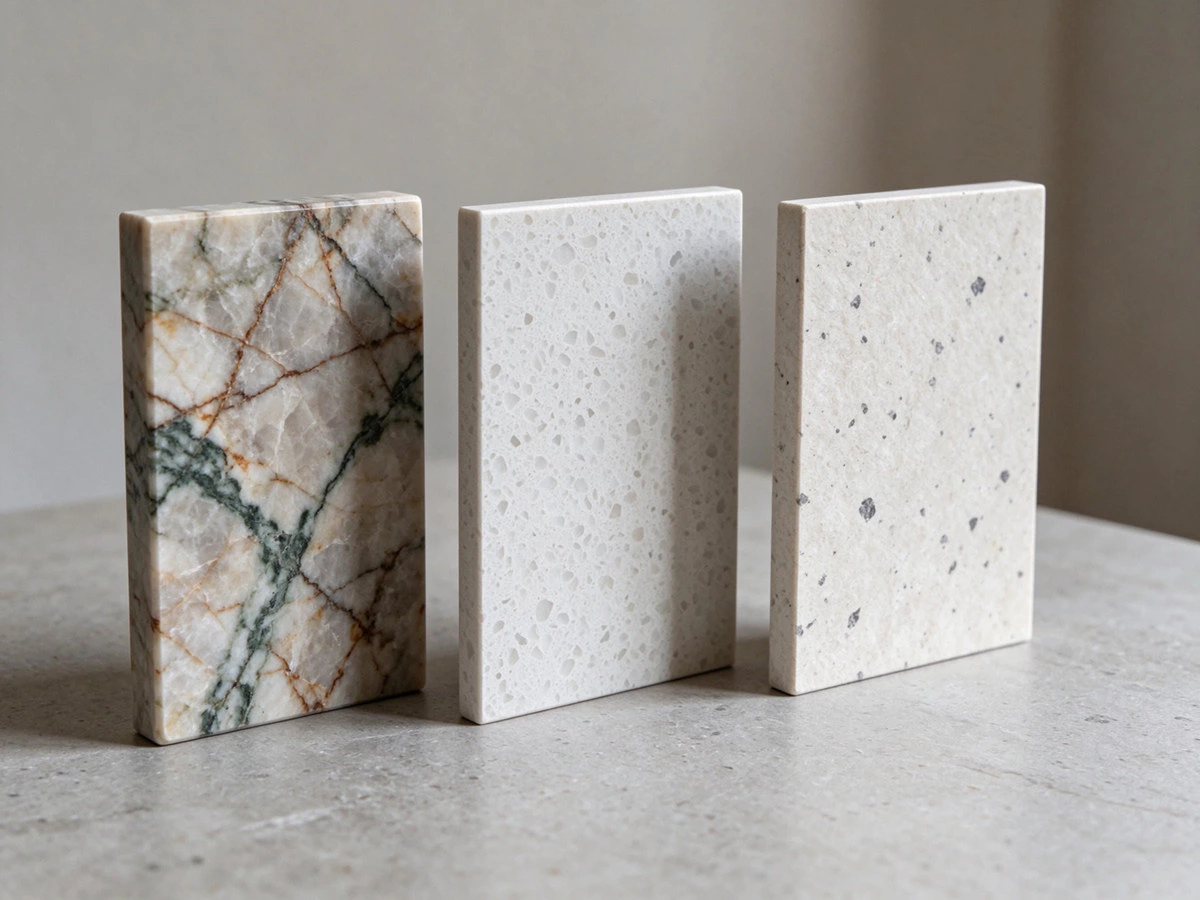
Compare Four Recorded Dimensions Before Choosing
First establish the required application, then compare the commercial choices. This article addresses specifications and recorded prices; it does not rank product performance or determine market eligibility. For the upstream application question, see the record-based marble and quartzite selection guide for a wok kitchen.
| Recorded dimension | Natural stone | Engineered quartz | Sintered stone |
|---|---|---|---|
| Entries | 101 | 131 | 184 |
| Main thickness group | 18 mm: 97 entries | 20 mm: 117 entries | 12 mm: 164 entries |
| Largest-area slab envelope in the export | 3100×2100 mm | 3200×1600 mm | 3240×1620 mm |
| Surface field | No dedicated field | 7 distinct exported label combinations | 57 distinct exported label combinations |
| Price-grade system | CNA特惠; CN1–CN9; CNX; CNSS | CQA; CQ1–CQ9; CQX; CQS | CS1–CS6 |
Two questions should lead the review: does a particular sheet envelope suit the island pieces, and what does the intended budget buy in the relevant product group? The answer may differ within one material family. Neither the family name nor its lowest displayed rate identifies a complete finished countertop specification.
For broader material-planning context, use the existing kitchen countertop materials guide. Here, the narrower job is to translate the catalogue into an identifiable selection and a comparable quote.
Countertop Slab Sizes and Island Seam Planning
Compare both sides and the area
The table shows selected large-format entries in the reviewed export, not industry-wide size limits. Millimeters are the source dimensions; inches and areas are calculated conversions. “Largest” here refers to area, not necessarily the longest individual side.
| Family / product / grade | Recorded in mm; approximate inches | Area: m² / approximate ft² | Thickness |
|---|---|---|---|
| Natural stone: 潘多拉 CN9; 白底潘多拉 CNSS; 亚马逊蓝 CN6 | 3100×2100; 122.0×82.7 in | 6.51 / 70.1 | 18 mm |
| Natural stone: 安第斯雪景 CNX | 3200×2000; 126.0×78.7 in | 6.40 / 68.9 | 18 mm |
| Natural stone: 毕加索黑 CN2 | 3000×2100; 118.1×82.7 in | 6.30 / 67.8 | 18 mm |
| Engineered quartz: 雨花石 CQ2; 阿尔卑斯白 CQ7; 超白 CQ1 | 3200×1600; 126.0×63.0 in | 5.12 / 55.1 | 20 mm |
| Sintered stone: 陨石白 and 麻石白, CS6, 拉米娜 field category | 3240×1620; 127.6×63.8 in | 5.25 / 56.5 | 12 mm |
| Sintered stone: 卡其棕 CS4, 积嘉岩板 field category | 1200×2700; 47.2×106.3 in | 3.24 / 34.9 | 12 mm |
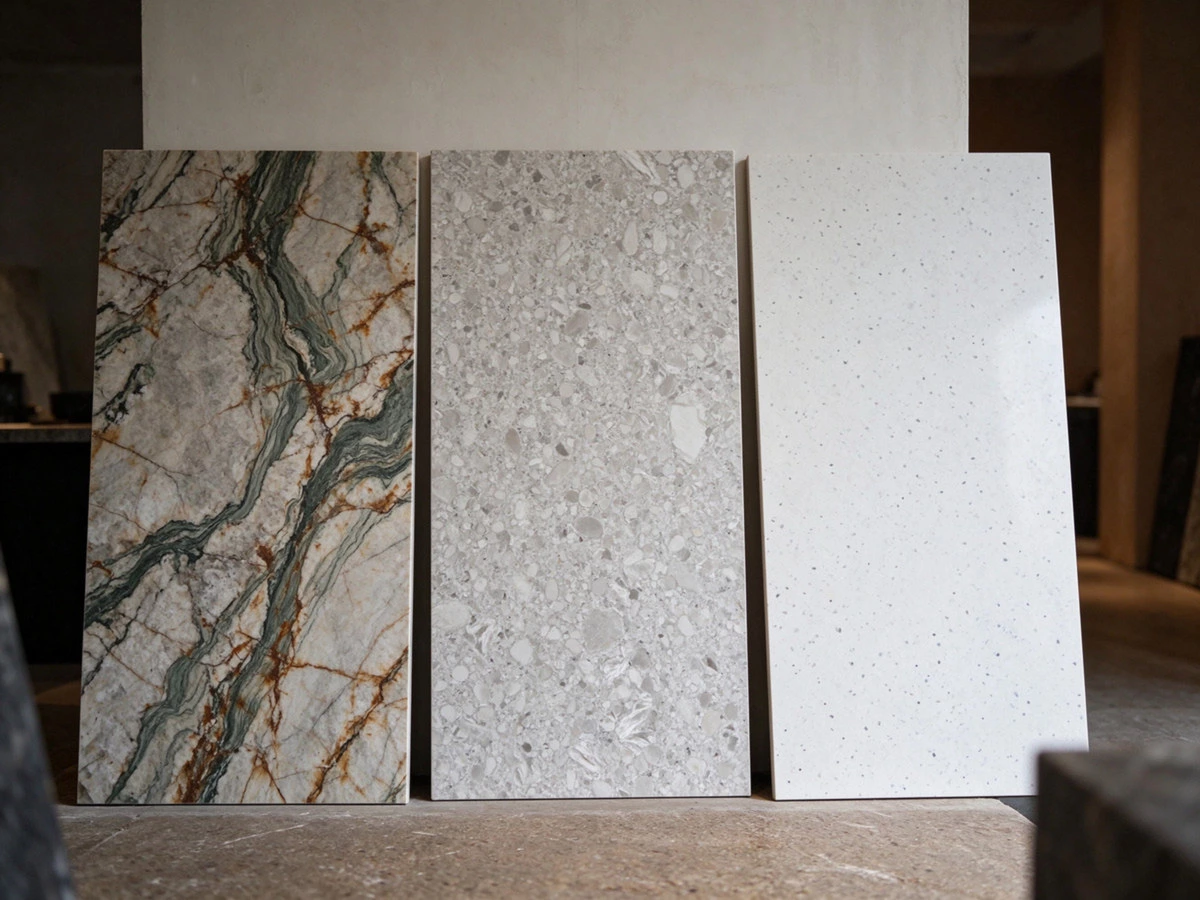
The natural-stone records above include a larger area than the other two families’ listed area leaders. The sintered-stone entry has the longer individual side. Those are different observations; neither establishes that one family is the right choice for every island.
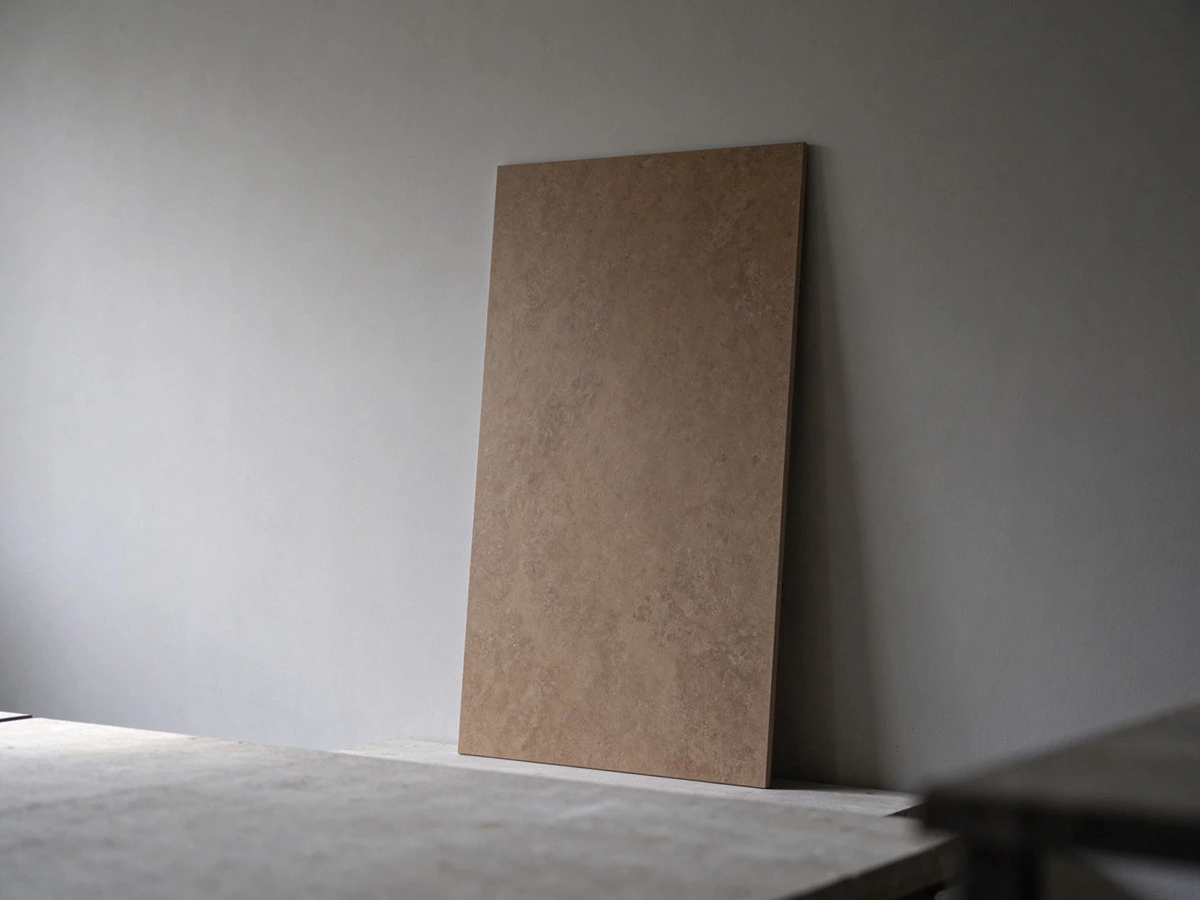
Use the dimensions as a first layout filter
Consider an illustrative rectangular island top measuring 3000×1500 mm, approximately 118.1×59.1 inches. Its outline falls within several nominal envelopes above. That is a reason to request a slab layout, not a promise of one-piece fabrication.
The fabricator still needs the actual usable slab, trimming, pattern direction, openings, edges, and the other pieces cut from it. A waterfall panel or backsplash may compete for the same sheet. Delivery and installation access also need review. A rectangle that fits the nominal outline may not produce the requested complete arrangement.
If a finished piece cannot fit inside the usable slab in any permitted orientation, the proposed one-piece layout cannot proceed as drawn. Review seams, another sheet, or a changed piece layout. Do not assume rotating a veined pattern is acceptable without checking its direction.
Distinguish fewer seams from an approved layout
Ask for the proposed seams to appear on a drawing with the actual slab allocation. Discuss which joints are visible and how the pieces relate. For example, a proposal for an island top alone is a different layout exercise from one that must also supply two matching waterfall panels. Give each piece a reference on the drawing. If the fabricator proposes a joint, ask which piece or pattern constraint led to that position, rather than judging the plan from slab length alone. Countertop slab sizes are useful evidence at this stage, but they are only one part of the fabrication decision.
Match the Thickness to the Intended Product
| Family | Thickness and count | How to read it |
|---|---|---|
| Natural stone | 18 mm: 97; 20 mm: 3; 15 mm: 1 | 18 mm is the dominant recorded group. |
| Engineered quartz | 20 mm: 117; 15 mm: 11; 6 mm: 3 | The three 6 mm entries are translucent decorative variants, not the main worktop group. |
| Sintered stone | 12 mm: 164; 6 mm: 12; 3.5 mm: 8 | The twenty thinner entries belong to facing-series groups. |
Do not use the catalogue minimum as the countertop specification
All twelve 6 mm sintered-stone records belong to the 大漆薄板 series. The eight 3.5 mm records comprise six from that series and two from 自然薄板. In this comparison, they are facing products, not substitutes for the 12 mm worktop group. A separate proposed application would need its own supplier documentation.
This distinction matters when reading the price ladder: all twenty CS1 entries are these thin products. Their RMB2,250 rate must not be advertised as the starting rate for a 12 mm kitchen countertop.
The three 6 mm engineered-quartz entries are 欧若拉 translucent versions of 蒂芙尼蓝, 雪山绿 and 雪域白, all CQ9. They should not be confused with another version sharing a similar name. Specify the full product suffix and thickness.
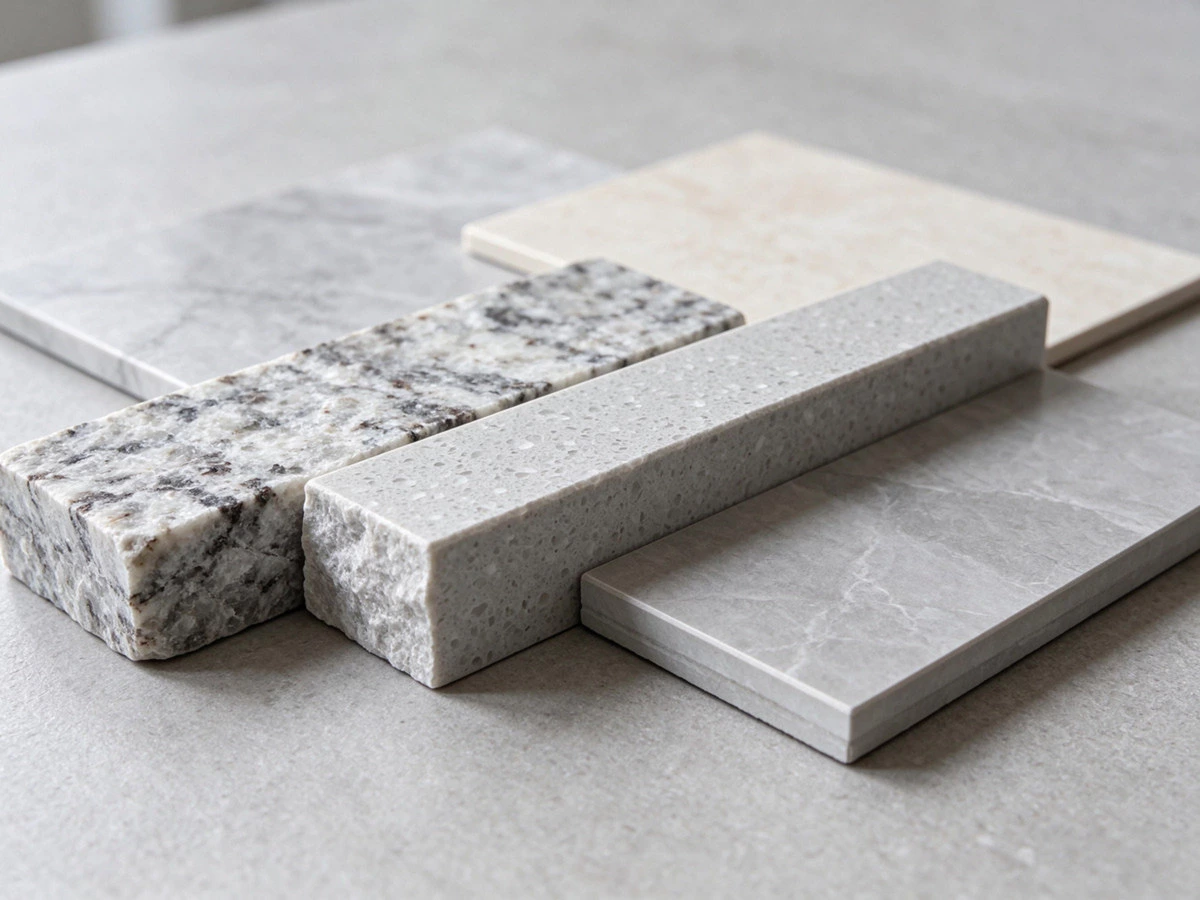
Separate slab thickness from the finished visual edge
A photographed thick front edge does not measure the underlying slab. Ask the proposal to distinguish the sheet thickness, finished edge construction, and surrounding cabinet relationship. An edge detail can change the appearance without changing the source product’s nominal thickness.
Thicknesses remain specified in millimeters. Approximate inch equivalents are 18 mm=0.709 in, 20 mm=0.787 in, 15 mm=0.591 in, 12 mm=0.472 in, 6 mm=0.236 in, and 3.5 mm=0.138 in. Additional precision is retained here because rounding thin sheets to one decimal place would obscure their differences.
Compare the Exact Surface Finish, Not Just the Color
Read the exported labels carefully
The engineered-quartz surface field has seven distinct exported values or combinations; 94 records are labeled 亮光. Other entries use labels such as 抛光, 皮纹, or a combination of finishes. These labels have not been normalized into a single manufacturing vocabulary.
The sintered-stone field has 57 distinct exported values or combinations. That does not prove 57 independent technical processes: one value may combine texture and another treatment. Retain the supplier’s exact wording until the finish is matched to a sample.
Natural stone has no dedicated surface-type field in this export. That is missing structured information—not proof that a slab is untreated or that every natural-stone product has one standard finish.
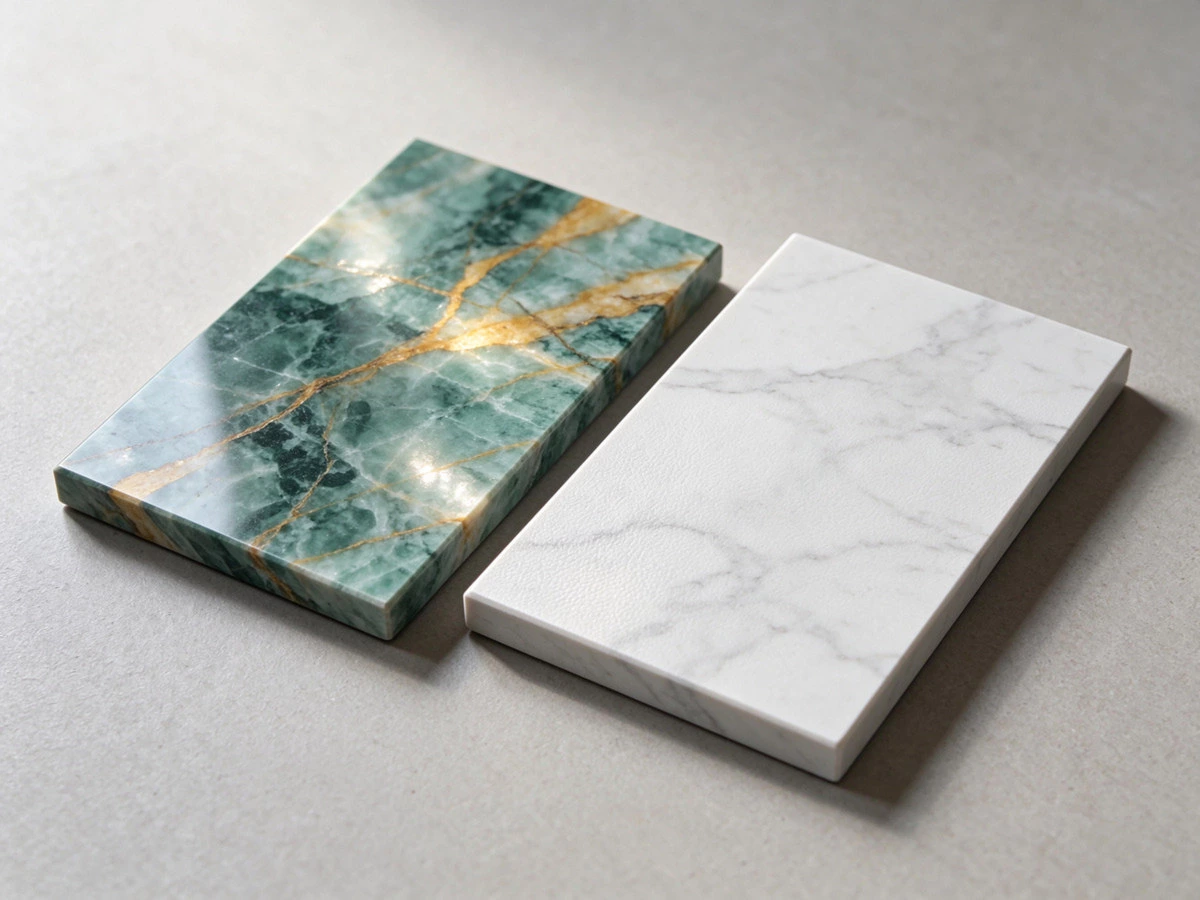
Compare the sample under the room light
Ask for an identified physical sample or close-up of the quoted finish. View it beside the selected cabinet front and under the intended room light. Check the appearance you want, then record the exact product and surface wording. Keep that sample reference with the cabinet finish selection. If two samples look different, first check their labels and lighting before assuming the catalogue name is wrong. When choosing remotely, request a full-slab image and a surface close-up of the same identified version; unrelated photographs do not form a reliable sample set.
Terms including 干粒, 精雕, 肤感, 火烧, 复刻釉 and 对纹通体 need supplier-confirmed English descriptions. A working translation should not add a composition or performance promise. A photograph may show sheen or texture, but it cannot capture every detail of the process.
In the records, sintered stone 帝皇玉 CS2 has 干粒抛亮面, while engineered quartz 顶极鱼肚白 CQX has 皮纹. Keep those labels with their own families and products. Matching a color without matching the surface can produce a different visual result.
Specify the Actual Slab or the Complete Product Version
Natural stone: identify the selected piece
The natural-stone table is organized through product names, rock-series information, and origin descriptions, without a brand field. Full-slab photos and identifiers help connect the selected appearance to the cutting proposal. A small sample is not a substitute for reviewing the particular slab.
For repeat pieces, show how the requested pattern relates across the countertop, wall, and any waterfall panels. The catalogue gives a starting specification; the actual piece still needs identification before fabrication.
Manufactured surfaces: record the complete version
The engineered-quartz export has 11 nonblank brand-field categories and three records with that field empty. Two categories are functional labels—工程专用 and 调色—so the count should not be presented as 11 independently verified manufacturers. The sintered-stone export has seven recorded brand-field categories.
A supplier, product code, and finish make an order more identifiable, but do not by themselves guarantee identical batches. Ask how the supplied version will be confirmed against the agreed sample and layout.
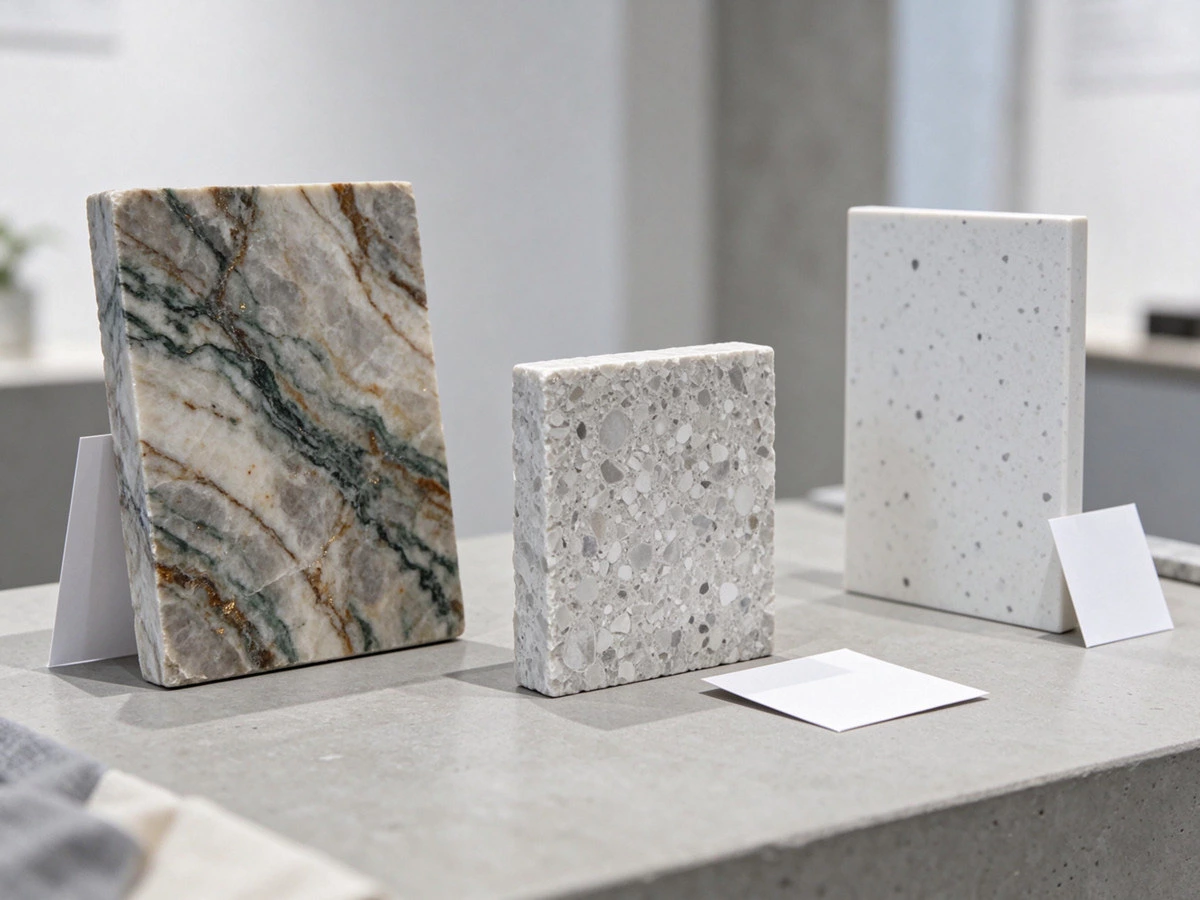
Keep material names distinct. Natural quartzite is not engineered quartz. Keep the material family beside the product name in your shortlist, sample labels, and quotation so that similar wording does not merge different specifications.
The engineered-quartz substrate field also includes 33 entries labeled “0硅石,” alongside 94 labeled 石英石 and four labeled 透光石英石. Those are catalogue classifications, not composition tests or market-eligibility evidence. This article makes no such determination.
How to Read the Three Countertop Price Ladders
Price basis for every table below: tax-exclusive RMB per linear meter in the November 26, 2026 catalogue snapshot. These are dated internal catalogue references, not current availability, an installed-price offer, or a foreign-currency conversion. Actual quotation scope and validity must be confirmed.
Natural-stone price tiers
| Grade | Entries | Listed rate(s) | Examples / scope |
|---|---|---|---|
| CNA特惠 | 2 | 1,550 | 黑白根 variants; natural stone |
| CN1 | 21 | 2,300 | 爵士白; 黑金花; natural stone |
| CN2 | 11 | 2,800 | 毕加索黑; 紫罗红; natural stone |
| CN3 | 9 | 3,000 | 凡尔赛黑; 白洞石; natural stone |
| CN4 | 6 | 3,200 | 熊猫白; 君子兰; natural stone |
| CN5 | 9 | 3,700 | 连卡佛洞石; 樱花粉; natural stone |
| CN6 | 4 | 4,700 | 亚马逊蓝; Cristallo Blue Quartzite; natural stone |
| CN7 | 10 | 5,400 | 草原绿; 海纳百川; natural stone |
| CN8 | 5 | 6,100 | 黄金丝绸; 超白洞; natural stone |
| CN9 | 4 | 7,800 | 潘多拉; 泰姬陵; natural stone |
| CNX | 5 | 8,900 | 安第斯雪景; 紫山水; natural stone |
| CNSS | 15 | 10,000 / 10,700 / 12,500 / 14,200 / drawing-based quote | 莫奈花园; 七彩丹霞; 白底潘多拉; natural stone |
For example, CN3 contains nine records at RMB3,000 per linear meter. Most natural-stone grades map to one listed rate, but CNSS does not: it contains several rates and drawing-based quotations. Keep the exact product in the request rather than assigning the first CNSS rate to every entry.
Engineered-quartz price tiers
| Grade | Entries | Listed rate(s) | Examples / scope |
|---|---|---|---|
| CQA | 12 | 1,250 / 1,400 / 1,550 / 1,950 | Project/color-matching entries; engineered quartz |
| CQ1 | 8 | 2,100 | 超白; engineered quartz |
| CQ2 | 5 | 2,450 | 雨花石; 白底细纹; engineered quartz |
| CQ3 | 5 | 2,600 | Solid/fine-grain entries; engineered quartz |
| CQ4 | 3 | 2,800 | 鱼肚白; 幻影白; 新幻影白; engineered quartz |
| CQ5 | 14 | 3,200 | 天使流星; 瑶池秘境; engineered quartz |
| CQ6 | 16 | 3,300 | 阿莱奇冰川; 柏拉图紫纹; engineered quartz |
| CQ7 | 41 | 3,580 | 阿尔卑斯白; 风云飘飘; engineered quartz |
| CQ8 | 4 | 4,100 | Patterned entries; engineered quartz |
| CQ9 | 7 | 4,300 | 雪域白; 雪山绿; includes decorative variants |
| CQX | 8 | 4,400 | 顶极鱼肚白; 极地鱼肚灰; engineered quartz |
| CQS | 8 | 5,100 / 5,450 / 12,600 | 宝格丽(可透光) and other engineered-quartz entries |
CQ7 contains 41 of 131 records, making it the largest represented grade by entry count. This is selection breadth in the export, not a stock, sales, or lead-time measure. CQA and CQS contain several rates, so the grade alone is insufficient for those groups.
Sintered-stone price tiers
| Grade | Entries | Listed rate(s) | Examples / scope |
|---|---|---|---|
| CS1 | 20 | 2,250 | Thin facing-series entries; not the 12 mm worktop group |
| CS2 | 50 | 2,300 | 千山暮雪; 帝皇玉; 莫奈花园; sintered stone |
| CS3 | 60 | 2,650 | 雪域白; 莱姆石白; sintered stone |
| CS4 | 40 | 2,950 | 卡其棕 and other sintered-stone entries |
| CS5 | 2 | 3,500 | 沙罗蓝; 闪电黑; sintered stone |
| CS6 | 12 | 7,200 | 拉米娜 field category: 陨石白; 麻石白; sintered stone |
CS2 and CS3 together account for 110 of 184 records, approximately 59.8%. Their listed rates differ by RMB350 per linear meter. This does not mean a higher grade supplies more entries, or that the lower grade is less appropriate for the desired appearance.
CS6 combines the 拉米娜 field category with the 3240×1620 mm format in this export. The table shows its higher recorded rate; it does not isolate a brand premium or explain every cause of the price difference. CS1 must remain clearly identified as the thin facing group.
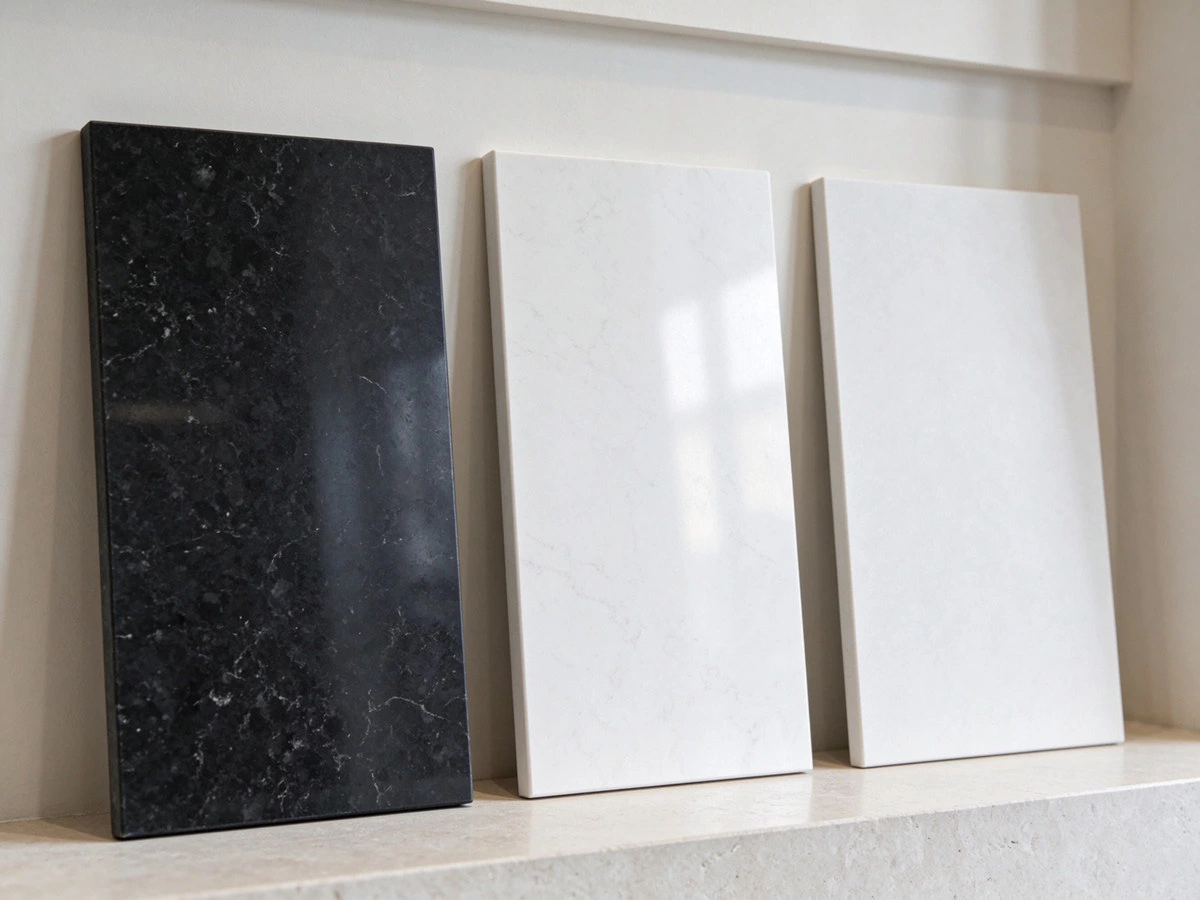
Compare a rate with its complete scope
A linear meter measures length, not area. Confirm the priced depth, product, finish, and processing scope before using the rate in a project total. The export has separate countertop and wall-stone price fields; a wall rate should not silently replace the countertop rate. A useful quotation schedule gives each fabricated piece its own description and ties it to a drawing revision. Ask whether the proposed rate covers the agreed edge and openings, or whether those are separate lines. Mark an unanswered inclusion as awaiting confirmation; leaving it blank should not imply that it is included without charge.
Also distinguish the number of catalogue entries from distinct designs. Two records may share a name but differ in thickness, substrate suffix, or finish. Record counts help navigate the offer; they do not automatically equal that many unique patterns.
What Similar Reference Budgets Buy in Each Family
The checkpoints below illustrate nearby choices, not identical prices or an exhaustive list of everything below each budget. All rates retain the same dated, tax-exclusive RMB-per-linear-meter basis.
| Reference band | Natural stone | Engineered quartz | Sintered stone |
|---|---|---|---|
| Around RMB2,300 | CN1: 2,300; 21 entries. Natural stone 爵士白 or 黑金花. | CQ2: 2,450; 5 entries. Engineered quartz 雨花石 or 白底细纹; 150 above the checkpoint. | CS2: 2,300; 50 entries. Sintered stone 千山暮雪 or 帝皇玉. |
| Around RMB2,800 | CN2: 2,800; 11 entries. Natural stone 毕加索黑 or 紫罗红. | CQ4: 2,800; 3 entries. Engineered quartz 鱼肚白, 幻影白 or 新幻影白. | CS3: 2,650; 60 entries. Sintered stone 雪域白 or 莱姆石白; 150 below the checkpoint. |
| Around RMB3,200 | CN4: 3,200; 6 entries. Natural stone 熊猫白 or 君子兰. | CQ5: 3,200; 14 entries, or CQ6: 3,300; 16 entries. | CS5: 3,500; 2 entries. Sintered stone 沙罗蓝 or 闪电黑; 300 above the checkpoint. |
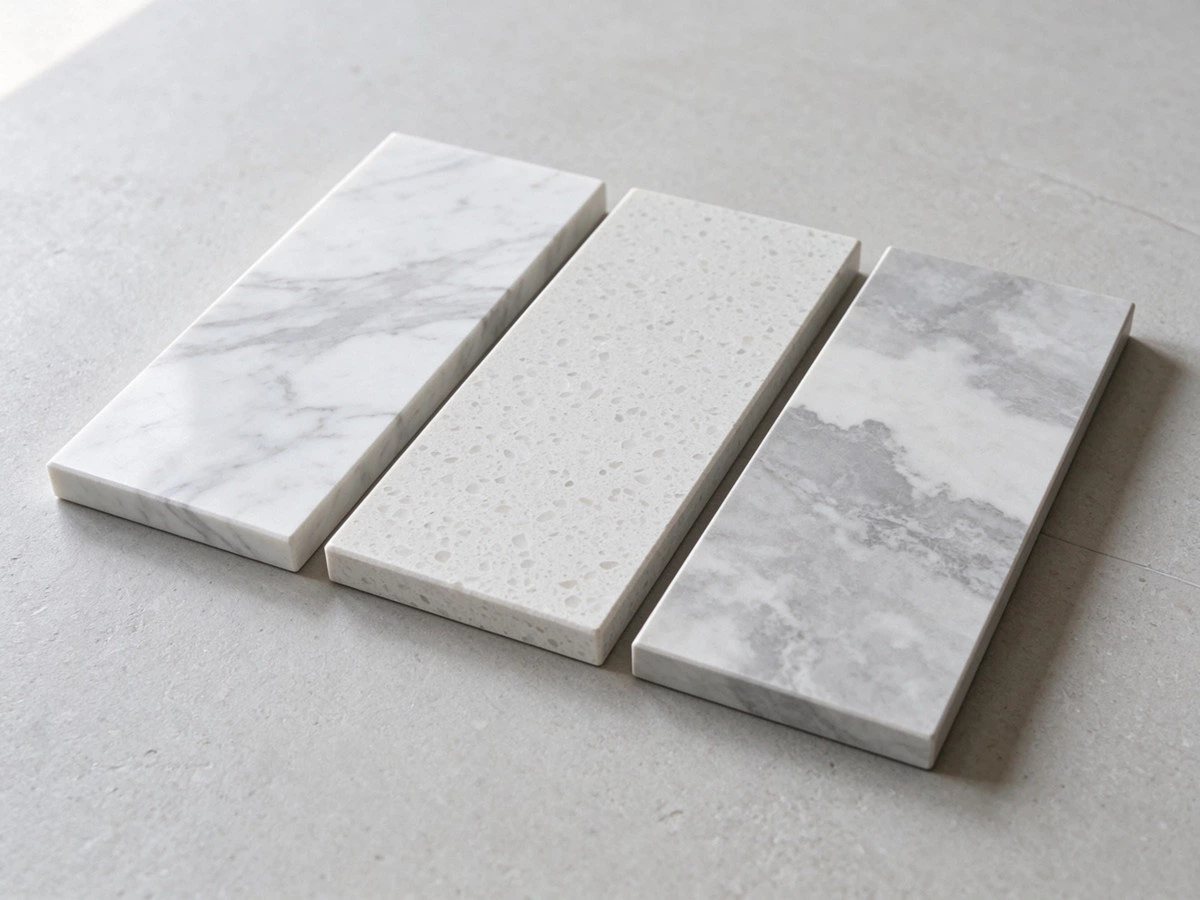
Set a firm ceiling or allow a comparison band
If RMB2,300 is a strict ceiling, the CQ2 example is above it. Engineered-quartz CQ1 at RMB2,100 is another group to review instead. Likewise, the CS5 example is not a within-budget choice for a strict RMB3,200 limit; sintered-stone CS4 at RMB2,950 is a lower-rate group with 40 entries.
These alternatives explain why a neat three-column comparison must not flatten real price differences. Ask which features matter before moving to another grade: the particular full-slab pattern, a finish, or a format that assists the layout.
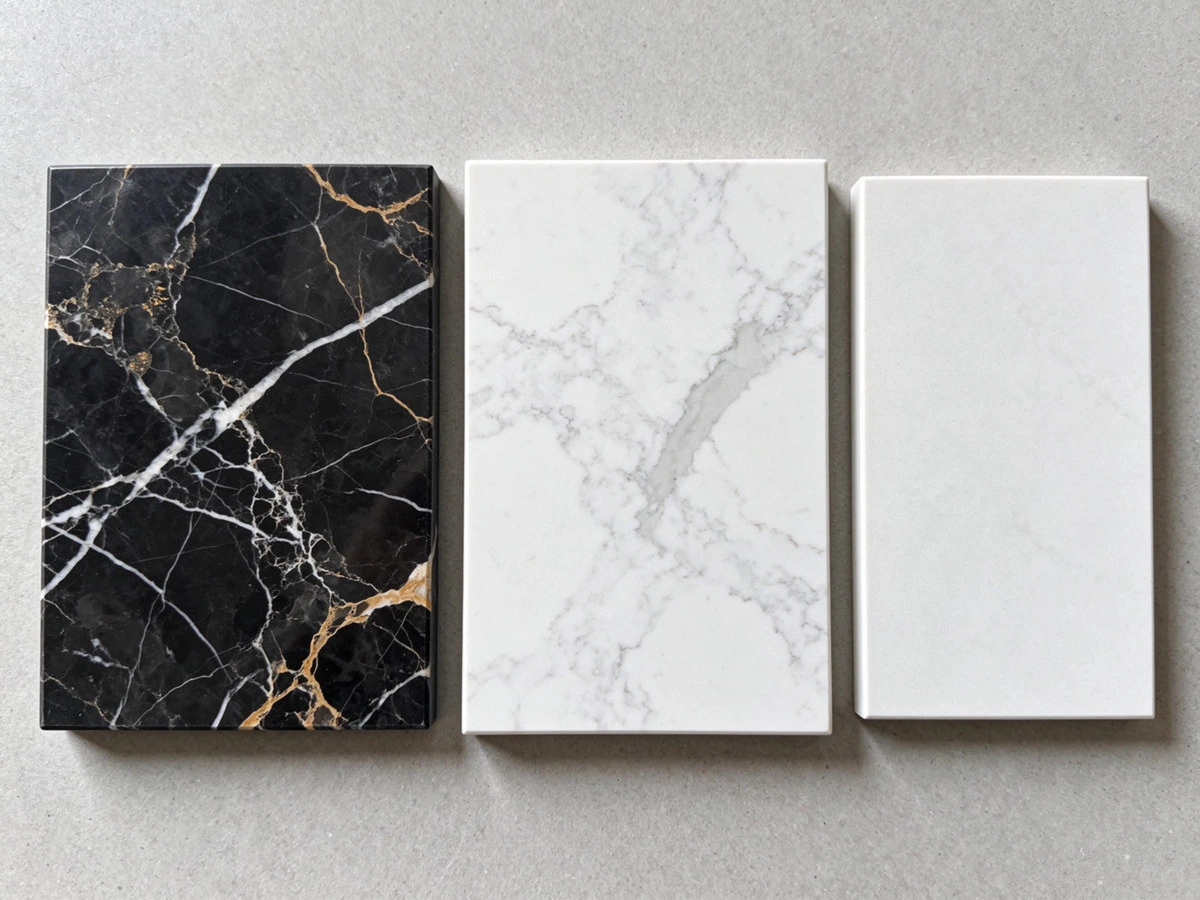
Choose the specification before calling something better value
Natural stone gives the project a particular slab to review. Manufactured surfaces offer identifiable products and versions to discuss. Neither route is a universal value winner. A listed lower rate may not describe the required thickness, finish, or complete set of fabricated pieces.
For the island, return to countertop slab sizes after shortlisting the budget. An appealing price and color remain provisional if the requested pieces cannot be laid out as intended. Compare the actual scope rather than the rate alone. Keep two shortlists if necessary: one that strictly respects the reference material-rate ceiling and another that shows the extra cost of a preferred appearance or format. The second list should show its difference openly. Once fabrication and delivery are quoted, revisit the whole-project allowance; a material-rate checkpoint is only one part of that decision.
Four Confirmations Before You Order
1. Confirm the actual slab and cutting layout
Show the island top, any waterfall panels, wall pieces, openings, and pattern direction on the proposal. Use the available slab’s usable dimensions, not only its catalogue envelope. Agree where seams are proposed and what changes if the piece layout is revised.
2. Confirm thickness and application, group
State both the source sheet thickness and finished edge detail. Keep sintered-stone facing-series entries and the 6 mm decorative engineered-quartz versions separate from the worktop shortlist in this comparison.
3. Confirm the complete product and surface version
The same Chinese name may identify different materials. Natural-stone 莫奈花园 CNSS is listed at RMB10,700, while sintered-stone 莫奈花园 CS2 is listed at RMB2,300. They are different records, not interchangeable offers for an identical product.
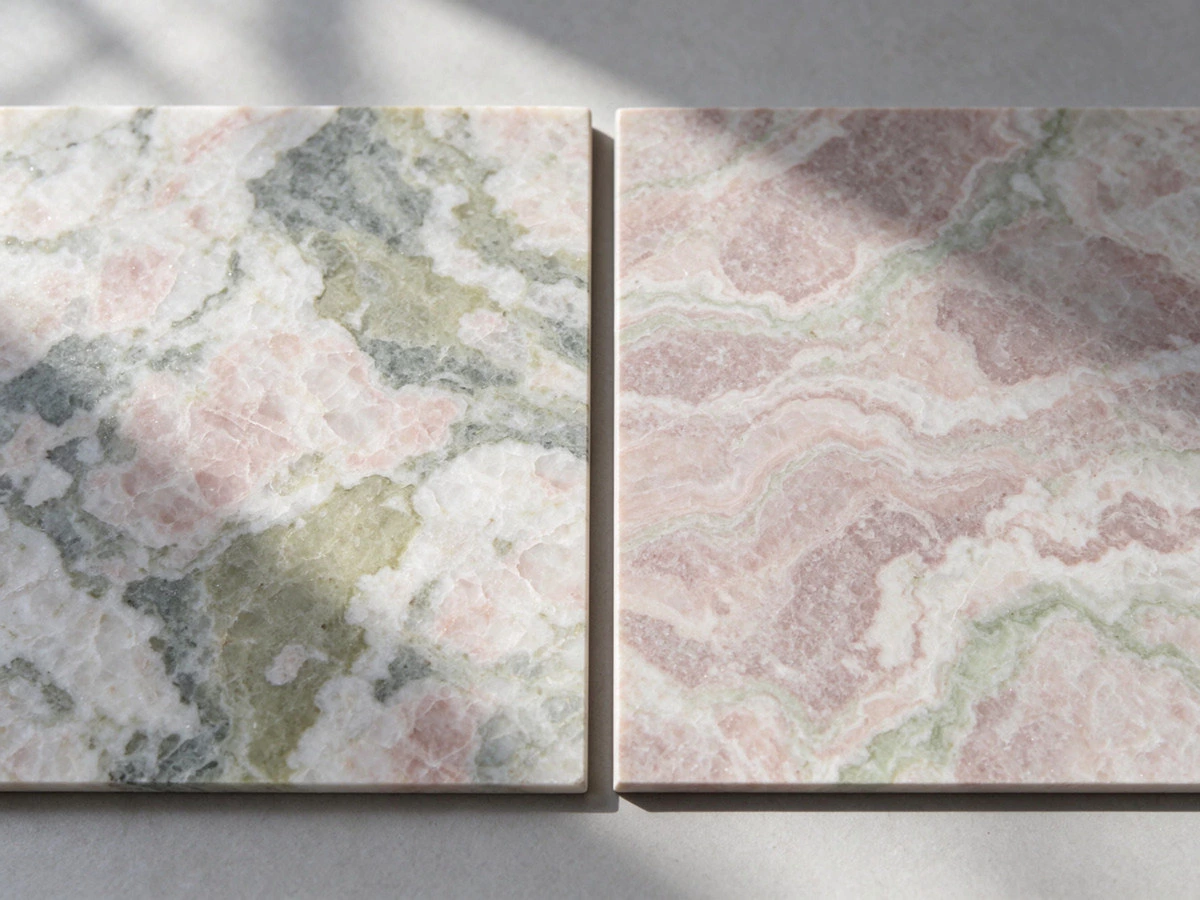
Version suffixes matter too. Engineered-quartz 白底细纹 and 白底细纹(0硅) are distinct entries, even where grade and rate coincide. A similar name in another family must also retain its category. Preserve the finish wording when a product has several surface versions. Before approving an order, compare the material schedule with the latest drawing and sample reference together. If the product, thickness, or finish changes during discussion, update all three records. This gives the project team a clear selection to price and review, instead of relying on an earlier message or an unlabeled inspiration image.
4. Confirm the pricing basis and responsibilities
Ask the quotation to identify the currency, tax treatment, priced depth, material, finish, and included work. Keep countertop and wall-stone components separate. Clarify delivery, fabrication, and installation responsibilities without assuming that a catalogue material rate includes them.
A complete comparison of countertop slab sizes, thickness, finish, and grade should end with a traceable schedule: the actual product, its version, the proposed pieces, and the quoted scope all refer to the same selection.
Send Your Island Drawing for a Layout and Quotation
Send ALLURE the kitchen or island drawing with overall dimensions, piece shapes, openings, and preferred material references. Mark unknown details and include the grade, thickness, and finish where already selected. Initial measurements start a discussion; they do not authorize fabrication.
Source: ALLURE catalogue exports reviewed November 26, 2026. Prices and counts are snapshot references, not a current stock statement or final project quotation. Metric dimensions govern; converted dimensions are approximate.