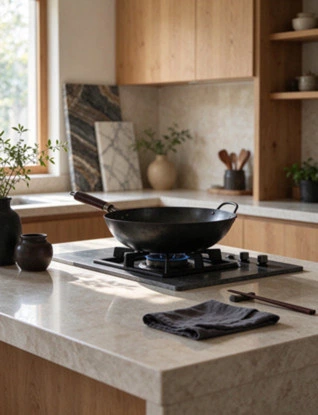
A pale countertop can look right beside a wok and still be the wrong stone for the job. Lemon juice, tomato, vinegar, and red wine expose the stone to acid before heat is even considered. Carbonate marble and quartzite are different rock types, and a marble-like pattern does not make their application limits interchangeable.
Our comparison of marble vs quartzite countertops uses ALLURE’s catalogue export covering 101 natural-stone entries, reviewed on November 26, 2026. Two records explicitly support a wok-countertop application; eight prohibit or discourage it. The other 91 do not provide a direct decision on wok use. These are catalogue application notes, not results from an independent laboratory test of 101 slabs.
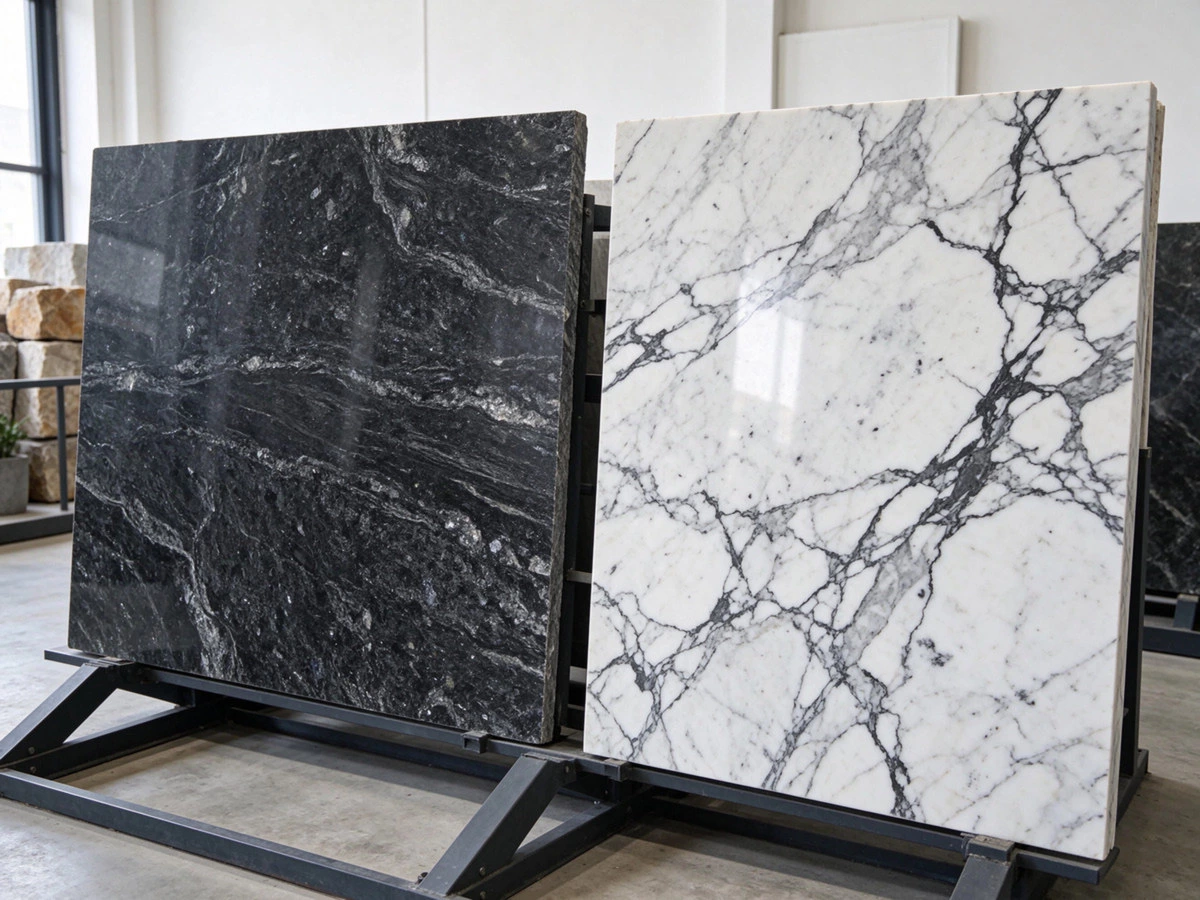
Can Marble Countertops Work in a Wok Kitchen?
Start with acid sensitivity, then the actual cooking zone
For an active wok-preparation surface, carbonate marble should not be the default selection when acid exposure and an unchanged finish are important. An etch mark is a surface alteration, rather than simply dirt to wipe away. A beautiful slab does not remove that trade-off.
The Natural Stone Institute’s care guidance distinguishes acid-sensitive calcareous stone from generally more acid-resistant siliceous stone. That explains the starting point; it does not certify an individual ALLURE product. Ingredient exposure, the actual slab, and its recorded restrictions still matter.
Use three catalogue statuses
| Status | Records | Selection meaning |
|---|---|---|
| Explicit support for a wok application | 2 | Shortlist the named record, then confirm the slab and fabrication. |
| Wok application prohibited or not recommended | 8 | Respect the individual restriction, including differences in wording. |
| No direct wok decision in the note | 91 | Seek product-specific confirmation; silence is not approval. |
“Wok kitchen” describes an intended working environment, not permission to place hot cookware directly on stone. The Natural Stone Institute recommends trivets or mats under hot items. This guide supplies no temperature limit or thermal-shock rating because the catalogue contains neither.
Also describe what actually happens on the island. A surface used only for serving is a different brief from one receiving acidic preparation ingredients or freshly removed cookware. Record that distinction rather than relying on “Chinese” or “western” kitchen labels alone.
Marble vs Quartzite Countertops: Why the Name Matters
Trade names and rock categories answer different questions
A trade name helps identify a pattern or commercial offering. A geological category describes the type of rock. Chinese sales descriptions may group different natural stones under broad decorative-stone terminology; an English marble or quartzite label should not be treated as interchangeable.
The catalogue’s series fields contain 70 Marble, 15 Quartzite, seven Granite, six Travertine and three Onyx records. These counts describe the source fields, not an independent geological verification. One internally conflicting record is excluded from recommendations later in this guide.
Engineered quartz is also different from natural quartzite. A similar word or white-veined appearance is not a substitute for checking the material family and the exact product entry.
Two entries called 蓝水晶 have opposite application notes.
蓝水晶 — Cristallo Blue Quartzite — CN6 is a quartzite entry whose note supports a wok-kitchen island. 蓝水晶 — Calcite Azul Extra Marble — CNSS is a calcite-marble entry whose note excludes a wok countertop. Always identify the international name and grade together.
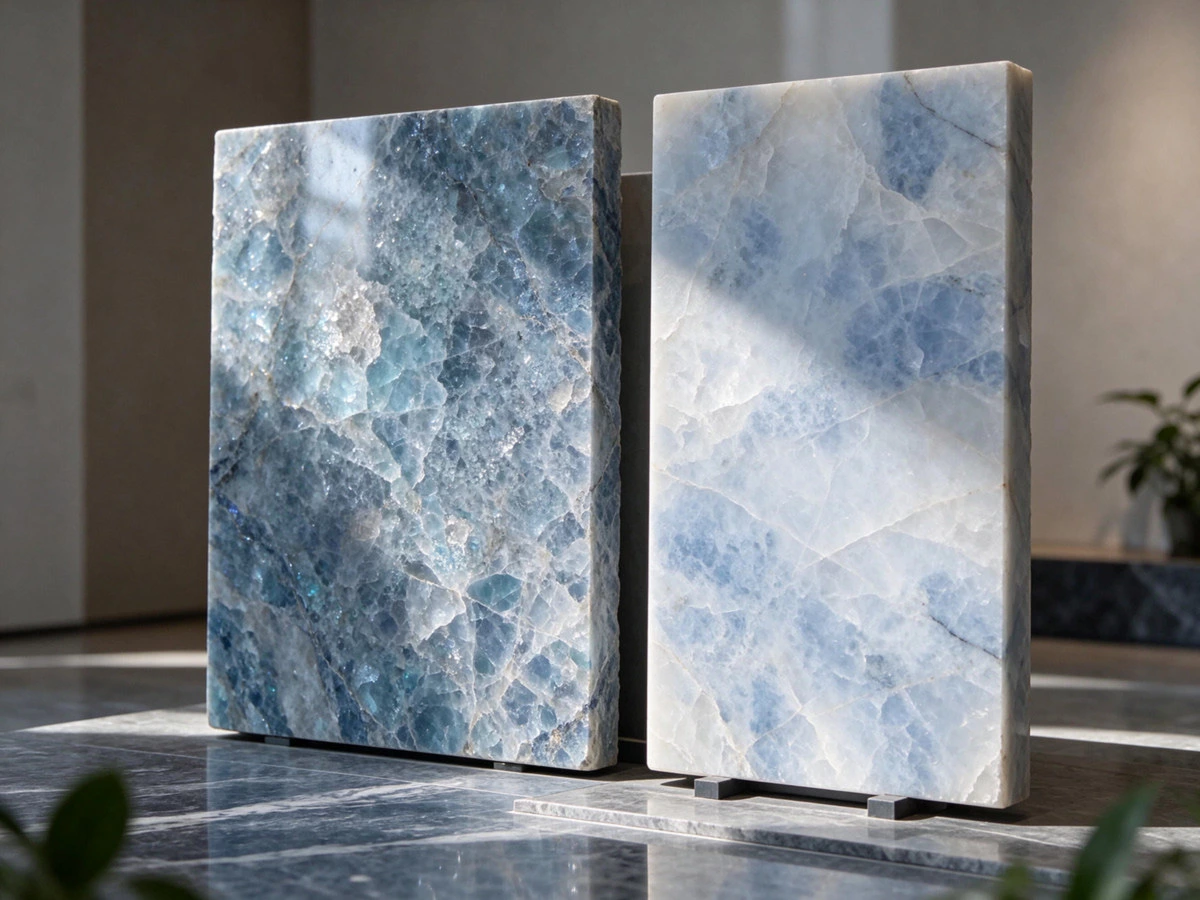
The difference cannot be resolved by picking the more expensive entry, a bluer photograph, or a translucent sample. Those observations do not change the material category. The CN grades are internal commercial identifiers, not laboratory performance classes.
Industry guidance also discusses marble sold under quartzite-like labels. Use Natural Stone’s quartzite care article reinforces why identity matters. For an order, match the slab, catalogue entry, and written specification rather than relying on a name in a message.
Three Questions Before You Approve a Slab
1. What is the material category?
Ask whether the entry is Marble, Quartzite, Granite, Travertine, or another material family. Keep the international name, Chinese name, and grade on the same schedule. If the title and technical fields disagree, stop the selection until the supplier resolves the discrepancy.
This is the first check when comparing marble vs quartzite countertops: it prevents an application note from one product being attached to another with a similar name.
2. What hardness information is actually recorded?
The two quartzite entries explicitly supporting wok use list Mohs hardness 6–7. Several restricted marble entries list Mohs 3–4. Preserve these as recorded descriptions; a missing hardness value should remain missing.
Hardness is not a temperature rating, an acid-resistance test, or a promise that a finished countertop cannot be damaged. Do not convert it into those conclusions or fill in a familiar number for an unrecorded product.
3. What do the restriction and process notes say?
Read the note all the way through. Indoor/outdoor use, acid sensitivity, fissures, filling, backlighting, and advanced cut-outs describe different conditions. A statement about backlighting cannot answer whether the slab is suitable beside a wok.
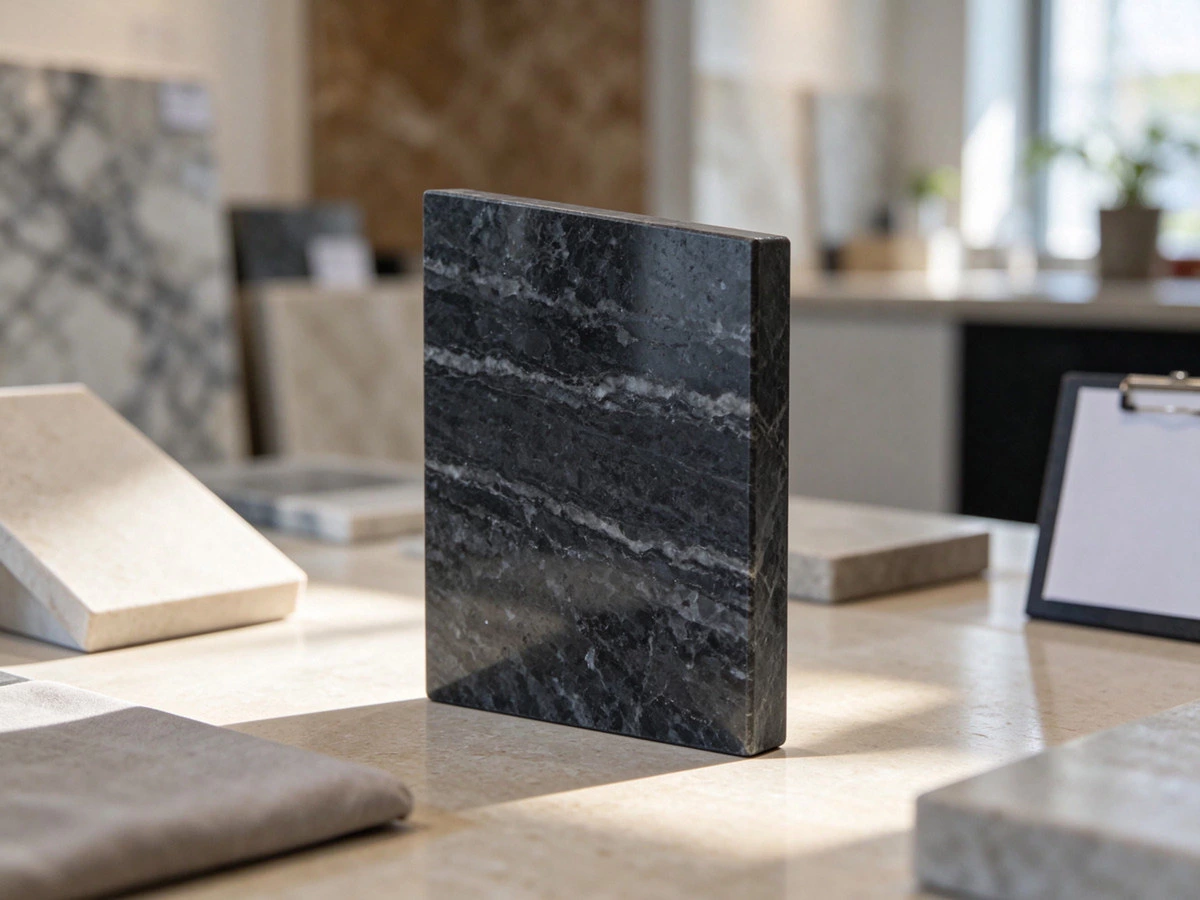
Record the intended zone too: cooking run, island, backsplash, or decorative wall. Confirmation should identify the exact material and application. A generic “stone is suitable for kitchens” statement is not as useful as a decision tied to the selected slab and drawing.
Which Natural Stones Have an Explicit Wok-Use Note?
Versailles Black Quartzite — 凡尔赛黑 — CN3
This Brazilian quartzite record explicitly supports Chinese wok-kitchen countertops. It lists Mohs hardness 6–7, acid-and-alkali resistance, and indoor/outdoor use. It also records naturally occurring fine layering fissures.
Keep the fissure disclosure beside the positive application note. Review the actual slab and proposed cutting layout before release, including how natural features will be treated and documented. A supported application is the start of a product discussion, not permission to ignore slab condition.
Cristallo Blue Quartzite — 蓝水晶 — CN6
The Brazilian record lists Mohs hardness 6–7, acid-and-alkali resistance, indoor/outdoor use, and suitability for a Chinese wok-kitchen island. Backlighting is also recorded, but it is an additional design characteristic rather than the reason for the wok-use decision.
Keep the island wording in view when developing the proposal. The intended use, actual slab, cut-outs, and support still belong on the project drawing. Do not silently transfer this record to 蓝水晶 — Calcite Azul Extra Marble — CNSS.
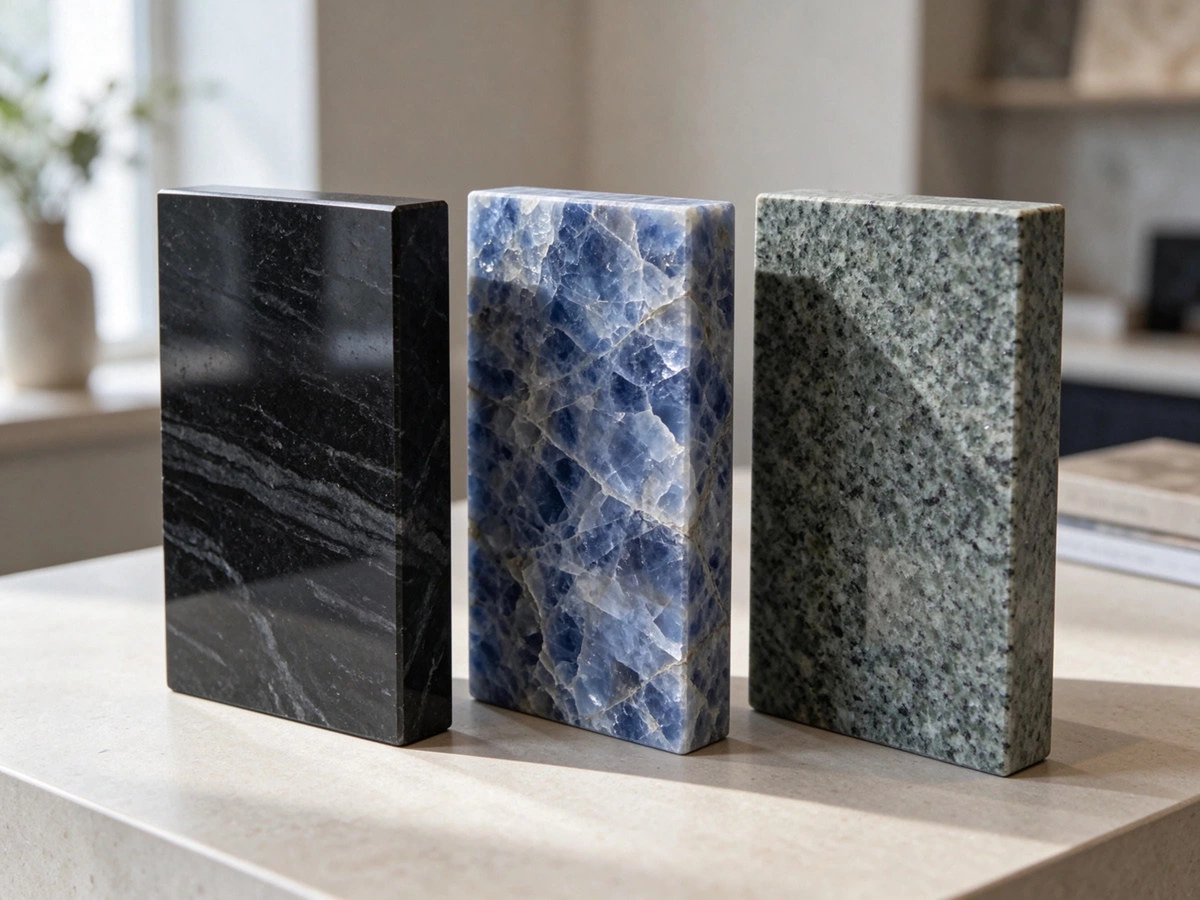
Prairie Green Granite — 草原绿 — CN7: a separate candidate
This granite entry records high hardness, scratch and heat resistance, and indoor/outdoor use. It does not expressly state that a wok countertop is supported. It can therefore be discussed as a granite candidate requiring application confirmation, not counted as a third explicit approval.
The catalogue’s wording about acid and alkali is not a license to use any chemical cleaner. Obtain the care instructions for the selected material and finish; the record does not define every exposure condition.
Eight Marble Records That Restrict Wok Countertops
Panda White: a recognizable pattern with a clear restriction
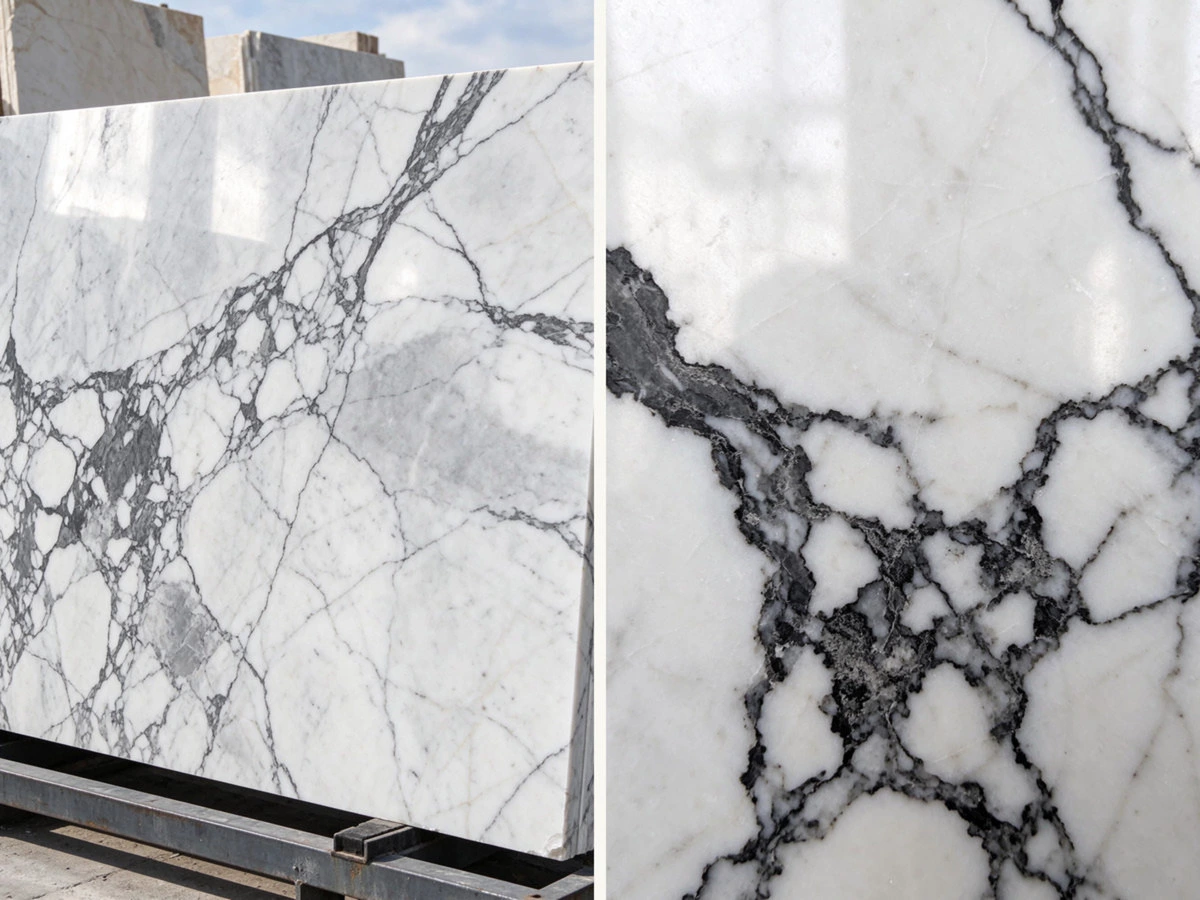
Panda White Marble is often selected visually for its contrasting pattern, but the CN4 record prohibits Chinese wok-kitchen countertops. It identifies carbonate metamorphic marble, Mohs hardness 3–4, acid sensitivity and indoor-only use, and notes natural fine lines in some slabs.
The same record allows western-kitchen countertops. That does not mean every western-style kitchen is a low-exposure environment. A serving area and a heavily used acidic preparation surface need different discussions. Describe the real task and preserve the wok restriction.
All eight restricted records
| Material / grade | Recorded properties | Application wording and disclosures |
|---|---|---|
| Panda White Marble / 熊猫白 / CN4 | Carbonate metamorphic marble; Mohs 3–4; acid-sensitive; indoor only. | Wok-kitchen countertop prohibited; western-kitchen countertop allowed in the record. Some slabs have natural fine lines. |
| Clivia White Marble / 君子兰 / CN4 | Dolomitic marble; not acid-resistant; indoor only. | Wok-kitchen countertop prohibited; western-kitchen countertop allowed. Natural fissures may occur; the record recommends identifying resin-filled slabs in the contract. |
| Grand Ocean Marble / 海纳百川 / CN7 | Layered metamorphic marble; not acid-resistant; indoor only. | Not suitable for a wok-kitchen countertop. Layering fissures are noted, with resin-filled slabs recommended in the contract. |
| Breccia Pernice / 艳阳红 / CN7 | Calcareous breccia marble; acid-sensitive. | Wok-kitchen countertop not recommended. The record lists western-kitchen countertops and wall/floor uses. |
| Purple Landscape Marble / 紫山水 / CNX | Dolomitic-bearing marble; Mohs 3–4; not acid-resistant; indoor only. | Not suitable for a wok-kitchen countertop; western-kitchen countertop use listed. |
| Brèche Fantastique Marble / 爱马仕橙 / CNSS | Calcitic breccia marble; Mohs 3–4; not acid-resistant; indoor only. | Wok-kitchen countertop not allowed; western-kitchen use listed. Numerous natural fissures and breccia gaps are noted. |
| Calcite Azul Extra Marble / 蓝水晶 / CNSS | Translucent calcite marble; acid-sensitive; indoor only. | Not for a wok countertop. Backlit walls/decorative uses are emphasized; numerous fissures and required resin filling are recorded. |
| Colorful Danxia Marble / 七彩丹霞 / CNSS | Recorded as siliceous metamorphic marble, but also specifically not acid-resistant; indoor only. | Not suitable for a wok-kitchen countertop; do not infer suitability from the word siliceous. |
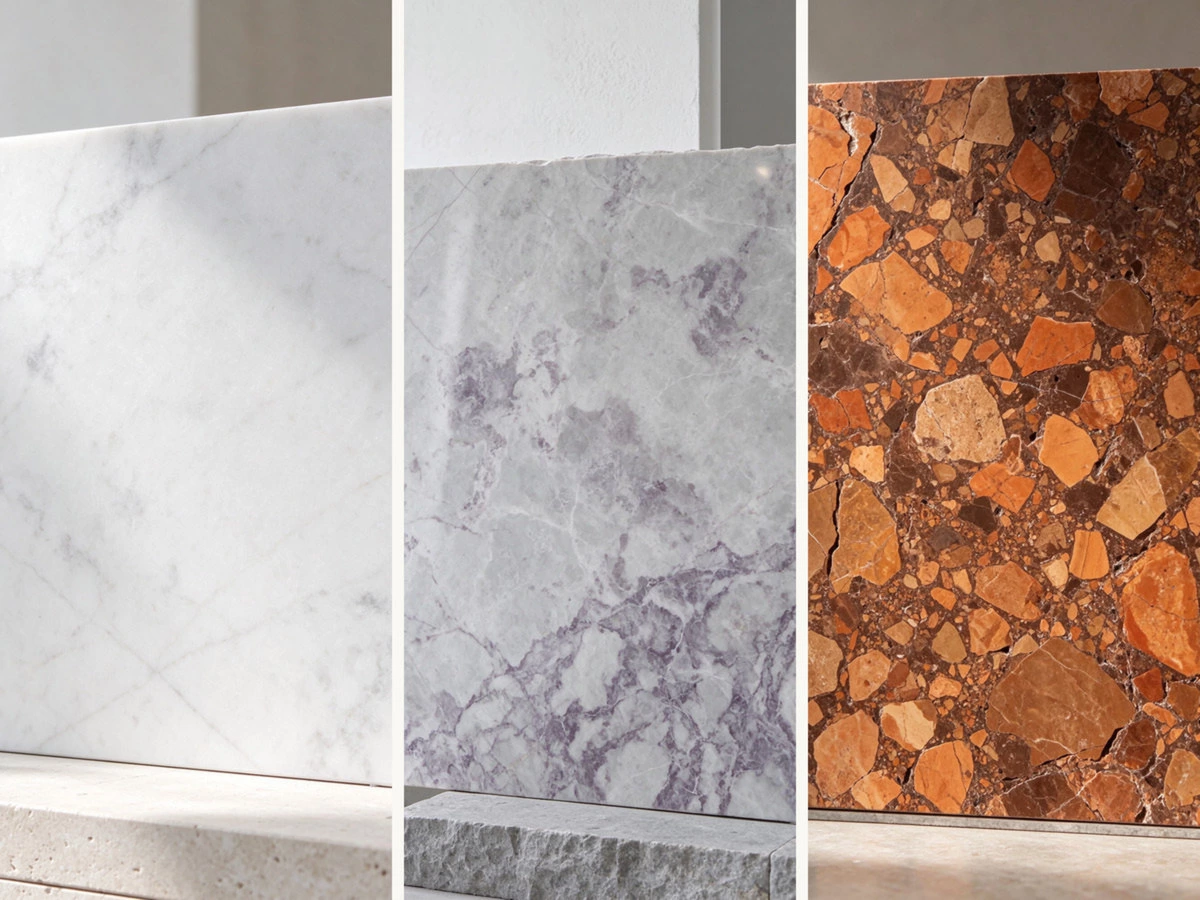
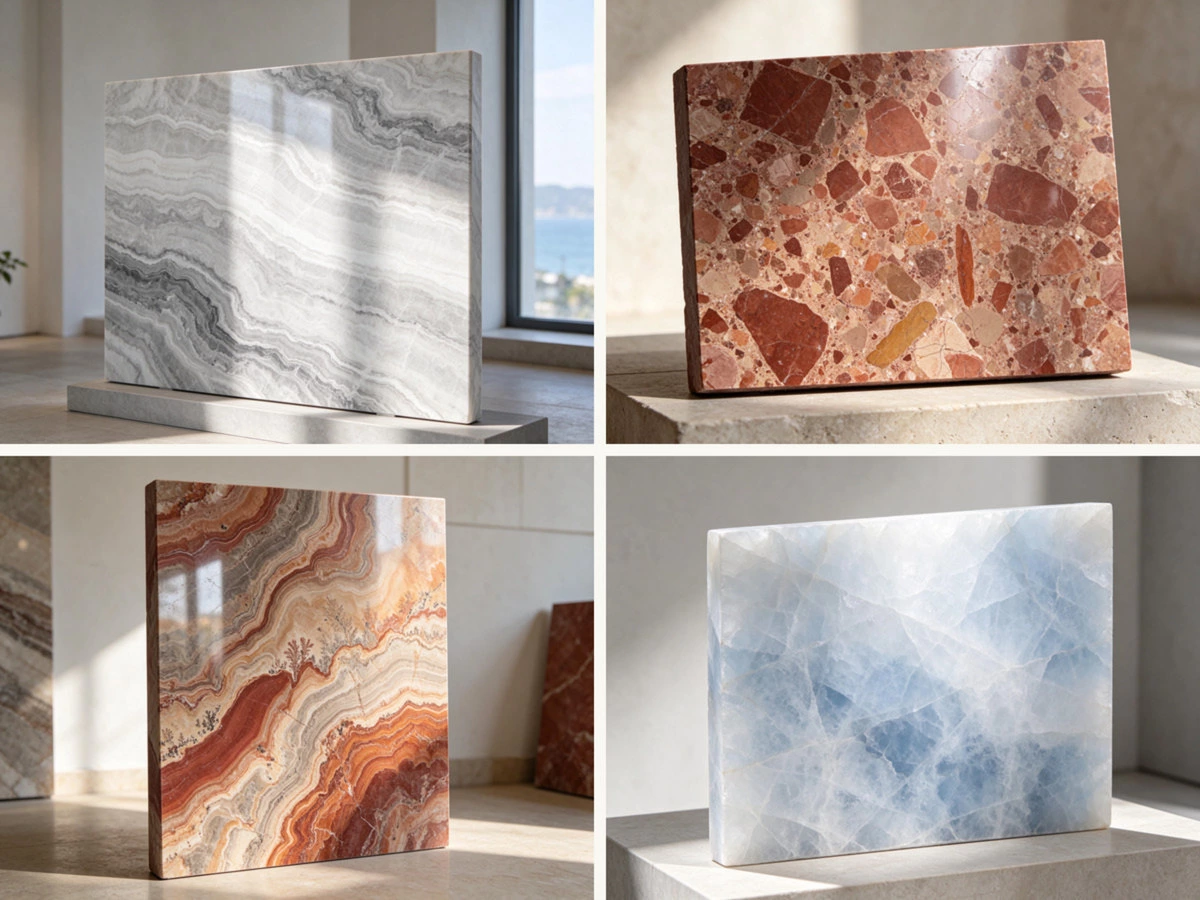
These entries do not all use identical language: “prohibited,” “not suitable,” and “not recommended” should retain their distinctions. Likewise, a filling requirement or a note about natural fissures must stay attached to the relevant product.
Do not turn a finish or repair into a new application approval
For Clivia White and Grand Ocean, the source recommends identifying resin-filled slabs in the contract. The calcite-marble CNSS entry requires resin filling. These statements describe material condition or processing; they do not cancel the same entries’ wok-use restrictions.
Other records, including Italian Grey variants and Modern Grey, contain acid-sensitivity notes without a direct wok decision. The records for 帝诺米黄 (CN1) and 圣诞米黄 (CN2) have indoor-use, porosity, or hardness information. Keep them in the confirmation category rather than adding them to the eight-entry prohibition list.
Price or visual impact cannot override a restriction. A quote for a more striking slab still needs to match the task for which the material is actually proposed.
Why the Other Quartzites Still Need Confirmation
Of the 15 quartzite-category records, two contain explicit wok-use notes, six have blank process notes, and seven describe other matters without deciding wok suitability. Here is the complete set, preserving the difference between missing information and a negative result.
| Record identity | Grade | What the note establishes |
|---|---|---|
| Star Vein Quartzite / 星脉灰 | CN1 | No process note. |
| Versailles Black Quartzite / 凡尔赛黑 | CN3 | Explicit wok-countertop support. |
| Jeriba Blue Quartzite / 亚马逊蓝 | CN6 | No process note. |
| Cristallo Blue Quartzite / 蓝水晶 | CN6 | Explicit wok-kitchen island support. |
| Star Vein Blue Quartzite / 星脉蓝 | CN7 | No process note. |
| Mariance Black Quartzite / 巴西鱼肚黑 | CN7 | No process note. |
| Fusion Gold Quartzite / 黄金丝绸 | CN8 | Backlighting note only. |
| Patagonia Quartzite / 雪山银狐 | CN8 | Backlighting note only. |
| Taj Mahal Quartzite / 泰姬陵 | CN9 | Advance drawing/cut-out note only. |
| Perla Venata Quartzite / 镜湖春晓 | CN9 | Advance drawing/cut-out note only. |
| Patagonia Quartzite / 潘多拉 | CN9 | Backlighting note only. |
| Andes Snow / 安第斯雪景 | CNX | No process note. |
| Monet Quartzite / 莫奈花园 | CNSS | Strong slab-appearance variation note only. |
| Patek Green Quartzite / 百达翡翠 | CNSS | No process note. |
| Patagonia Quartzite / 白底潘多拉 | CNSS | Backlighting note only. |
A Taj Mahal or Perla Venata fabrication note explains why openings should be planned in advance. It does not answer the acid or wok-use question. Similarly, a backlighting note is about appearance, and Monet’s slab-variation note concerns the actual pattern.
Across the wider 101-record natural-stone export, 49 entries have process-note text, and 52 do not. This is a documentation gap, not evidence that every unrecorded stone is unsuitable. Ask for a written, material-specific answer rather than converting an attractive category description into blanket permission.
The 幻彩红 record also needs reconciliation: its series field says Marble, its note describes granite, and the international-name field is blank. It is excluded from recommendations pending clarification, not added to the eight-entry restriction list.
Three Routes to a Marble-Look Kitchen
The choice is wider than marble vs quartzite countertops. If the goal is a particular vein pattern or color, compare three material routes while keeping appearance and performance evidence separate. The existing kitchen countertop materials guide provides the broader planning context.
Route 1: a documented natural-stone selection
Use an exact natural-stone record and its application note. The two explicitly supported quartzites are a narrower starting point than “any quartzite.” They also remain different designs, so the actual slab may determine whether the requested pattern suits the cabinetry.
Route 2: engineered-quartz patterns
The engineered-quartz export contains 131 products, including white-veined and luxury-stone-look patterns. Selected examples below show catalogue identity, surface and thickness, not a heat, acid or stain test. Their empty remarks fields do not establish equivalence to either supported quartzite.
Route 3: sintered-stone patterns
The sintered-stone export contains 184 products. Its detail records use 3.5, 6, and 12 mm thicknesses, which differ from a separate framework’s thickness wording. The examples use the detail records; the specification and intended use must be confirmed for the quoted item.
| Material / catalogue examples | Recorded surface and thickness | Grade |
|---|---|---|
| Engineered quartz: 鱼肚白, 幻影白, 新幻影白 | Polished; 20 mm | CQ4 |
| Engineered quartz: 顶极鱼肚白, 极地鱼肚灰 | Recorded leather-texture finish; 20 mm | CQX |
| Engineered quartz: 雪域白, 雪山绿 | Polished luxury-stone-look pattern; 20 mm | CQ9 |
| Engineered quartz: 宝格丽(可透光) | Polished; 20 mm; translucency noted in the name | CQS |
| Sintered stone: 千山暮雪, 帝皇玉, 宝格丽, 宝格丽紫, 云中翡翠, 安卡拉 | Different recorded surfaces and bodies; these examples are 12 mm | CS2 |
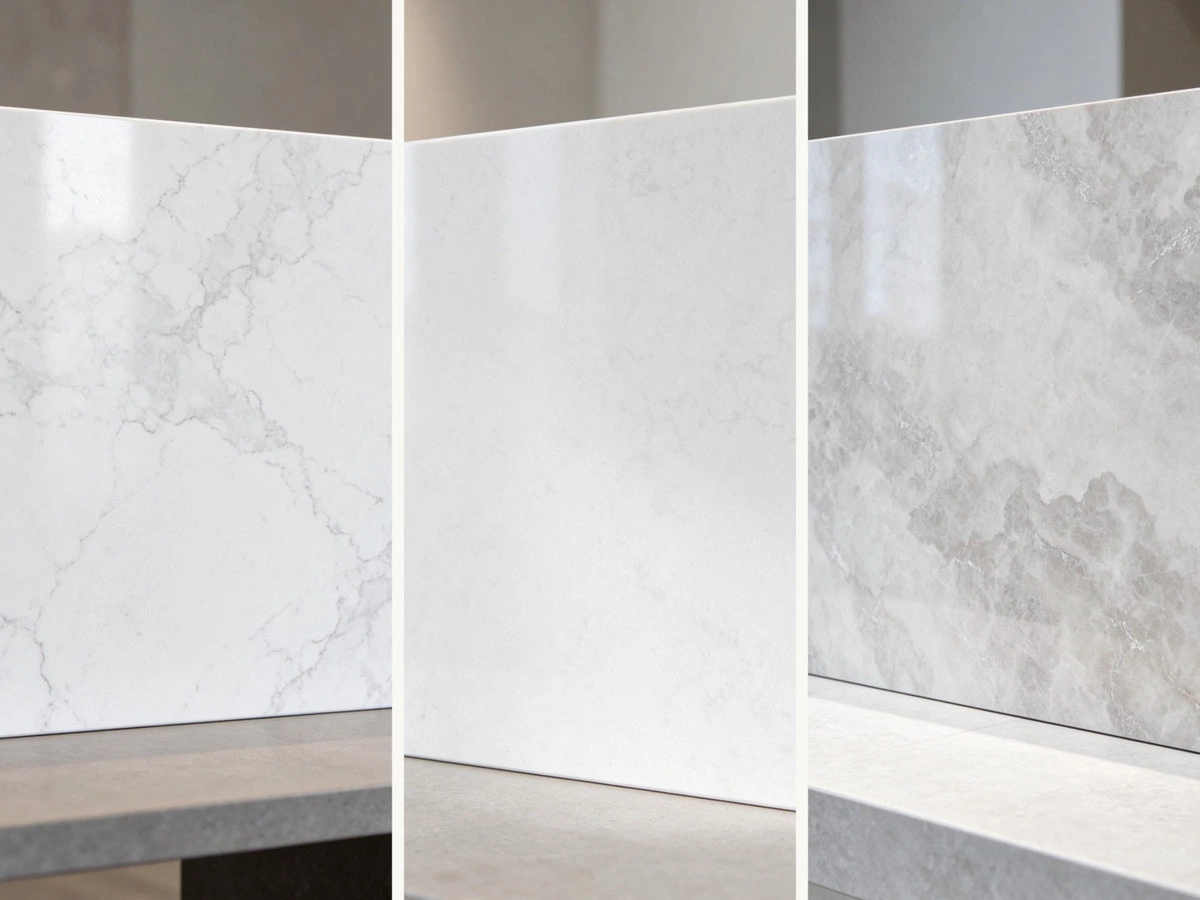
These are appearance options. The reviewed engineered-quartz and sintered-stone exports contain no performance remarks supporting a heat or acid conclusion for these products. Request the actual product documentation before deciding that a marble-look substitute meets the cooking brief.
A similar Chinese name can also span material families. Monet Quartzite CNSS and the 莫奈花园 sintered-stone entry CS2 are different products. 四季粉 and 四季绿 also occur in natural-marble and sintered-stone records. Quote comparisons must identify the family, product, finish, and scope rather than comparing names alone.
Four Checks Before Fabrication and Ordering
1. Approve the actual slab, not only a small image
Match full-slab photos and identifiers to the exact record. Monet Quartzite’s note specifically calls for confirming the pink/green balance because the appearance varies substantially. Record the proposed cutting orientation and which parts of the slab will become the countertop or wall panels.
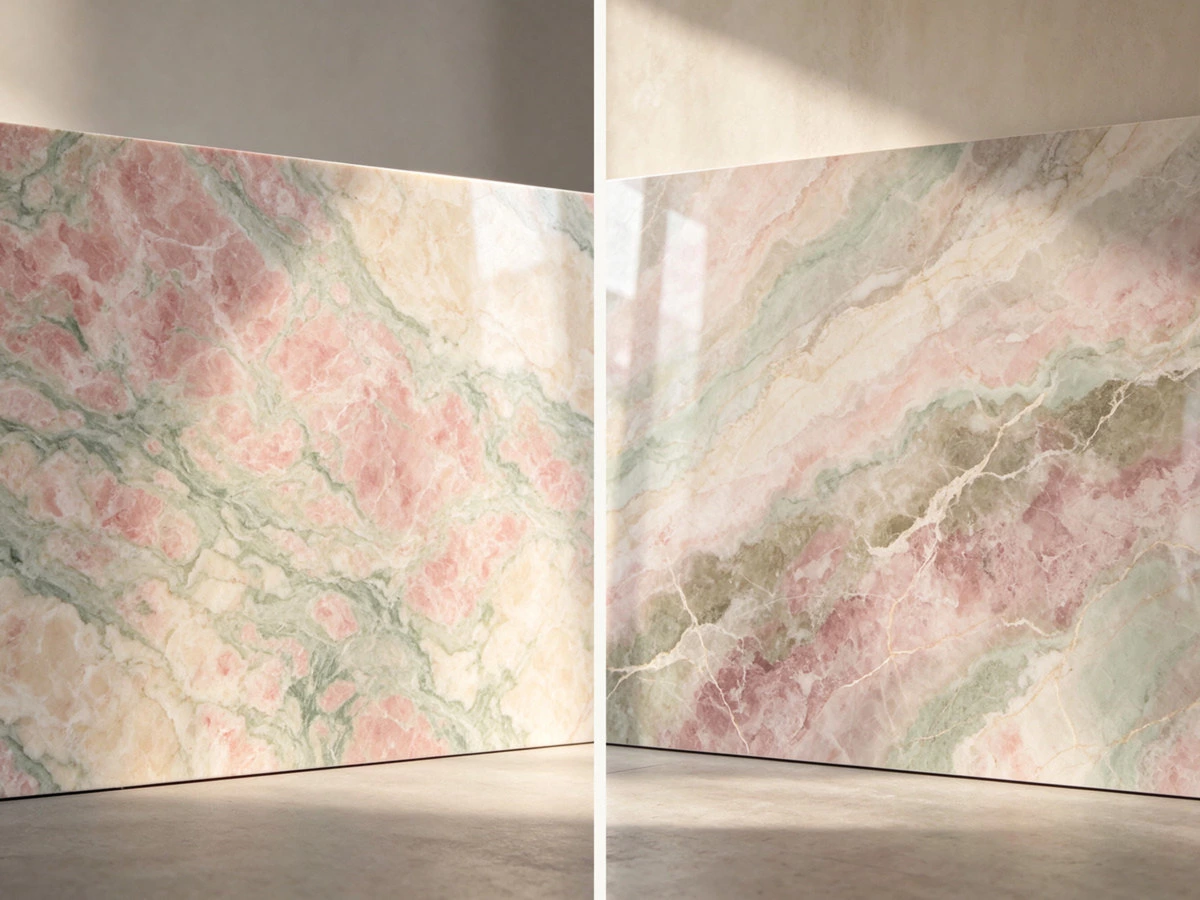
The export lists a nominal 2800 × 1500 mm and 18 mm thickness for both explicitly supported quartzites. Those are catalogue dimensions, not a measurement of the slab currently available or a finished countertop drawing. Confirm usable dimensions and condition for the selected piece.
2. Confirm the travertine surface-treatment requirement
Five named travertine records—Yellow, Red, Silver Grey, White, and Super White—require the treatment recorded in Chinese as 封釉 for countertop use. Their notes distinguish gloss and matte processing. Obtain the supplier’s exact treatment specification, finished sample, and quotation scope.
Lane Crawford Travertine instead has a note about fine pores and processing possibilities; that entry does not repeat the same treatment rule. Do not assign the five records’ instruction automatically to the sixth. Nor does a filled or treated surface establish permission for wok use.
3. Agree openings before fabrication
Taj Mahal Quartzite and Perla Venata Quartzite specifically require advance drawings for cut-outs because the material is difficult to open on site. Identify the sink, faucet, and cooktop models, openings, and relevant installation details before cutting.
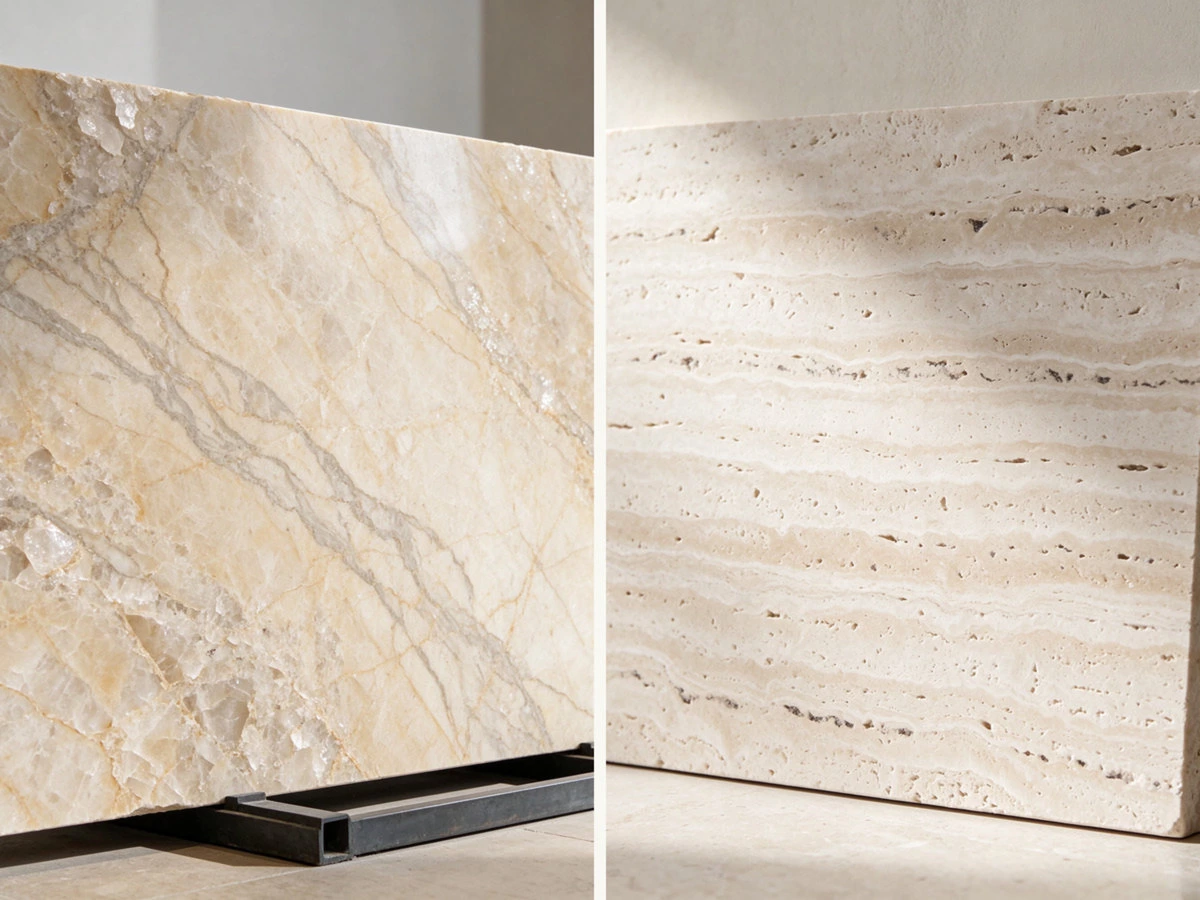
Resolve slab condition, supports, seams, and the responsibility for final checking with the project team. A photo showing the finished kitchen does not establish the hidden fabrication arrangement.
4. Compare the same pricing unit and scope
The source prices are tax-exclusive RMB per linear meter, not per square meter. A linear meter measures length; a square meter measures area. They are not interchangeable quotation units, and the priced depth and included processing must be stated rather than assumed.
Countertop and wall-stone prices are separate fields. Confirm the product, dimensions, finish, treatment, cut-outs, and applicable delivery or installation scope in the actual quotation. This English guide does not convert catalogue prices into foreign currency or publish a fixed installed price.
Questions worth resolving before approval
Does hardness settle the choice? No; compare the category, note, actual slab, and intended application. Does a decorative island approval cover the cooking run? Not automatically; identify the exact zone. Does a blank note mean unsuitable? No; it means the export does not supply the answer.
For marble vs quartzite countertops, the useful outcome is a traceable selection: the material identity, written application position, slab approval, and fabrication scope all refer to the same item.
Send Your Kitchen Plan or Request Specific Slab Photos
Send ALLURE your kitchen plan and cooking/preparation zones, or identify the material whose full-slab photos you want. For 蓝水晶, specify either Cristallo Blue Quartzite CN6 or Calcite Azul Extra Marble CNSS. Note the sink and cooktop information already selected and anything still undecided.
Source scope: ALLURE natural-stone, engineered-quartz, and sintered-stone catalogue exports reviewed November 26, 2026. Application decisions above are attributed to those records. Industry care references provide general context, not product certification.