Key Takeaways
The best kitchen carcass material is not automatically plywood, MDF, or particle board. The correct choice depends on cabinet location, moisture exposure, shelf load, hardware fixing, panel thickness, edge sealing, transport conditions, and the project’s expected service life.
For builders, the board name is only the beginning. A useful cabinet specification must also state where the board is used, its finished thickness, back-panel construction, edge-banding treatment, hardware fixing method, and the protection required for sink, dishwasher, pantry, island, and laundry zones.
A kitchen can look excellent on installation day and still create problems later if the cabinet box was chosen only by price or a door sample. The common warning signs are familiar to experienced project teams: a sink base swells after a minor leak, a shelf bows under cookware, a drawer slide works loose, an exposed edge chips during installation, or tall cabinets lose alignment after being carried and fixed on site.
These issues are not caused by one material alone. They are usually the result of an incomplete specification. This guide explains how to compare plywood, MDF, and particle board as a kitchen carcass material, what each material can reasonably be asked to do, and what a buyer should confirm before production begins.
What Is a Kitchen Carcass Material?
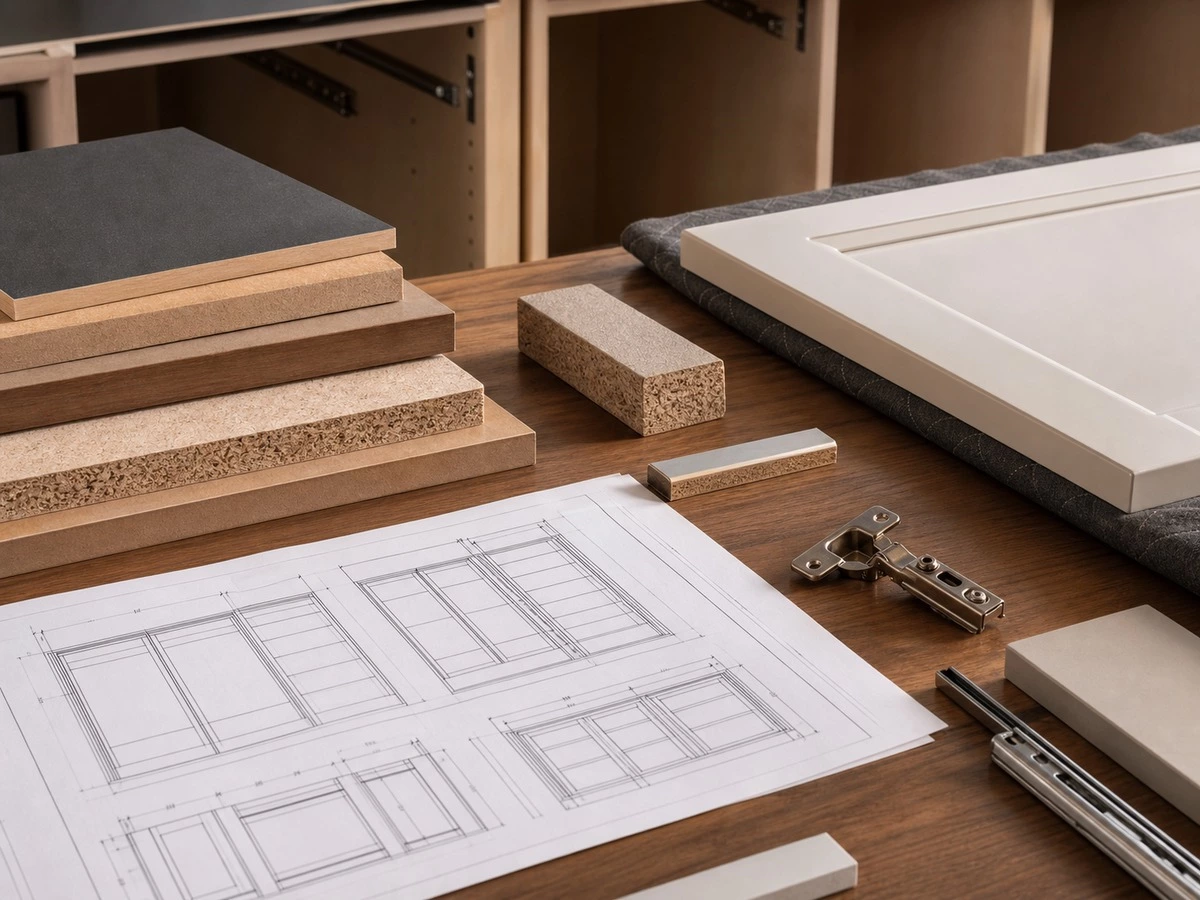
The carcass is the structural box behind the visible kitchen doors and drawer fronts. Depending on the cabinet design, it includes side panels, bottoms, fixed shelves, adjustable shelves, top rails or top panels, back panels, internal partitions, toe-kick structures, and the fixing zones for hinges, drawer slides, pull-outs, and wall-cabinet hangers.
It is important to separate the cabinet carcass from the cabinet face. A lacquered door, acrylic door, timber veneer door, or glass door may define the visual style, but the carcass controls the cabinet’s internal strength, squareness, shelf stability, hardware operation, and ability to tolerate normal kitchen use.
Before comparing materials, buyers should ask a supplier to distinguish the following items in the project specification:
- Cabinet carcass side, bottom, shelf, and partition board.
- Back-panel material, thickness, and fixing method.
- Door and drawer-front material.
- Decorative end panels and tall-panel material.
- Edge-banding type and exposed-edge treatment.
- Drawer-slide, hinge-plate, shelf-pin, and pull-out fixing zones.
- Reinforcement for stone countertops, appliance towers, wall cabinets, and islands.
Best for:
Builders are reviewing cabinet quotations where the visible door finish is clear, but the internal cabinet construction is not.
Check:
Request an exploded cabinet drawing or section detail that identifies the material and thickness of each major carcass component.
Risk:
A quotation can appear detailed while leaving the shelf, back panel, sink-base treatment, and hardware-fixing structure unspecified.

Five Performance Factors That Matter Before Choosing a Board
Moisture exposure
Kitchens are not wet rooms in the same way as shower areas, but cabinet boxes still encounter steam, cleaning splashes, dishwasher condensation, wet mops, plumbing leaks, water filters, and sink overflows. The relevant question is not whether a material can survive one drop of water; it is how the specified board, surface, edge, joint, and installation detail respond when moisture reaches a vulnerable location.
Screw holding and hardware fixing
Hinges, drawer slides, pull-out larders, corner systems, and wall-cabinet hangers all transfer repeated loads into the carcass board. Material choice matters, but so do thickness, pilot holes, fixing depth, hardware type, cabinet geometry, and the number of fasteners used. A strong board can still fail if the fixing design is poor; a more economical board can perform well when the hardware and structure are correctly planned.
Flatness and dimensional stability
Cabinets need stable panels so doors, drawers, countertop joints, and tall units can remain aligned. This matters particularly in full-height cabinetry, long pantry walls, wall-cabinet runs, islands, and cabinetry that continues into adjacent living spaces.
Load capacity
Shelves carrying cookware, pull-out drawers holding groceries, appliance towers, and deep pantry systems all require the project team to consider span, thickness, support points, and intended load. Do not select a kitchen carcass material only from a small sample; assess what the finished cabinet must carry.
Cost and supply consistency
Material price is only one part of the procurement cost. Board yield, machining, finish, handling, packaging, freight weight, local repair, replacement-part availability, and the possibility of site modification all influence the final project cost.

Plywood Kitchen Carcasses: Strength, Fixing and Moisture Awareness
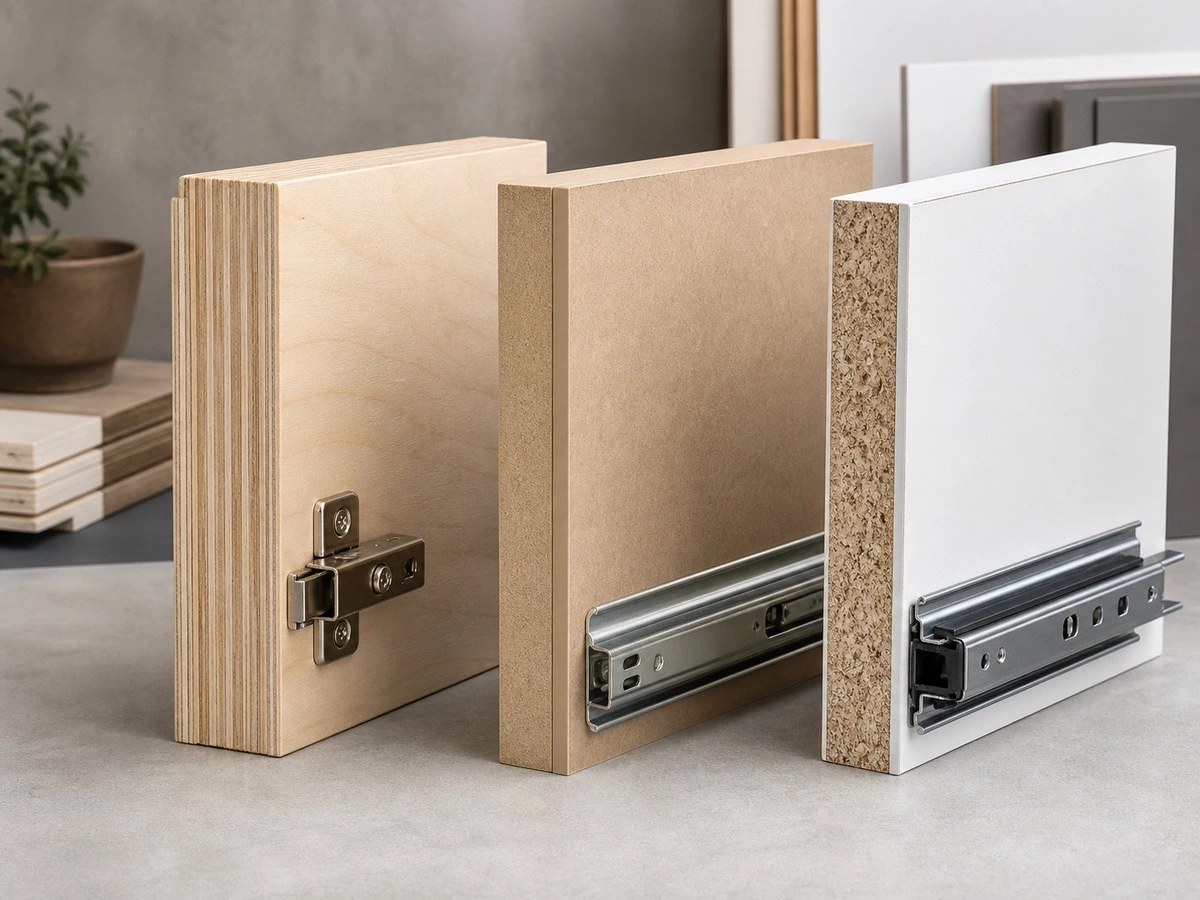
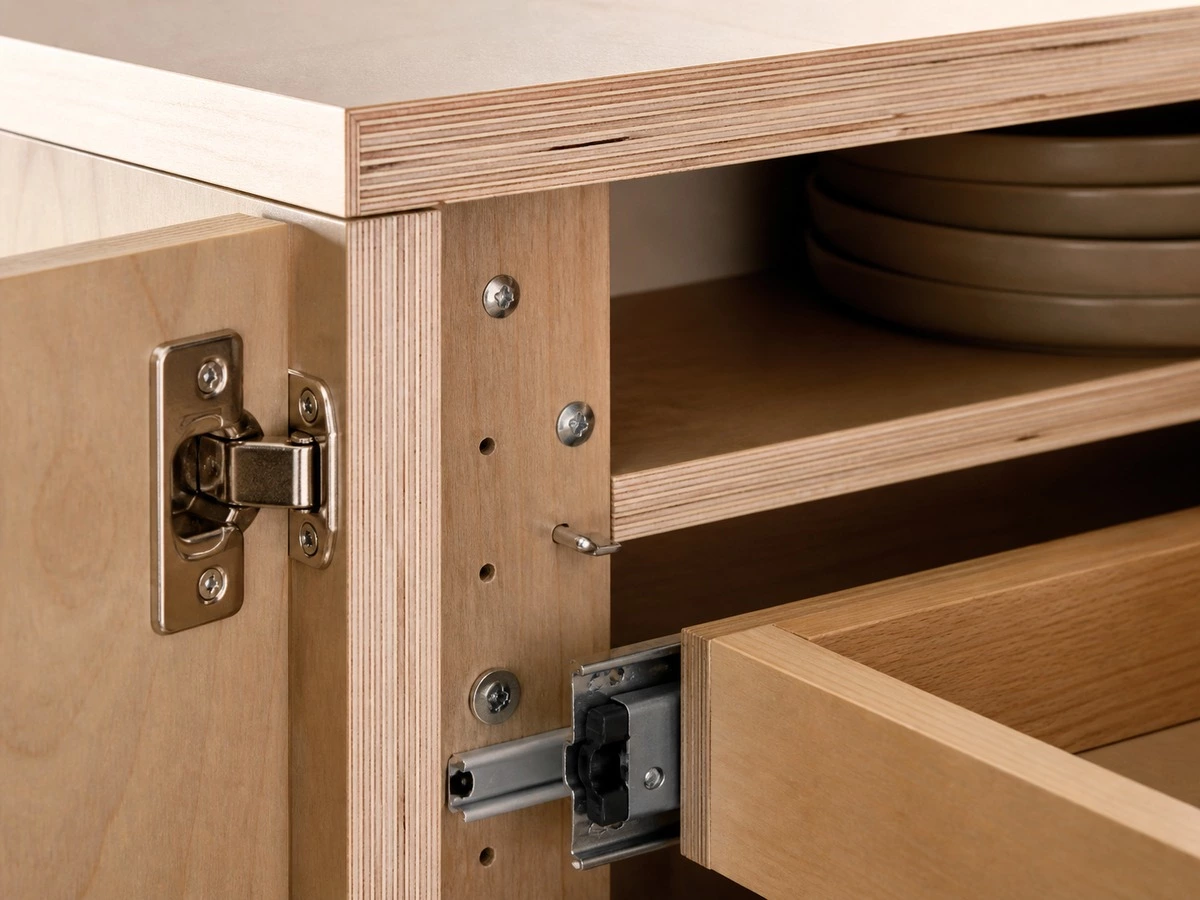
Plywood is made from layered wood veneers bonded together with alternating grain directions. It is often considered for cabinet carcasses where builders value structural confidence, hardware fixing, transport resilience, and moisture-aware detailing. However, plywood is not a uniform product. Veneer quality, core consistency, adhesive system, thickness, finishing, and machining all influence its actual performance.
Where plywood can be a strong project choice
- Sink-base cabinets where additional moisture awareness is required.
- Deep drawers, heavy pull-outs, and pantry systems with repeated hardware loading.
- High-use kitchens and family homes with demanding daily storage.
- Projects requiring durable cabinet boxes during long-distance transport or complex site handling.
- Tall cabinets, islands, or appliance zones where fixing strength and structural coordination are important.
What should be checked before approval?
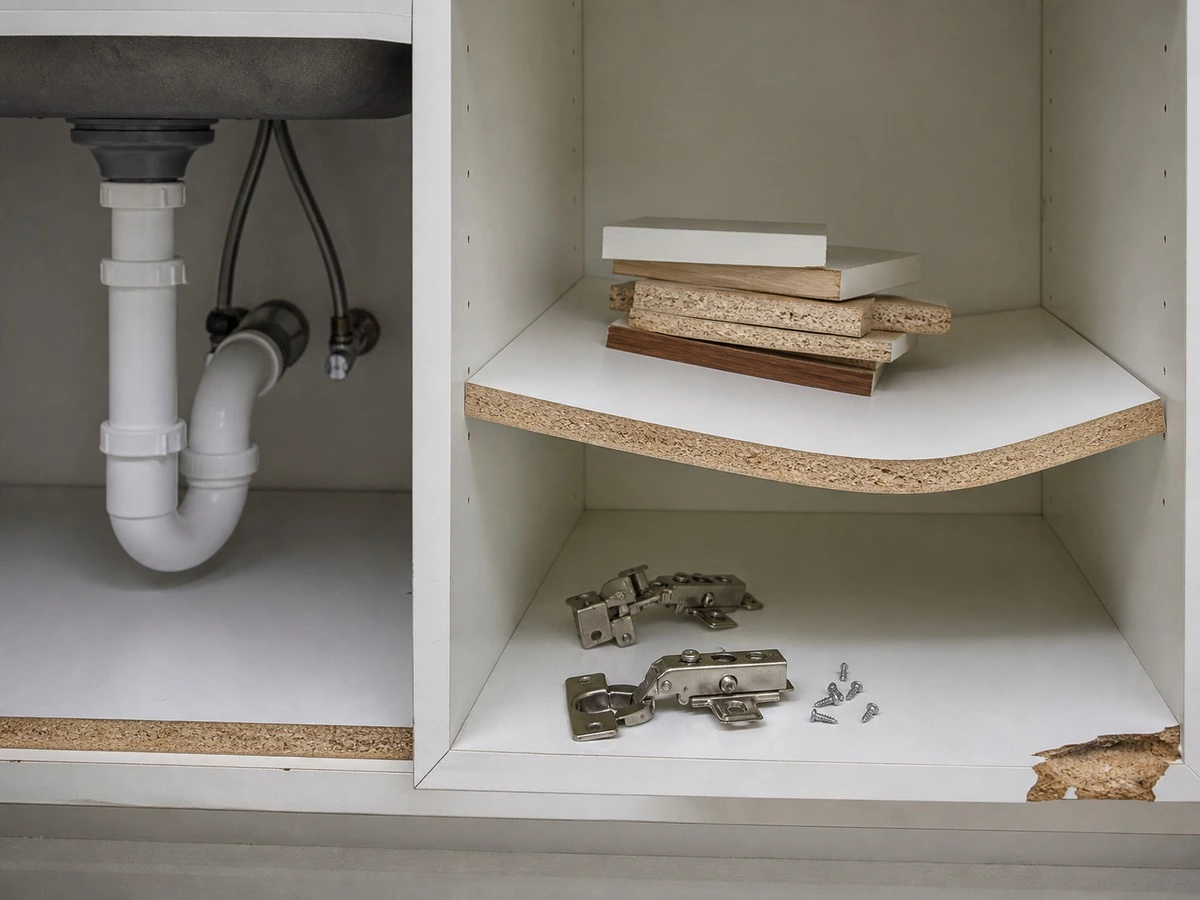
Ask to see an actual cross-section. The buyer should check panel thickness, core consistency, visible voids, surface finish, edge-banding treatment, back-panel material, shelf spans, and the locations where hinges and drawer slides will be fixed. If the cabinet package includes more than one material, clarify exactly which components use plywood and which do not.
Best for:
Projects prioritizing robust cabinet boxes, repeated hardware use, and stronger moisture-management planning around sink, pantry, and island areas.
Check:
Approve a physical sample and confirm the actual plywood specification, not only the word “plywood” in a quotation.
Risk:
Different plywood grades can have very different core quality, surface quality, and edge performance. A premium name does not replace a project-specific specification.
MDF Kitchen Carcasses: Smoothness, Density and Moisture Control
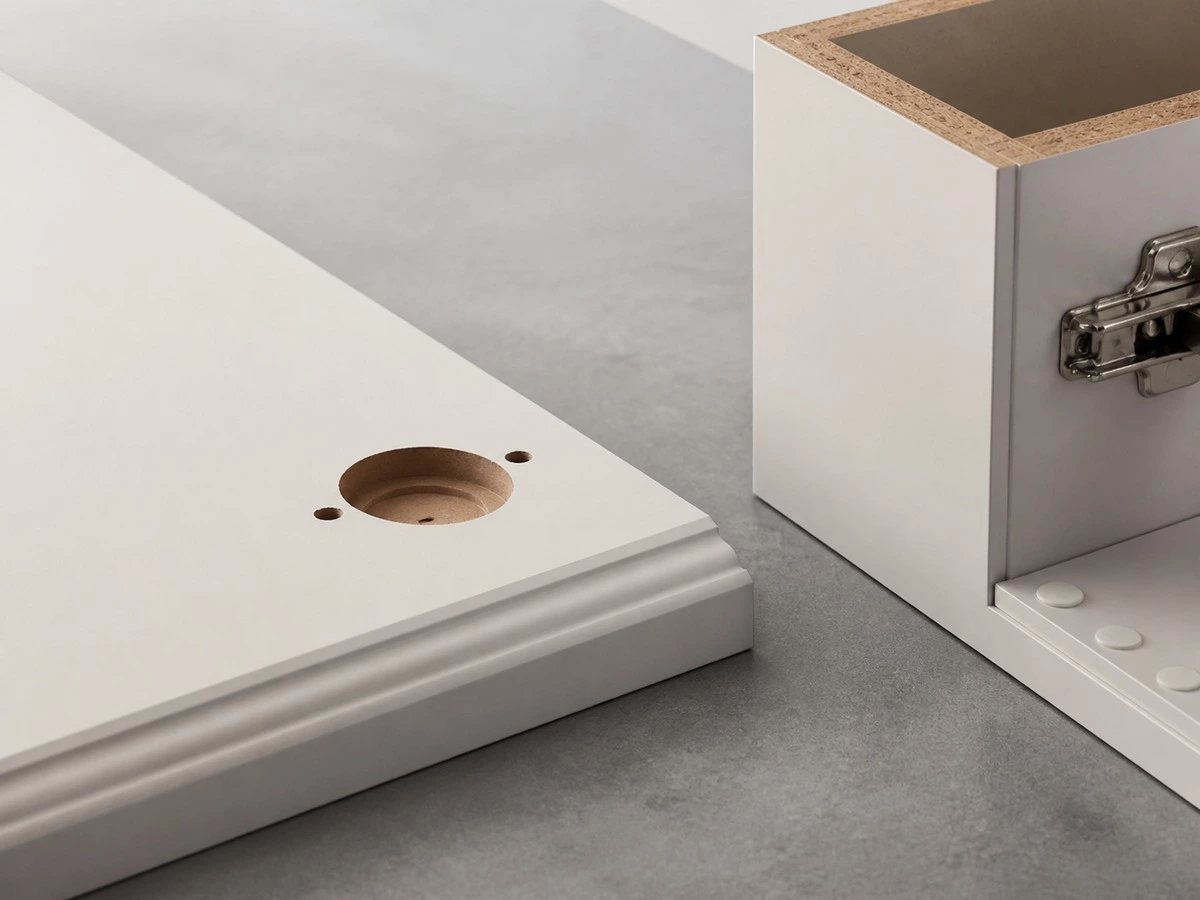
MDF is an engineered panel made from refined wood fibers and resin pressed into a dense, uniform sheet. It can provide a smooth surface and predictable machining characteristics, which is why it is frequently discussed in cabinet construction and painted furniture systems. Its suitability for a cabinet carcass should be assessed by the actual board specification and the conditions around it, especially moisture exposure and edge protection.
Where MDF can be suitable
- Controlled indoor applications with stable environmental conditions.
- Cabinet systems where smooth painted surfaces or precise machining are important.
- Selected internal components, partitions, or decorative cabinet elements.
- Projects where the supplier has a clear moisture-protection and edge-sealing detail.
Why moisture management must be explicit
Standard MDF should not be treated as equivalent to a moisture-aware board specification. Even where a supplier proposes moisture-resistant MDF, buyers should ask how edges are sealed, how sink and dishwasher zones are handled, what happens at floor level, and which board is used for the cabinet back and bottom.
What to request from the supplier
- Whether the board is standard MDF or a moisture-resistant grade.
- Finished panel thickness and surface finish.
- Edge-banding material and sealing method.
- Sink-base, dishwasher-adjacent, and floor-contact protection detail.
- Hardware fixing method for hinges, slides, and pull-outs.
- Replacement procedure if a damaged component must be reordered.
Particle Board Kitchen Carcasses: Cost Efficiency and Controlled Use
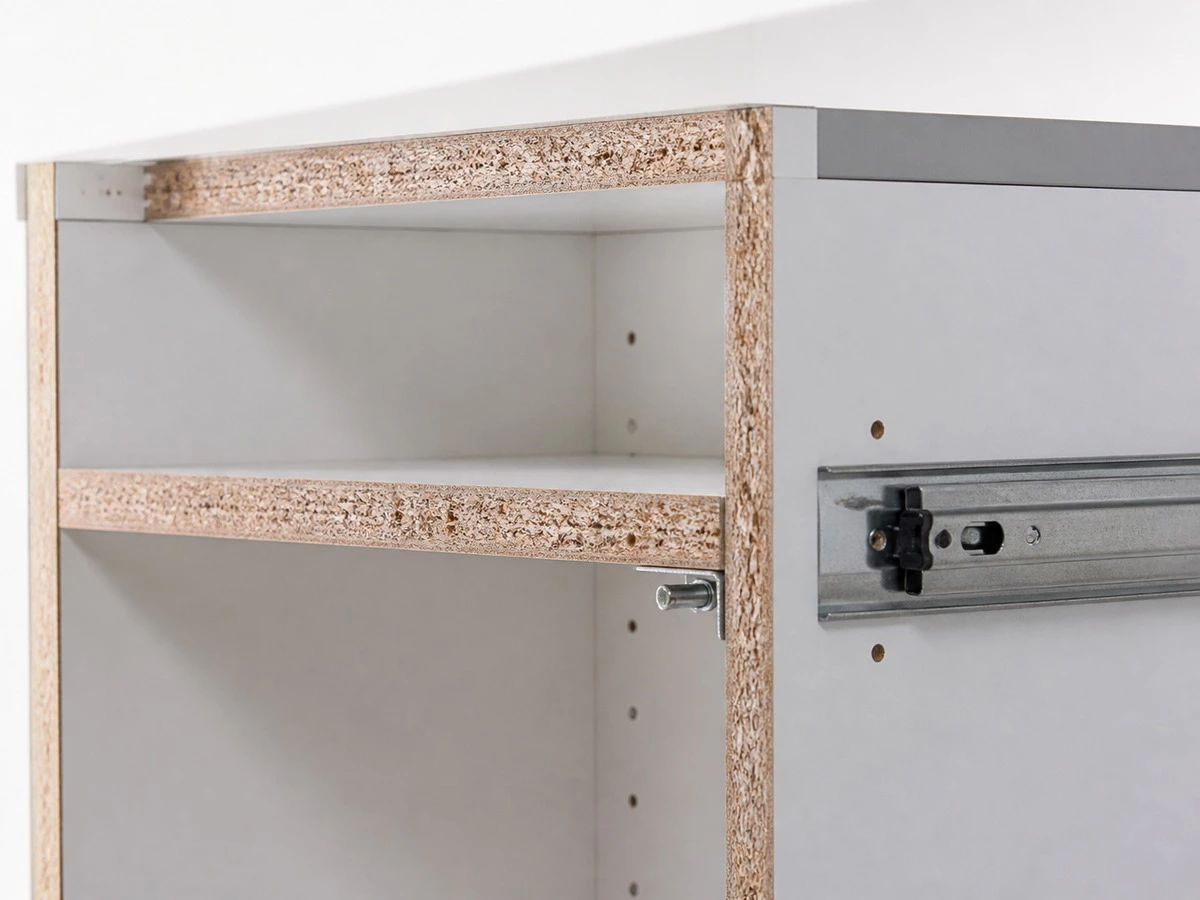
Particle board is an engineered panel made from wood particles bonded with resin and pressed into sheets. In kitchen cabinetry, it is commonly paired with melamine or laminate surfaces and edge banding. It can be a practical choice for controlled, dry applications when board quality, panel thickness, surface treatment, edge sealing, shelf spans, and hardware configuration have been considered.
The correct question is not “Is particle board good or bad?” It is x jvnzklaa nb whether the specified board system is appropriate for the cabinet function and project conditions. A dry, standard apartment kitchen with predictable modules is very different from a high-use family kitchen, a sink-heavy island, a humid laundry zone, or a long-distance export project with demanding handling conditions.
Where particle board can be practical
- Cost-controlled projects with standard cabinet layouts.
- Repeatable apartment or development units in dry interior conditions.
- Cabinet systems using suitable melamine or laminate surfaces and protected edges.
- Projects where shelf loading, hardware, and sink details are clearly specified.
Best for:
Budget-controlled, standard-layout projects where the room conditions and cabinet functions are clearly understood.
Check:
Confirm board thickness, surface finish, edge banding, sink-base protection, shelf spans, hardware installation, and packing method.
Risk:
Unprotected edges, unsuitable high-moisture locations, weak fixing zones, and poor transport protection can cause premature performance issues.
Plywood vs MDF vs Particle Board: Project Comparison
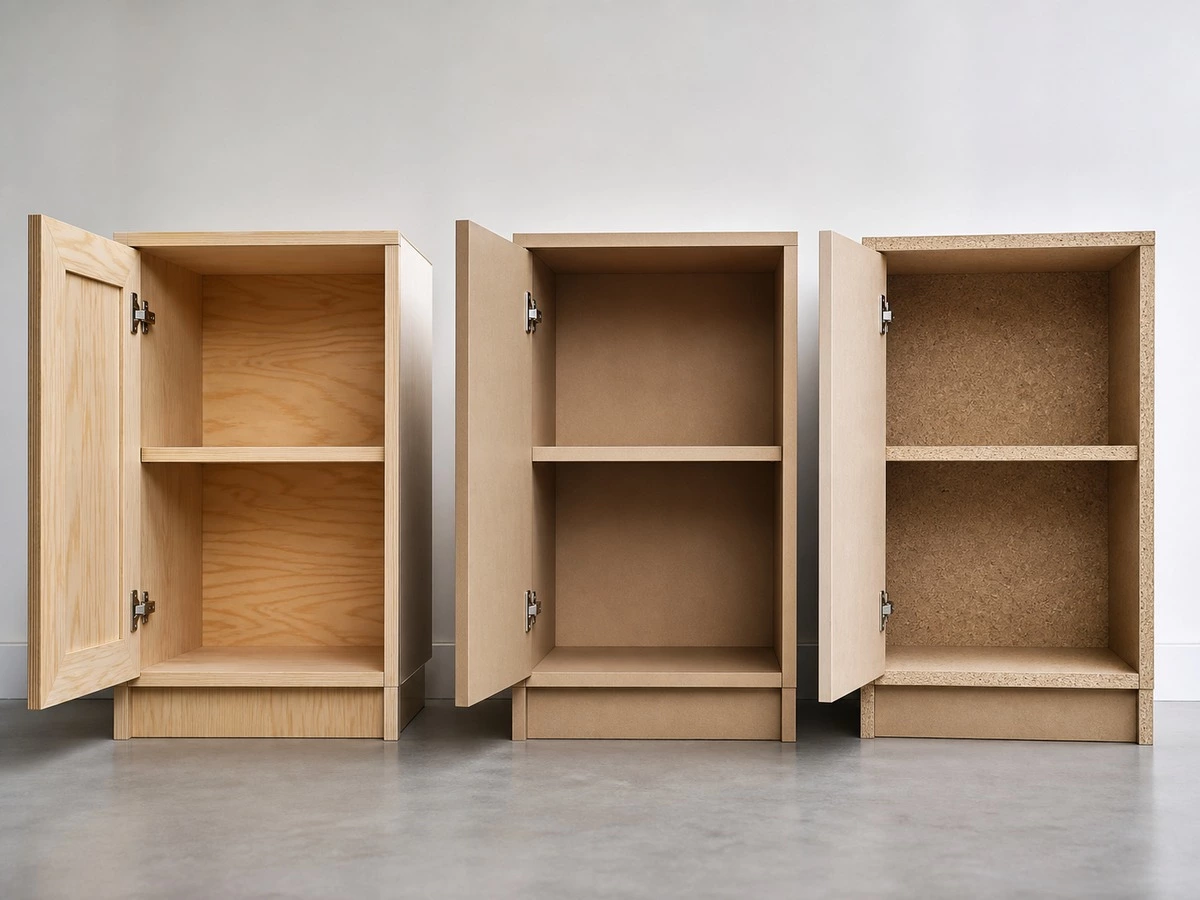
Use the following table as a procurement framework. It does not replace the factory’s material specification, approved samples, or the project’s local requirements.
| Decision Factor | Plywood | MDF | Particle Board | Buyer Review Point |
|---|---|---|---|---|
| Typical structure | Layered veneer construction. | Dense, uniform fiber structure. | Pressed wood-particle core. | Ask for the actual board sample and finished thickness. |
| Moisture decision | Depends on grade, construction, and edge protection. | Requires clear moisture-control detailing. | Requires protected edges and suitable room conditions. | Review sink, dishwasher, laundry, floor, and plumbing-risk zones. |
| Hardware fixing | Often selected where fixing confidence is important. | Depends on density, thickness, and fixing method. | Depends on board quality, thickness, and hardware design. | Check hinge plates, drawer slides, pull-outs, and shelf supports. |
| Surface and finish | Usually paired with a suitable visible surface or interior finish. | Smooth for selected painted or machined applications. | Often used with melamine or laminate surfaces. | Approve the interior carcass finish, not only the door finish. |
| Cost position | Often a higher material investment. | Varies by board and finish specification. | Often efficient for standard cabinet systems. | Compare total installed risk, not material price alone. |
Choose the Material by Cabinet Location, Not by One General Rule
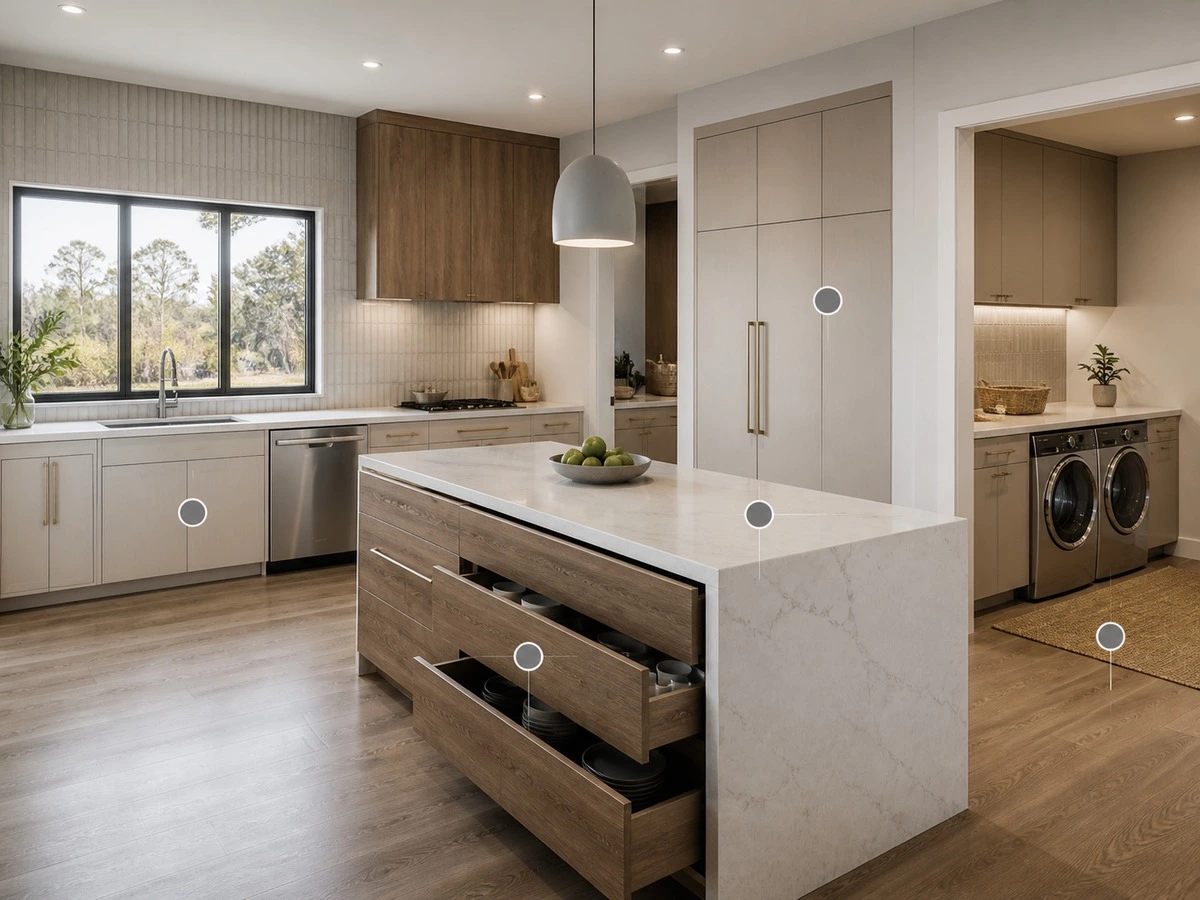
Sink-base cabinets
Sink bases need special attention because plumbing joints, filters, waste connections, cleaning products, and accidental overflows create localized moisture risk. The specification should identify the carcass board, bottom panel, exposed edges, and any additional protective detail around the sink zone.
Dishwasher and appliance areas
Dishwasher locations can involve heat, steam, condensation, and service requirements. The cabinet material must be considered together with ventilation, appliance instructions, adjacent panels, countertop edges, and the way the appliance is installed and removed for service.
Wall cabinets and tall pantries
Wall cabinets and tall pantries require attention to fixing, loading, back-panel construction, shelf spans, and wall conditions. A heavy pantry or appliance tower should never be treated as a basic cabinet run without checking support and anchoring requirements.
Kitchen islands
Islands can combine deep drawers, seating overhangs, power outlets, decorative panels, stone tops, plumbing, and cooking appliances. Their carcass design should reflect the actual structural and service demands rather than using an ordinary base-cabinet specification by default.
Laundry and utility cabinetry
Laundry rooms are not the same as bathrooms, but both can include elevated humidity and water-related risk. Material and edge protection must be selected according to washing machines, plumbing, floor cleaning, ventilation, and the cabinet’s distance from potential water exposure.
Thickness, Back Panels, and Edge Banding Matter as Much as the Board Name
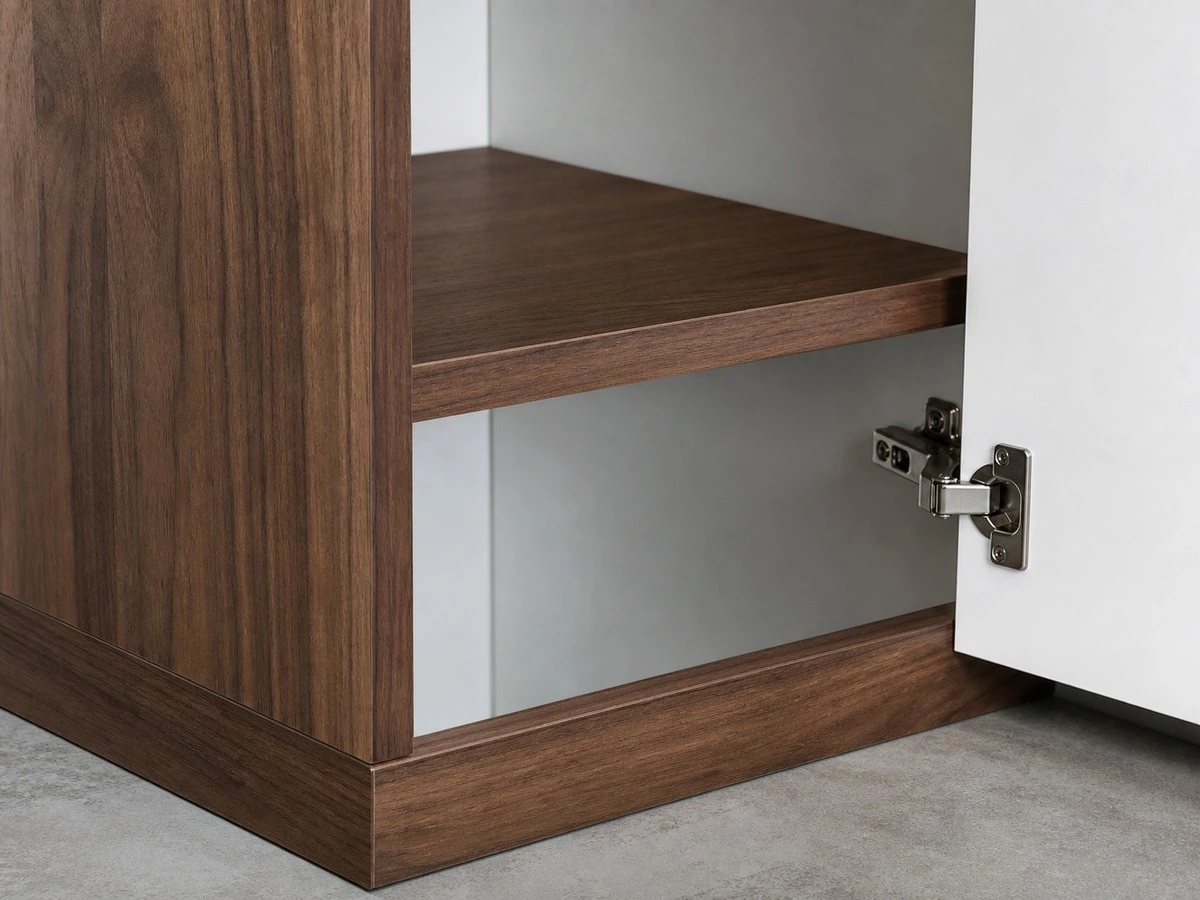
A reliable cabinet specification should never stop at “plywood carcass,” “MDF carcass,” or “particle board carcass.” The buyer also needs the construction details that control cabinet stability and protect vulnerable edges.
| Cabinet Component | What to Request | Why It Matters | Potential Risk |
|---|---|---|---|
| Side panels | Material and finished thickness. | Supports doors, slides, adjacent panels, and cabinet connections. | Flexing or weak hardware fixing. |
| Shelves | Thickness, span, and support method. | Controls storage load and long-term appearance. | Shelf sagging or damaged shelf-pin zones. |
| Back panel | Material, thickness, and fixing method. | Affects cabinet squareness, wall fixing, and structural stability. | Cabinet racking or poor connection to the wall. |
| Edge banding | Material, thickness, application, and sealing method. | Protects exposed panel edges from impacts and moisture entry. | Peeling, chipping, or swelling at vulnerable edges. |
| Sink base | Water-exposure protection detail. | Manages local leak and cleaning risk. | Swelling, deterioration, or hidden damage. |
Material Compliance and Documentation for Export Projects
For export projects, a material label is not a complete compliance strategy. The buyer should identify the destination market, project specification, required documentation, and applicable composite-wood requirements before approving the material schedule. This should be handled before production release, not after cabinetry is packed.
For projects entering the United States, buyers should discuss applicable TSCA Title VI documentation and labeling requirements for composite wood products and finished goods with the supplier and relevant project advisers. The U.S. Environmental Protection Agency’s composite wood standards guidance and the CARB Composite Wood Products Program provide useful reference points.
- United States: request applicable documentation for the actual board and finished-goods scope.
- Europe: confirm the project’s requested emission class and supporting material information before approval.
- Australia and New Zealand: assess intended moisture conditions for kitchens, laundries, and coastal or high-humidity locations.
- Middle East: assess heat, shipping storage, direct sunlight, finish stability, and installation conditions.
Best for:
Developers, builders, and distributors purchasing cabinetry for cross-border projects or formal project specifications.
Check:
Retain the material schedule, approved samples, relevant supplier documentation, and packing records with the project file.
Risk:
Do not publish or promise certification, testing, or compliance claims unless the supplier can provide current evidence for the exact material and shipment.

Factory Quality Checks Before Production and Packing
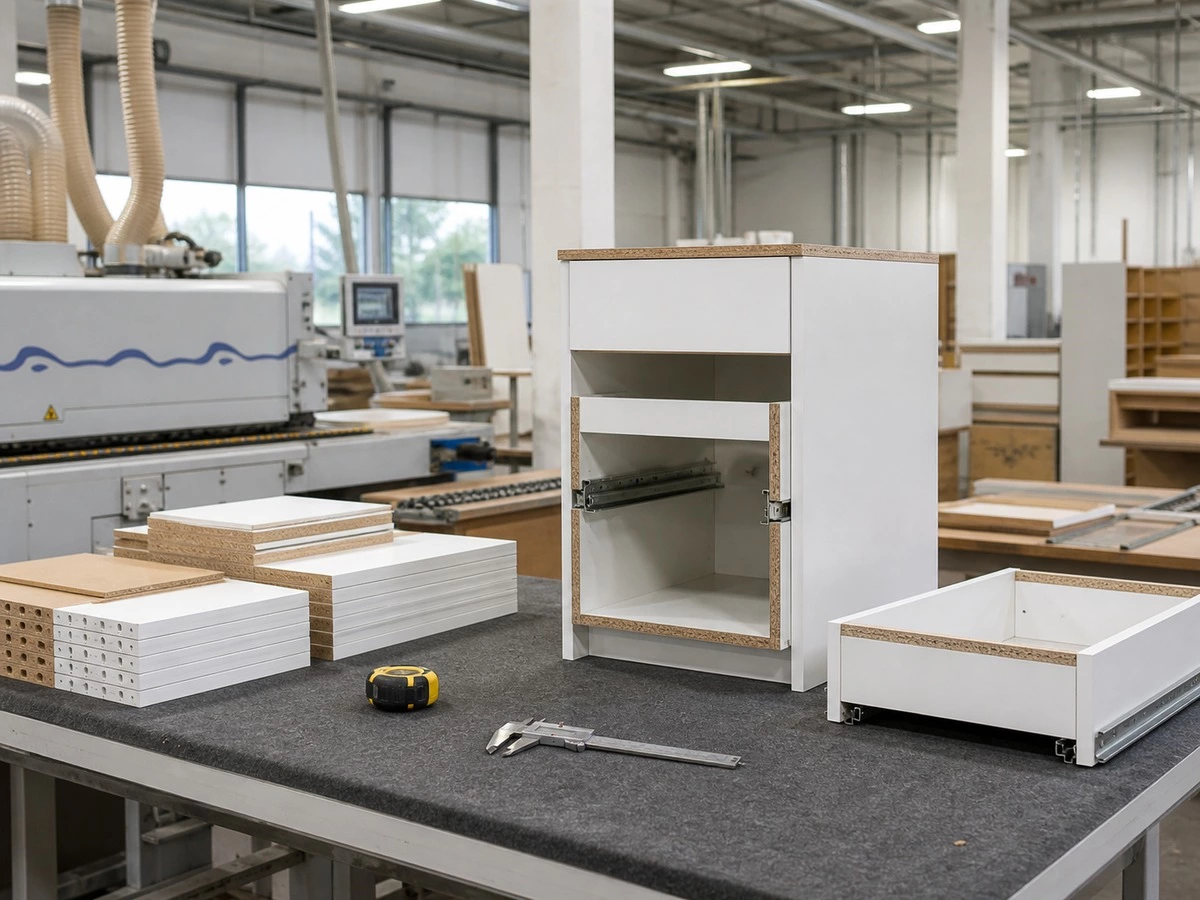
Material selection becomes meaningful only when it is controlled through production. A project team should ask how the supplier turns the approved board schedule into cut panels, edge-banded parts, assembled cabinet boxes, protected packages, and installation-ready components.
- Confirm the approved board, finish, edge-banding, and hardware schedule.
- Match incoming material to the approved project scope.
- Review cutting, drilling, and machining quality before assembly.
- Inspect exposed edges and edge-banding consistency.
- Verify hinge, drawer-slide, connector, and shelf-support locations.
- Pre-assemble representative cabinet units where the agreed process requires it.
- Check door and drawer alignment before packing.
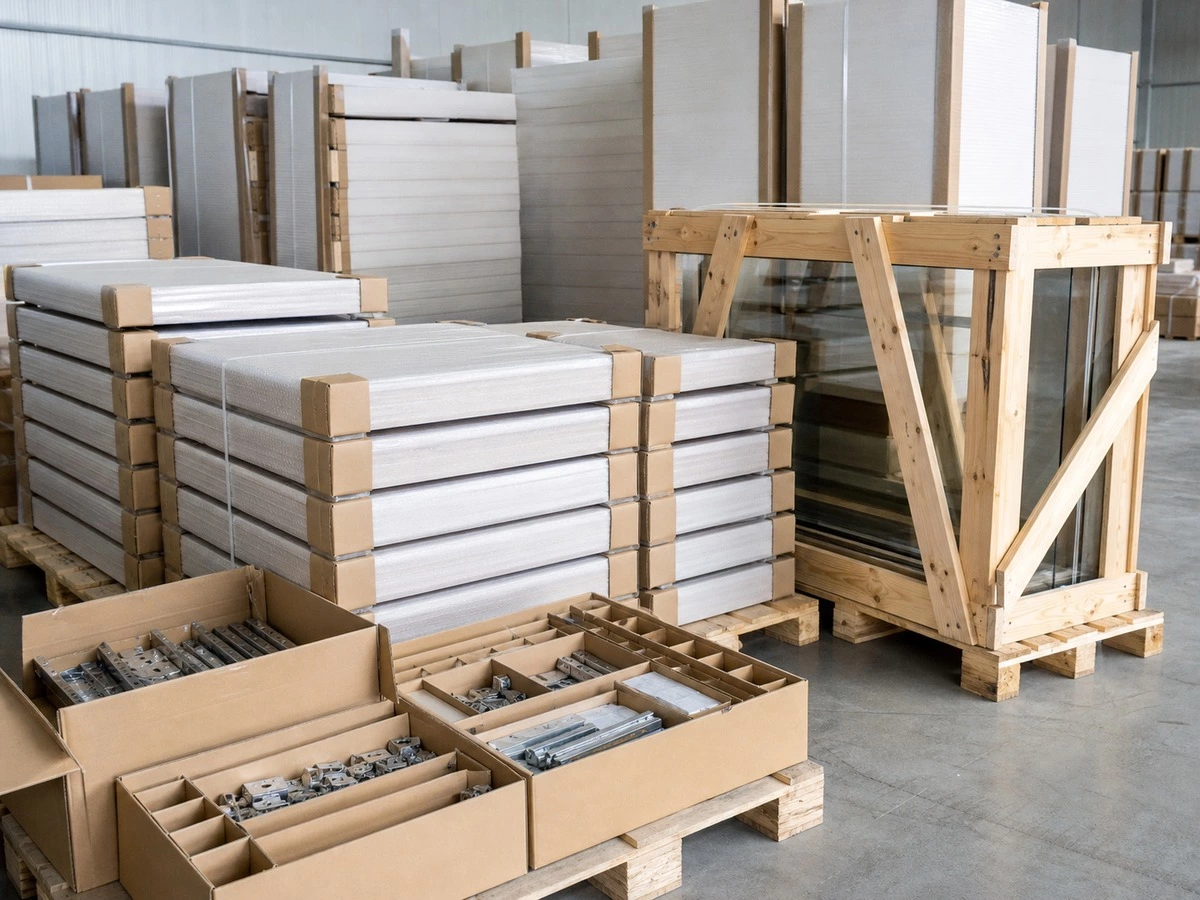
- Protect panels, glass, hardware, and special components according to the handling risk.
- Reconcile package quantities against the cabinet list or packing record.
- Prepare drawings, packing information, and installation references for project handoff.
For a broader view of how an order progresses from confirmed requirements to dispatch, review ALLURE’s cabinet order process. You can also review the factory video before discussing project-specific production and packing requirements.
A Practical Material Selection Matrix for Builders
Use this matrix during early procurement. It does not decide the material by itself; it highlights where the project team needs more information.
| Project Condition | Material Decision Priority | Information Required Before Ordering |
|---|---|---|
| High-use family kitchen with deep drawers and pantry pull-outs | Hardware fixing, shelf loading, cabinet alignment, and drawer support. | Panel thickness, drawer-slide type, shelf span, fixing details, and cabinet load plan. |
| Sink-heavy kitchen or island with plumbing | Moisture management and protected edges. | Sink-base material, bottom-panel detail, edge sealing, and leak-response approach. |
| Cost-controlled apartment development | Repeatable specification, supply consistency, and installation efficiency. | Standard cabinet modules, board schedule, edge treatment, and replacement availability. |
| Full-height appliance wall and tall pantry system | Structural alignment, anchoring, appliance clearances, and back-panel construction. | Approved elevations, appliance sheets, wall-fixing detail, and panel thickness. |
| Export project with destination-market requirements | Documentation, packing, and material identification. | Material schedule, applicable documents, packing plan, and shipping handoff requirements. |

Common Material Selection Mistakes That Create Cabinet Problems
- Selecting a cabinet box based only on a door-finish sample.
- Treating all plywood, MDF, or particle board as identical products.
- Leaving sink-base, dishwasher, laundry, and floor-contact protection unspecified.
- Ignoring the thickness and fixing method of the back panel.
- Using long shelves without checking span, support, and expected load.
- Assuming hardware performance without reviewing the panel and fixing the details behind it.
- Approving a digital rendering without a physical board and edge sample.
- Assuming generic compliance wording applies to every destination market or shipment.
- Ignoring transport, unloading, temporary site storage, and packing protection.
- Changing material after drawings are approved without reviewing hardware, dimensions, and visible finish interfaces.
For additional sourcing guidance, see ALLURE’s article on choosing a kitchen cabinet manufacturer for custom projects. Project teams comparing sourcing approaches can also read Kitchen Cabinet Factory vs Local Cabinet Maker.
FAQ: Kitchen Carcass Material
1. Is plywood always the best kitchen carcass material?
No. Plywood is often selected where builders want strong cabinet construction, repeated hardware use, or greater confidence in moisture-aware areas, but the correct choice still depends on grade, thickness, core quality, finishing, edge protection, cabinet location, and project budget. A standard kitchen with controlled conditions may not need the same specifications as a heavy-use island, sink base, or tall pantry wall. Ask for the actual construction rather than relying on the material name alone.
2. Is MDF suitable for kitchen cabinet boxes?
MDF can be suitable for selected kitchen cabinet applications when the project conditions, board specification, surface treatment, edge sealing, and moisture-control details are appropriate. It is often valued for its smooth and uniform surface, particularly in painted systems. However, buyers should be cautious about areas exposed to plumbing leaks, standing water, poorly ventilated steam, or unprotected edges. Confirm whether the board is standard MDF or a moisture-resistant specification and how vulnerable zones are protected.
3. Can particle board be used for kitchen cabinets?
Particle board can be used for kitchen cabinetry in controlled, dry environments when it is paired with suitable surface finishes, protected edge banding, appropriate hardware, correct shelf spans, and a clear installation plan. It is commonly selected for standard cabinet systems and cost-sensitive projects. The buyer should not assume that every particle board is the same. Panel thickness, density, moisture-related specification, edge quality, sink-base treatment, and packing protection all affect the final result.
4. What kitchen carcass material is best for sink base cabinets?
There is no single answer without reviewing the project’s plumbing arrangement, expected moisture exposure, board specification, edge sealing, cabinet bottom detail, and maintenance plan. Sink bases deserve more attention than ordinary cabinets because leaks and cleaning water can reach concealed surfaces. The supplier should identify the board used on the sides and bottom, explain how exposed edges are protected, and clarify whether additional moisture-management measures are included. This detail should appear in drawings or specifications before production release.
5. Does cabinet-board thickness matter more than material type?
Both matter, and neither should be assessed in isolation. Material affects the panel’s typical structural behavior, machining response, and moisture considerations, while thickness affects stiffness, fixing depth, shelf span, and cabinet alignment. Back panels, edge banding, connectors, hardware, and cabinet geometry also influence performance. A thinner panel of one material may not automatically outperform a well-designed thicker panel of another. Builders should request a complete cabinet construction schedule rather than comparing only one number.
6. How does edge banding affect cabinet durability?
Edge banding protects exposed board edges from impact, cleaning, moisture, and visual damage. It also affects how finished the cabinet looks after cutting, drilling, transport, and installation. Buyers should ask what edge-banding material is used, how thick it is, which edges receive it, and how it is applied. Sink bases, exposed end panels, drawer interiors, floor-adjacent areas, and high-use storage zones may need closer attention. Good edge treatment supports durability but does not compensate for an unsuitable board specification.
7. What should builders check for wall cabinets and tall pantries?
Wall cabinets and tall pantries should be reviewed for carcass material, panel thickness, shelf span, back-panel construction, wall-fixing system, hardware loads, and appliance interfaces. Tall units can magnify small alignment errors, especially where they connect to ceilings, bulkheads, ovens, refrigerators, or adjacent panels. Wall conditions and fixing substrates also matter. A cabinet may be well manufactured but still perform poorly if the installation wall, anchors, or service clearances were not considered during planning.
8. Which documents should buyers request for U.S.-bound cabinetry?
The documents required depend on the project, destination, board type, finished-goods scope, and applicable regulations. For relevant composite wood products and finished goods, buyers should discuss TSCA Title VI documentation and labeling requirements with their supplier and project compliance advisers. A useful project file also includes the material schedule, approved samples, cabinet drawings, packing records, and supplier declarations where applicable. Do not assume that a generic statement, catalogue image, or old test report applies to the exact material used for a current shipment.
Final Recommendation
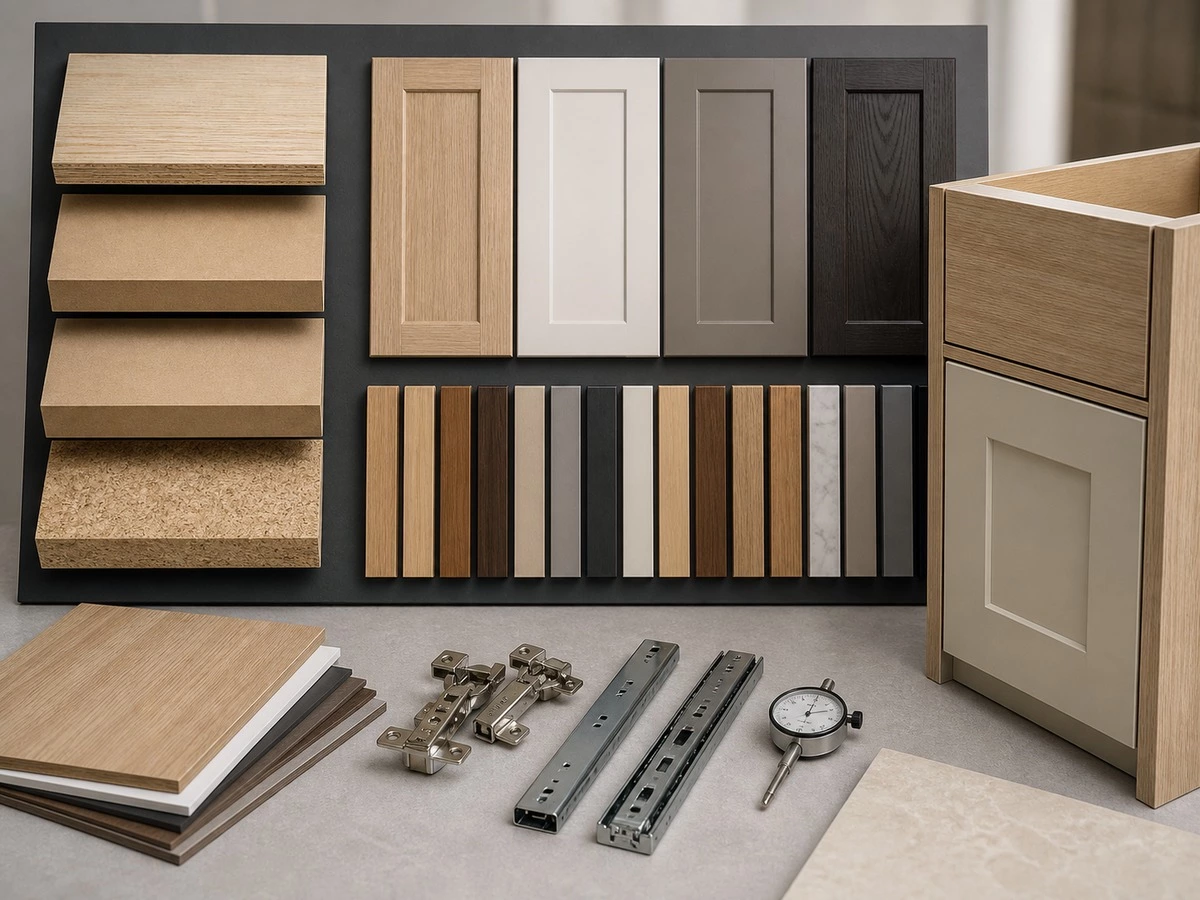
The most reliable kitchen carcass material is the one specified for the actual cabinet function and project conditions. Plywood, MDF, and particle board each have roles when their properties, thickness, edges, hardware, moisture exposure, and installation conditions are understood. A material decision should be tied to approved drawings, physical samples, high-risk cabinet locations, quality checks, packing, and the destination market’s requirements.
Before issuing a purchase order, ask the supplier for a project material schedule that clearly identifies every cabinet-box component. It is far easier to correct a missing specification before machining than to resolve swelling, weak hardware fixing, shelf sagging, or mismatched components after delivery.